Tuesday, July 24, 2012

The Enlightenment? Try Four Enlightenments

May, Henry F. The Enlightenment in America. New York: Oxford University Press, 1976.

May says that before he wrote this book he went exploring. He wanted to find “in the eighteenth century the roots of nineteenth-century American culture.” When he examined the writings of eighteenth century Americans, he saw a mixture of New England Calvinist Protestantism and the European Enlightenment. Moving on to the next century, he noticed that the “unexpressed and implied ideology of nineteenth-century America rested . . . on a series of tacit compromises. Of these the most basic was the compromise between a belief in moral certainties and a belief in the desirability of change and progress” (xi-xii).


Looking at the relevant secondary literature, he saw the hundreds of works that took up some aspect of Calvinist Protestantism in America. Yet hardly anyone had written about the American career of the European Enlightenment, although its principles were everywhere assumed. So, acknowledging that the two parts had to be taken together, he decided to focus on the one that had hardly been treated:


My book . . . does not deal equally with the two main clusters of ideas influential in early America: the Enlightenment and Protestantism, but rather about the Enlightenment, with Protestantism always in the background as matrix, rival, ally, and enemy. It is not about the Enlightenment and religion, but rather about the Enlightenment as religion (xiii).

May’s working definition of the Enlightenment as religion reads: “the Enlightenment consists of all those who believe two propositions: first, that the present age is more enlightened than the past; and second, that we understand nature and man best through the use of our natural faculties” (xiv). But things were never as simple as that because, as May observes, many Americans of the eighteenth and nineteenth centuries would fall somewhere along a spectrum between Protestantism and the Enlightenment. The most revealing question might be, “To what degree would a person assent to the idea that reason, as opposed to revelation, tradition, or illumination, is the best guide?”


The biggest challenge for May was related to the fact that, while scholars had seen and studied the varieties of Protestantism, hardly anyone had sorted out the variety and difference within the Enlightenment (xv-xvi). So May created his own four-part division of the European Enlightenment, an arrangement that follows a more or less chronological order:


1. Moderate.  “This preached balance, order and religious compromise, and was dominant in England from the time of Newton and Locke until about the middle of the eighteenth century” (xvi).

2. Skeptical. Developed in Britain but especially France around 1750, this Enlightenment’s grand master was Voltaire. Among its most significant results were the skepticism of Hume and the materialism of Holbach.

3. Revolutionary. According to this variety, one could construct a new heaven and a new earth by destroying the old. It began with Rousseau and culminated in Paine and Godwin.

4. Didactic. This Enlightenment opposed both skepticism and revolution. From what it saw as the debacle of those Enlightenments, it attempted to save “the intelligible universe, clear and certain moral judgments, and progress.” Its main center was Scotland and began around 1750, but really triumphed in America in 1800-1825 (xvi).

The Enlightenment in America is a survey of these four types. May concludes that by the time of early nineteenth century, the Skeptical and Revolutionary Enlightenments had died out. The Skeptical had always been much too radical and dismissive of religion, not to mention unintelligible, for most Americans. The Revolutionary had served its purpose in America and had been discredited by the more recent excesses connected with the revolution in France. Too, both of these Enlightenments were overcome by that triumph of Protestantism known as the Second Great Awakening. At the same time, the effects of the Moderate Enlightenment were still present in American politics and religion.  The Didactic Enlightenment was both practical and easy to understand. Above all, it could be mixed with the variety of religion that was popular in America at that time. Thus, the Didactic emerged as the greatest philosophical force in American intellectual culture during the first quarter of the nineteenth century.

Tuesday, June 26, 2012

Puritan Backgrounds to the Churches of Christ

"To the eyes of the Puritan faithful, Scripture presented a dramatic panorama which moved from Creation to Redemption to Resurrection and Last Things, a panorama that sprang into present life in preaching, biblical study, and meditation." --T.D. Bozeman, To Live Ancient Lives: The Primitivist Dimension in Puritanism. Chapel Hill, NC: University of North Carolina Press, 1988, p. 33.

Those who suspect that the Stone-Campbell Movement (a.k.a, the American Restoration Movement) goes back no further than Barton W. Stone and Thomas and Alexander Campbell really should read this book. Bozeman clearly reveals that from their start in the 1560s the Puritans were biblical primitivists with assumptions and specific language that anyone who grew up among the Churches of Christ knows very well.  When I read the foregoing words from Bozeman, I immediately thought of an elaborate biblical timeline I had seen before. It's painted on the wall in one of the children's Bible classrooms at the San Jacinto Church of Christ in Amarillo, Texas.  I snapped a few photos. Take a look:

From Creation to Final Consummation
and points along the way . . .


Monday, June 18, 2012

Two Sorts of Puritans?

Knight, Janice. Orthodoxies in Massachusetts: Rereading American Puritanism. Cambridge, MA: Harvard University Press, 1994.

In this carefully-researched and well-written book, Janice Knight argues that the standard scholarly portrait of American Puritanism stands to be corrected and supplemented. She begins by observing that from Cotton Mather to Perry Miller, historians have portrayed American Puritans as a unified group that upheld a coherent orthodoxy. Knight, on the other hand, hears what she calls “significant differences and alternative voices within Puritan culture” (2). In fact, she identifies two distinct groups with well-known leaders in each one. Knight distinguishes between what she terms the “Intellectual Fathers,” roughly equivalent to Miller’s orthodoxy, and the “Spiritual Brethren.” In contrast to the first group, the “Spiritual Brethren” embraced a “mystical strain of piety” that was “associated with Augustinianism.” Another distinction was that, contrasted with the first group, the second emphasized “divine benevolence over power” and “converted biblical metaphors of kingship into ones of kinship” (3).

Knight says that the “Intellectual Fathers” were represented in England by William Perkins and, above all, William Ames. In America, the Amesian tradition was carried forward by Thomas Hooker, Thomas Shepard, Peter Bulkeley, John Winthrop and most of the ministers of the Massachusetts Bay Colony. The “Spiritual Brethren,” on the other hand, were led in England by John Preston and, above all, Richard Sibbes. In America, the Sibbesian tradition was upheld most prominently by John Cotton, John Davenport, and Henry Vane.

Assuming for the moment that Knight’s distinction is valid, someone might ask how it could have been so consistently overlooked in the past. In response, Knight observes that in England, in spite of their differences, Puritans were held together by common enemies like Catholicism and High Anglicanism. In America, following the Antinomian Controversy (1636-1638), the apologies written by Shepard and Winthrop actually began the process of establishing what Perry Miller would eventually identify as a univocal Puritanism. That is to say, from very early times, differences among American Puritans were white washed and suppressed. From the time of Miller forward, scholarship on the Puritans has tended to simply reinforce his reigning interpretation, while investigating some aspect or another. Even those historians who have identified something different in John Cotton have typically seen him as exceptional. But, again, Knight interprets Cotton as representative of a dissenting tradition that originated in England and of which several other popular leaders were a part.

For the remainder of the book, Knight explains and illustrates how her thesis is no mere academic distinction, but that it actually serves as a kind of interpretive master key. Her basic insight, she says, is vital to a full understanding of historic episodes like the Antinomian Controversy and Henry Vane’s loss of the governorship in 1637. But more than anything else, Knight’s distinction shines a light on significantly different ideas, beliefs, and practices within Puritanism. These include the following: the attributes of God, theological anthropology, the nature of sin, the process of conversion, preaching styles, love for God, self, and neighbor, and pastoral roles and responsibilities. From beginning to end, Knight attempts to show that on each of these points, we can readily perceive what she identifies as two different and coherent traditions.

Wednesday, May 23, 2012

Chloe and Dad go to Pepperdine

On Sunday, April 29th, I went to worship with my home congregation, the San Jacinto Church of Christ in Amarillo, TX. Nothing unusual about that. The unusual part began sometime after lunch.

That afternoon, I said my good-byes to Michele and Aubrey and drove to Albuquerque, NM, where my daughter Chloe would be flying in from Hartford later that afternoon. I hadn't seen Chloe since my last trip to Connecticut in January. So I was excited about our reunion. I was also excited about our plans: We were headed for the Bible Lectures at Pepperdine University, a first for both of us.

There aren't many signs of civilization between Amarillo and Albuquerque. As it turned out, I didn't stop once. That worked out pretty well since Chloe landed about 15 minutes after I got to the airport! By the time she got off the plane and we picked up her bag, it had already been a fairly long day for the both of us. But I wanted to get as far west as Grants, NM by that night. It was time for dinner, so we decided to get something to eat near the airport. I asked a stranger where we should go to eat. "Go over to Central and have supper at Scalo," she said. She told us that it wasn't far from the airport and that the food was great. She was right. Here's the stuffed pork chop Chloe had.


By about 10 that night, we'd made it to Grants, where we spent the night. Sometime Monday morning, we made it to the Arizona border.


By the early afternoon, we'd made it to Flagstaff, AZ. And we were hungry. But we didn't want to eat at a fast-food place. We were looking for something a bit more adventuresome. So we drove around for a minute until we happened upon this place. It was really good . . . .


And we took pictures of each other. . . .


By the time we finished our leisurely lunch, we knew it had to make good time. We had to make it to the coast that night. So from Flagstaff on, it was serious car time. We stopped only a few more times and made it to Thousand Oaks, CA in good time. We got to sleep in the next morning, and since the Pepperdine events wouldn't start until later that day, we decided to go take a look at Beverly Hills. Here's the nice little "ristorante" where we had lunch on Beverly Drive.


Later that afternoon, we drove up the Pacific Coast Highway to the Pepperdine campus in Malibu. The California weather wasn't cooperating just yet. It was overcast and kind of gray. But it was beautiful anyway.


Once we got moved in to the dorm, we walked down the hill to Firestone Fieldhouse. There, we got to sing with hundreds of other Christians and hear a really fine sermon by Jonathan Storment. I was especially interested in one of the late-night sessions, the series by John Mark Hicks and Bobby Valentine. Their focus for the week was the great K. C. Moser in the context of his times. The first night was so good, I wound up going to all three sessions. Here they are on the first night.


After breakfast the next morning, I was ready to meet and to hear Tom Olbricht speak about the history of Bible lectureships. I really enjoyed taking in his two presentations on Wednesday and Thursday. . . .


Later, Chloe and I met up and went to the Harding School of Theology luncheon. It was great to see Dean Evertt Huffard for the first time in several years. I also got to meet fellow blogger Matthew Morine (purple shirt in the photo) and several others. We listened to Dr. Ed Gray who reminded us of the role and kingdom purposes of Christian counselors. His presentation featured an announcement regarding a new program of counseling studies at HST.


By Thursday, the clouds had mostly gone away, and the Pacific coast was drenched in sunlight. . . . .

Later that afternoon, we went further up the hill to where the graduate schools are. We found a nice patio where we just sat and read and took this picture . . . .


Friday morning, I got to hear Terry Gardner's really fine presentation on the life and times of Austin McGary. The Restoration Quarterly luncheon featured a talk by Doug Foster. He focused on four historic leaders among the African-American Churches of Christ.

That afternoon, we headed east. We spent the night at Needles, CA, and by Sunday morning, I was taking Chloe to the Albuquerque airport. It had been a great week for the two of us, one that we won't forget for a long time.

Friday, May 18, 2012

The Big Picture of Puritan History

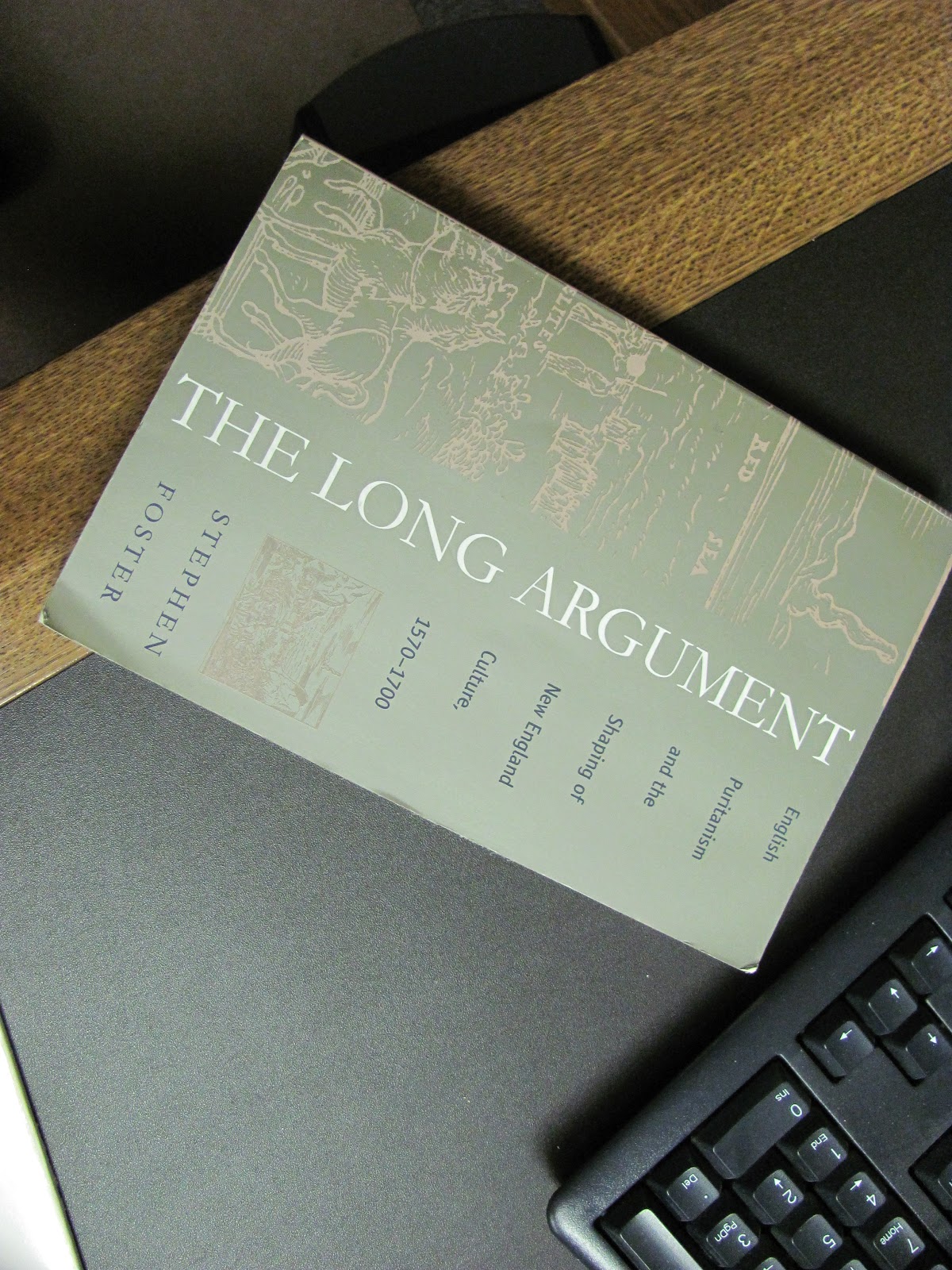
What follows is not a critical book review of Stephen Foster's, The Long Argument. At the beginning, I do say a few things about the content and significance of the book. But for the most part, I'm simply writing about some of my reflections and curiosities as I was reading.

Foster, Stephen. The Long Argument: English Puritanism and the Shaping of New England Culture, 1570-1700. Chapel Hill, NC: University of North Carolina Press, 1991.


Foster begins this fine, influential survey of Puritan history with a general observation: American historians have written as though they assumed that English migration to America represented a brand new beginning, something separate from everything else before. Whenever these historians have acknowledged transatlantic connections, invariably these have been connections to England. Along this line, the author reminds us that the Spanish established settlements in America at least as early as the English. Yet, American historians have normally called those earliest Spanish settlements “borderlands,” which are “peripheral by definition” (2).

Foster notes that Puritan studies have not avoided this common feature of American historiography. Thus, the American chapter of Puritan history has usually been isolated from its English parentage. This, says Foster, has resulted in a number of misunderstandings and poor reconstructions of the past. He observes:

Without some longer view that fuses the American and English histories of the Puritans and thereby locates enduring commitments and points of accord in decade after decade of reverses, internal divisions, and lamentations of decline the inevitable temptation has been to single out as definitive some one characteristic or another of a much broader movement and to tie the fate of a protean phenomenon to purely temporary arrangements (4).

Given that set of circumstances, Foster issues the following prescription and expectation: "Reassemble the English and American halves, examine the result over time, and with a proper regard to its settings, and the rough outline of the beast becomes visible enough" (5). With that, the author takes the reader on a masterful tour that begins during the reign of Queen Elizabeth I and ends with the First Great Awakening whose events so ruptured Puritanism that by 1800 “there was no longer a movement” (290). In telling this longer version of the story, Foster demonstrates the validity of what stands behind the main title of his book. Near the end, he explains that The Long Argument does not refer so much to disputes or even to a particular dispute, “but to the continuing narrative” of at least 130 years of Puritan history (287).

Along the way, the author provides a good number of important insights on his topic, as well as some significant additions and corrections to the secondary literature. In what follows, I will report a few of these (the ones that really struck me), and will also mention some of the daydreams and questions that occurred to me as I was reading this book.

In Chapter 1, “The Elizabethan Contribution,” Foster says that one of the early hallmarks of Puritanism was a tension according to which (a) an individual must not live a life that is random. You cannot live as you want nor do as you please. To state it positively, there must be a better, greater purpose to a person’s life than simply pursuing one's own desires. But (b), said the Puritans, the church and the secular powers are failing in their duties to promote and enforce this ideal (9). I was especially interested in a related section where Foster describes how English Puritans had a stock literary character: the decent person who is really not engaged in religious matters. He is disinterested and ignorant. Yet he assumes he has nothing to worry about. After all, he’s really not much worse than anyone else (38-39).

I was intrigued by this because, looking back from the time of the Puritans, the impulse just described appears to be a theme among the followers of John Wyclif. I am aware that having studied a little about the Lollards, I am susceptible to seeing their influence everywhere. Still, we have the following statement from Foster himself:

The Lollards do merit a place in the prehistory of Puritanism because they persisted as an exclusively popular heresy for several generations after the authorities had frightened off the movement's original university-based leadership and its knightly supporters and because in some undetermined and perhaps indeterminable way they contributed to the Reformation itself (7).

So I wonder: in the Puritan trope identified above, are we looking at something that is at least in part a vestige of Lollardy? In his informal heresy trial before Archbishop Thomas Arundel, for example, the Lollard priest William Thorpe laments what “a great pity and sorrow” it is “that many men and women do their own wayward will; nor busy them not to know nor to do the pleasant will of God” (103). Later, Thorpe complains to Arundel that religion in England is so confused that those regarded to be out of the faith are really in, and vice versa. Remarkably, at least in this part of the examination, Thorpe does not distinguish the two groups along the lines of propositional truth. Instead, his accusation against people who are wrongly considered true members of Christ’s Church has more to do with their neglect of the things that matter most. According to Thorpe, these people “neither know nor have will to know nor to occupy their wits truly and effectuously in the right faith of Holy Church” (122). [The text used here is found in Alfred W. Pollard, FifteenthCentury Prose and Verse (New York: Cooper Square, 1964), 101-67]. Of course, it would take much more than this to demonstrate a line of historical influence. But to my ears, Foster’s description and Thorpe’s accusation sound very similar.

Moving forward from the time of the Puritans, I think about some of my own experiences growing up going to church. A minor theme in the sermons I heard back then was, if you’re going to be God’s person, then you must necessarily rise above the ordinary. The world being what it is, to be average is to be displeasing to God. More frequently, I heard that sincerity is not enough. One can be sincerely wrong. And, balancing bad deeds with good will not work. Good deeds are not the antidote to sin.

In Chapter 2, “Continuity and Ambiguity, ‘The Gospel Doing,’ 1590-1630” Foster tells us about Robert Cawdry, a radical Puritan of the late sixteenth century. Cawdry produced and refined “the first monolingual English dictionary” as a means of helping the common people to learn more from the sermons they heard (66). Clear definition, he believed, was basic to growing in knowledge. There is a lot of truth to that, of course. But here’s what really struck me as I read about Cawdry’s project: In the sermons I heard growing up, the dictionary was almost as likely to be quoted as the Bible. Not as often, of course. Usually, if the dictionary (almost always, Webster’s) was cited in a sermon, then that citation came at the beginning (much in the way of debates, where defining terms was a basic part of the first speech). In my experience, some theological definitions were mentioned so often, we came to memorize them. The first mention of “grace” almost always came with the reminder that this word means “unmerited favor ” (a definition that, strangely, is true enough while not really getting to the heart of the Christian message, which offers forgiveness in spite of demerits). And then there were these sort of folksy definitions that weren’t really accurate. But because they were so memorable, so preachable, ministers found them irresistible. For example, “justified” meant “just as if I’d” never sinned. Break up the word “atonement” and you get “at one ment,” and so on.

When reading about Cawdry and his dictionary, I also thought about Sherman, Texas, during the first half of 1904. That was the scene of T. B. Larimore’s gospel meeting that lasted six months. Larimore preached at two services every day, and three times on Sunday: fifteen sermons a week. David Lipscomb, then editor of the Gospel Advocate in Nashville, took an interest in the extraordinary meeting and wrote to Larimore asking him to report. Larimore’s reply includes this tidbit: “What books do I consult? The Bible, Webster's Dictionary, and the Bible--these three, and no more.” For more about this famous Churches of Christ episode, see an earlier blog post of mine.

In Chapter 5, Foster describes the circumstances in New England which led to the so-called Halfway Covenant. This is an example of where a longer treatment can be significantly more revealing. I say this because, although Edmund Morgan discusses the same episode in his book Visible Saints, he does not describe the particulars, at least not to the extent that Foster does.

Foster makes the case that at least two things led to the development of the Halfway Covenant: First, in New England, the descendants of the Puritans who migrated to New England did not have the same volume and quality of religious sources that their forefathers had had in England; not as many pamphlets, books, sermons, etc.

Second, as the population in New England grew larger, it grew younger. The percentage of very young people, all of them born in America, and all of them without the benefit of the religious “means” known in England, was remarkably high. To their parents and grandparents, they seemed hopelessly irreligious.

Foster explains that the Halfway Covenant,developed in 1656-57, essentially said that these young people who had come of age (16 or older) were still members of the church. However, until they could convince their congregations that they had had the experience of saving grace, they were not considered in communion with the church. Therefore, they could not participate in the Lord’s Supper and were not permitted to vote. And he makes it a special point to say that “all of the seventeen clergymen at the assembly were English-born; all but two were English-educated and had come to America as adults” (187-88). Foster’s description went a long way in helping me to get a feel for what was to Puritans of the time a situation that had to be dealt with.

Monday, March 12, 2012

A Trip to Turkey on the Trail of R. W. Officer

For a few years now, I've wanted to travel to two Turkeys. I've now visited one. That country in Asia? The scene of some of the most impressive growth experienced by the first-century Church? That'll have to wait for another time. This time, last Friday, March 9, 2012 to be exact, I went to the other Turkey, a small town located in the southwest corner of Hall County, Texas.

And why did I want to visit this Turkey? Mainly because it is the last home and the resting place of one R. W. Officer, a most impressive historical figure. Born in 1845 in Georgia, Officer was a veteran of the Civil War who later became a preacher, writer, debater, and a renown missionary in Indian Territory (part of what is now Oklahoma). Early on, Officer was a Baptist. But for the big majority of his career as a Christian leader, he was connected to the Churches of Christ. The following are some of my notes about Turkey and my search for him and his family.

It's sort of a rite of passage now. To get to R. W. Officer, you first have to meet someone else. Entering town from the north, visitors are greeted by this sign paying tribute to Turkey's favorite son, Bob Wills, "the King of Western Swing." Check out the detail of the silhouettes on this sign. Impressive! Incidentally, Bob Wills is one of the few (or, the only?) to be inducted into both the Country Music Hall of Fame (1968) and the Rock and Roll Hall of Fame (1999). I've only recently begun listening to his music. What an interesting, charismatic person he was. He epitomizes the unmistakable spirit of West Texas, the one that says, "Life is what you make it!" I can only imagine the hundreds of thousands of people who had to smile when they heard his songs. He was one-of-a-kind. And, before Wills became famous it's very likely that he was R. W. Officer's barber.

Just one block north of Main Street (Highway 86), on 3rd Street stands the historic Hotel Turkey. Yes, that's a mounted turkey on the front porch. My understanding is that the original settlement was called "Turkey Roost." Just behind the bird are two plaques on the wall . . .


Pictured here is Cody Bell, a friendly guy and the owner of the hotel. When I met him in the lobby, he took an immediate interest in my research and provided me with a good bit of information about the town and its history. In the early 1900s, both sets of his grandparents, the Bells and the Meachams, were early settlers in Turkey. Cody confirmed that President George W. Bush has spent a night or two at the hotel. I know, you Democrats will think that explains the name.

The hotel features an very good restaurant. I thoroughly enjoyed my grilled chicken sandwich, one of the best ever!

After lunch, before I went out to the cemetery Cody took me over to the old school building that houses the public library and the Bob Wills Museum. Pictured above is just one of the many wall-sized photos in the museum. Fans should make time to visit this place. When you do, be sure to watch the video. The annual Bob Wills celebration in Turkey is held each year on the last Saturday in April. Just one more reason to go back.

Dreamland Cemetery is a few miles south and east of town. Take Highway 70 south to Farm to Market Road 656. A sign on 70 directs you toward the cemetery. From the highway, the road runs east and then curves to the south. The road divides the cemetery. A newer section lies to the east. The older graves, including Officer's, are on the west side.

Both Laurence W. Scott (Texas Pulpit, 1888, p. 384) and F. D. Srygley (Biographies and Sermons, 1898, p. 309) tell us that R. W. Officer's first wife was Lota Venable of Winchester, Tennessee, and that the two were married on Christmas Day 1870. Srygley, writing near the end of the 1800s, says that the two were still married at the time.

At this point, my assumption is that Alice Gist Officer was R. W.'s second wife. I don't know of any other wives. According to Earl I. West, (Search for the Ancient Order, vol. III, p. 134), Lota Venable Officer died January 30, 1900. I don't know where she is buried. Likely in Paris or Gainesville, Texas, or somewhere in Oklahoma. Another mystery: Alice Gist Officer's tombstone provides no dates. Silas Shotwell, an authority on Officer now living at Fort Sumner, New Mexico, tells me that when Alice died, her husband R. W., then 85 years old, remarked that he was ready to go. Within a few days, he died. So, the presumed date of death for Alice Gist is 1930.

Sometimes, seeing a place for yourself makes a real difference. And here we have a case in point. According to this source, Leon Officer is "the only family member of note in the plot." From that, one would never guess that R. W.'s wife lies buried in the very next grave, a strange oversight.

People still living who grew up in Turkey speak of a "Mrs. Officer" who was a "tough" school teacher. Because these people would have gone to school after 1930, my assumption is that this "Mrs Officer" was not Alice Gist Officer. Was the school teacher Leon's widow, R. W.'s daughter-in-law? Or was she R.W.'s daughter or granddaughter? Also, piecing together the available evidence, it is clear that Alice Gist Officer was not Leon's mother. Yet, "Mother" is her epitaph. So who was her child?

According to my best information, Leon V. Officer (1877-1922) was R. W.'s son, born when the father was 32 years old. Leon never reached his 45th birthday. Remarkably, the father made it to his 85th. Does Leon's middle initial stand for "Venable," the maiden name of Officer's first wife, Lota? I wonder.


I have found a place in West Texas where we are almost unknown for several counties. They have called me. There is no use to go there to stay a few days and return. On July 1, I am going to stay. The Indian Territory is coming in. It will be settled by white people, and my work there is done. I am off again for another waste, or neglected place, trusting God's promise and the brethren. (R.W. Officer, writing in the Gospel Advocate, as quoted in Earl I. West, Vol. III, p. 134).

Clearly, the marker for R. W. Officer's grave does not go back to 1930. I have no information on who provided this stone or when it was set. I'm told that this stone was most likely crafted in Clarendon, Texas, a larger town about 40 miles north of Turkey. The quality of the surface and the style of font suggest that the stone does not go back very far. What is clear, however, is that the Methodist Clergy badge that was attached to this marker at one time has since been removed. Note the two holes at the top right of the stone. No, I'm not the one who removed the badge. But attaching it to this headstone does seem to have been inappropriate.

A block or two north and east of the Hotel Turkey stands the meeting house of the Church of Christ. Along with Cody, I shared lunch with the preacher for the congregation, Stuart Smith. Stuart impresses me as being a fine guy. In addition to serving as a minister, he is a teacher and coach in the local school system. He has worked there in Turkey for 21 years. It was apparent to me that Stuart, his wife, and their family are highly respected in the community.

From Turkey, I traveled north and east to Memphis. From there I went over to Altus, Oklahoma to spend the weekend with my folks. On Saturday, it gently rained the better part of the day. So we stayed in, except for a visit with Betty Osborne, the widow of the late Bill Osborne. The two of them were a dynamic team. For many years, Bill, who possessed a unique mixture of homespun humor and Christian charisma, served as minister of the Elm and Hudson Church of Christ in Altus. Betty was the congregation's secretary. No one was better at encouraging and building up other people than the Osbornes. I'll always be grateful to the Lord for their remarkable service to His church.

On Sunday morning, it was a joy to visit my home congregation, to worship the Lord sitting next to my parents. In his lesson that morning, Tom Bailey emphasized that God is good.
---------------
Special note: I began this weblog in January 2005. Since then, I've had a few regular readers and a lot who have dropped by every now and then. I'm really thankful for the long-distance relationships that have begun, and for the reconnections I've made with people I have known in various places through the years. Special thanks to those who have commented. Like all bloggers, I'm always thrilled to get meaningful feedback. I'm writing this note mainly because this post just happens to be my 600th.

Yes, I plan to keep going. But not because of I have thousands of followers. I don't. Fact is, there have only been a few times that I even considered what makes a blog popular: Ten Things about this current topic, or Five Ways to do something everybody wished they did. No, from the first post until now my main interest has been getting down in print some of the things that were on my mind at the time. For me, this is a matter of talking about something I'm currently into, sorting out something that's running through my mind. If you truly understand something, then you can clearly say something about it. If you can't, then maybe you should reconsider your assumption that you understand it. So for me, blogging is a matter of making sure I have some level of understanding. Like I said, for me that's been a big part of the motivation.

Saturday, February 25, 2012

Reformed Protestantism to 1700

Benedict, Philip. Christ’s Churches Purely Reformed: A Social History of Calvinism. New Haven, CT: Yale University Press, 2002.

Philip Benedict introduces this big impressive book as a survey of “the history and significance of Reformed Protestantism in Europe from its origins until the end of the age of orthodoxy around 1700” (xvii). He points out that no single author has attempted anything similar since John T. McNeill wrote The History and Character of Calvinism, which was published in 1954. However, says Benedict, since then the broad field of history and also a specific part of that field, the corner known as Reformation studies, have each gone through what he describes as a dramatic sea change. What were those changes?

First, in general, historians no longer report only those events surrounding “elite actors.” Instead, they now incorporate “the actions and aspirations of ordinary men and women.” Second, the half-century following McNeill’s book witnessed what Benedict calls the “deconfessionalization” of Reformation history. He explains that, before, “most church history was written by members of the church in question eager to explore a critical moment in the formation of their religious tradition.” But since then a new scene has emerged where it is not uncommon, for example, for Roman Catholic scholars to offer “sympathetic and penetrating studies of Protestant theology” (xviii). Clearly, Benedict hopes that his book will be a good example of both trends. He not only subtitles his work A Social History of Calvinism, he also describes himself as “a total outsider, an agnostic, nonpracticing Jew raised in a secular household” (xxv). In this regard, the book under review is very different from a much more traditional title like Timothy George, Theology of the Reformers (Nashville: Broadman, 1988).

Benedict’s overview of the period follows a four-part outline. In Part I, “The Formation of a Tradition,” the author describes the hectic and disorganized character of the first few decades of Protestantism. He observes that the distinctive Reformed tradition in Protestantism had two beginnings. Huldrych Zwingli led the first. The second was associated with primarily three names: Heinrich Bullinger, Zwingli’s protégé who tirelessly advanced the views of his mentor over a period of forty years, John a Lasco, who played a central role in the propagation of Reformed ideas in East Friesland and also among French and Dutch refugees in London, and, of course, John Calvin, “the most forceful voice within the increasingly multipolar and multivocal Reformed world” (77).

Part II, “The Expansion of a Tradition,” takes up the second half of the sixteenth century, a critical time of remarkable growth, one that turned out to be essential to the future prominence of the Reformed branch of Protestantism. Benedict explains that

the dynamism evidenced by the remarkable geographical expansion of Reformed churches in those years arose from an accumulation of specific theological features, organizational attributes, and historical circumstances that all helped the cause win supporters among princes and people alike, then defend itself tenaciously in those instances in which it expanded in defiance of the ruling authorities (124).

This part of the book also examines, in turn, six different regions in which the Reformed tradition was well known during a fifty-year period of historic growth: France, Scotland, the Netherlands, the Holy Roman Empire, England, and Eastern Europe. Benedict notes that between 1554 and 1600, the Reformed branch multiplied in number by a factor of twenty. More than that, for all of the various regional expressions of Reformed Christianity, this loosely organized international group managed to establish and maintain a certain solidarity. The unity of the movement expressed itself through mutual aid in times of distress, personal connections across long distances, consultation on theological questions, and an effort to draft documents that would express a basic consensus.

Part III, “The Transformation of a Tradition,” relates the story of Reformed Protestantism from about 1590 to 1700, “a period of theological ferment of the utmost importance” (298). Benedict says that during this time the tradition became more scholastic, more organized. These were the years, for example, when the doctrine of double predestination was refined, and when the idea of the verbal inerrancy of Scripture was developed as an answer to the counter-Reformation. But in addition to being a time of change from within, the seventeenth century also witnessed the Reformed tradition being challenged from the outside as a result of its sometimes falling into political disfavor. Finally, religious controversy and political upheaval in isolated Great Britain created unique struggles over theology and polity. These generated Anglicanism, Puritanism, and the Church of Scotland.

In Part IV, the most entertaining section of the book, Benedict concludes by describing the practical day-to-day differences that the Reformed tradition brought to the lives of adherents. He deals with three specific topics: ministerial leadership, church discipline, and common piety. Reformed believers appreciated sound biblical scholarship, preaching that brought with it strong conviction, and ministers who were models of Christian attitude and behavior. Along this line, Benedict reminds the reader that anti-clericalism stood at the center of what initially sparked the Reformation as a popular movement. Benedict says that the fragmentary nature of consistory records makes a full description of church discipline difficult. In spite of the sketchy evidence, two things are certain: the Reformed highly valued an actively disciplined church. Yet, it is a mistake to assume that Calvin’s Geneva was typical. In no other place and at no other time did any other presbytery measure up to that standard. Regarding common piety, Benedict observes that Reformed Protestants drastically reduced the number of Catholic holy days and abandoned the abstinence of meat during Lent. Their rhythms were not annual, but weekly: attendance at worship, which strongly focused on the preached Word.

In his “Introduction,” Benedict explains that his agenda for the book includes two specifics. First, he intends to examine Max Weber’s theory announced in The Protestant Ethic and the Spirit of Capitalism (1900), a book that famously associated Calvinism with disciplined work. Second, he wants to test the supposed special connection between the Reformed tradition and modern democracy. As he concludes, Benedict announces his verdict: the evidence disproves both ideas, though still widely accepted.

Working through any book, especially one this size, readers are bound to notice what they regard as inconsistencies and gaps. This one is no exception. I have two criticisms of Benedict’s treatment. First, at some points, he seems unaware of the biblical and theological positions and the issues that were at stake in some of the Reformation debates. His descriptions of the controversies surrounding the Lord’s Supper are the most notable examples. He rightly points out that there was no theological issue more hotly contested among reformers than the question of the Real Presence of Christ in the Eucharist. But when detailing the variety of views held by first and second generation reformers, Benedict appears to assume that Martin Luther maintained the dogma he had inherited from the Roman Catholic Church, the doctrine of transubstantiation. As any survey of Christian historical theology reveals, Luther actually subscribed to a different position, an old viewpoint known as consubstantiation. Before Thomas Aquinas finally anathematized it, consubstantiation had actually been regarded by a number of highly regarded medieval theologians as an acceptable understanding of the Real Presence. This was true even after the Fourth Lateran Council. Luther himself illustrated the concept by noting that the distinction between metal and fire was impossible when looking at red-hot fiery iron still in the flames. But at no point does Benedict provide an explanation of such distinctions. Across hundreds of pages the reader searches in vain for even one mention of consubstantiation. And the name of Aquinas comes up only in a single reference to Thomas’s natural theology, not his interpretation of the Real Presence. This sort of omission does not fit with Benedict’s welcome acknowledgment that there is “no gainsaying the force of belief systems in the story of the European Reformation” (xxii). Although he says that his approach takes into account both religious traditions and the contexts in which they arose (xxii), it is the contexts that tend to take over Benedict’s discussion. How can a history of a movement dedicated to the premise of sola Scriptura contain so few biblical references?

A second disappointment is the scant attention that Benedict pays to the Reformation’s prehistory. Specifically, only rarely does he touch on the question of how the movements associated with John Wyclif and Jan Hus might have influenced and contributed to what unfolded in the sixteenth and seventeenth centuries. Among the many fine features of this book are the dozens of figures, maps, graphs, and tables that accompany and illuminate the text. One of these, a Dutch print from the mid-seventeenth century found on page 52, depicts the men who were then regarded as the great heroes of Protestantism. Benedict includes the print in order to show that, at that time, people did not consider only Luther, Calvin and perhaps one or two others as the significant leaders. Instead, the print includes the faces of more than twenty men. Among these champions are Wyclif and Hus. Clearly, then, at least some Protestants of those early generations believed that in some ways their movement pre-dated Martin Luther. Yet, the caption for the print is one of only two times that Benedict simply mentions Wyclif in the entire book. Likewise, in a bare reference to Lollardy, Benedict suggests that its continuing presence and influence may have contributed to the sudden iconoclasm in England in the 1520s (233). The names “Lollard” and “Wyclif” do not appear in the Index. Thus, Benedict misses the opportunity to distinguish for the reader between influence and mere anticipation. How appropriate it is when, for example, modern-day Protestants speak of Wyclif as “the morning star of the Reformation”? Readers of this book will be left still wondering.

These criticisms notwithstanding, Christ's Churches Purely Reformed is a fine piece of historical scholarship and an incredible achievement. I learned so very much, and am glad I read it.

Wednesday, February 08, 2012

Edmund Morgan on the Puritans of New England

Morgan, Edmund S. Visible Saints: The History of a Puritan Idea. New York: New York University Press, 1963.

In this book, Edmund Morgan traces the history of the Puritans from their beginnings in sixteenth-century England through developments in seventeenth-century New England. He gives special attention to their quest to purify the church so that its membership would more closely approximate the true and perfect church of Christ.

Morgan tells us that his title, Visible Saints, is a term that occurs frequently in the writings of the Puritans. More than that, quoting Geoffrey Nuttall, he asserts that this phrase “was undoubtedly their controlling idea and provides the key to what they were after” (vii-viii). Morgan explains that the fundamental question the Puritans raised actually goes back at least as far as the ancient church and the Donatist schism. The Donatists tried to relieve the tension between the ideal and the real by establishing and maintaining what they asserted were "holy" Christian communities. Famously, Augustine responded by insisting that there are at all times, in fact, two churches: one is pure, unmixed, but invisible, while the other is visible, but mixed and impure. In other words, although the Lord knows those who are his, the church doesn’t. With a few radical exceptions, says Morgan, the Puritans “never repudiated St. Augustine’s distinction between the visible and invisible church. They all insisted on the impossibility of a church without blemish in this world” (33). They nevertheless carried out a unique attempt to further the reformation of the visible church so that it would more closely resemble the invisible.

Eventually, there emerged among the Puritans two distinct groups: nonseparatists, who sought ecclesiastical reform while retaining membership in the Church of England, and separatists, who believed that their national church was hopelessly corrupt and that, above all, it lacked the essential quality of the true visible church: namely, the capacity of a congregation to discipline itself under the Word of God.

Among separatists, one question in particular naturally arose: who is worthy to belong to the church? What should be the terms of membership? At first, the conditions of membership appear to be a simple renunciation of the English Church and a promise not to attend the parish congregation. However, although all Puritans assumed that the invisible church was made up precisely of those people who had experienced the saving grace of God, early separatists made no attempt to determine the religious experiences of prospective members. The standards of membership were orthodox faith, voluntary submission to the discipline of the congregation, and the absence of obvious, gross sin.

In time, all Puritans eventually developed an ideal and practice of church membership which tested every candidate's experience of saving grace. The author notes that historians have typically believed that this practice was followed by the separatists who fled to Holland, and that it came in 1620 with the Pilgrims who, in turn, influenced later arrivals. Morgan's thesis disagrees with this traditional account:

My contention is that the practice came, not from Plymouth to Massachusetts as initially supposed, nor from England or Holland as presently assumed, but that it originated in Massachusetts among the nonseparating Puritans there and spread from Massachusetts to Plymouth, Connecticut, New Haven, and back to England (65-66).

Regarding Puritanism in America, Morgan says that in the 1620s and even the 1630s, membership in both separatist and nonseparatist churches did not require a description and test of a prospective member's experience of saving grace. Yet, around 1640 and afterwards, this procedure was the norm. If the new system was well established in the 1640s, but was not known in 1629, how did it come to be? Morgan suggests that the idea was likely developed by George Phillips, minister at Watertown who came to America with John Winthrop in 1630. At any rate, within a few years the practice was forcefully advocated by John Cotton so that, by 1635, it was the norm in New England. There, churches "held it a duty to exclude from the church everyone who failed to persuade them in speech or writing that he possessed saving grace" (93).

Morgan points out how his thesis helps to explain other developments in the history of early New England Puritanism. For example, the uniquely-American movements and episodes associated with Roger Williams and Anne Hutchinson were radical extensions of the emergent New England religion. Hutchinson and her followers believed that God had granted them the ability to judge perfectly the professions offered by candidates for membership so that, in their community, the visible and invisible churches were one and the same.

The development of the so-called "the halfway covenant" can also be traced back to the standards of membership first recognized in New England. Morgan explains:

The absence of ties between the unregenerate part of the community and the church gave the latter an unprecedented purity, but it also placed the very life of the church in jeopardy. The members of the New England churches had themselves come from imperfect churches, in which they had learned the doctrines of Christianity, had taken the sacraments and received the experience of grace that qualified them for membership in the proper churches of New England. But how would the mass of men who had come to New England unqualified for membership ever become qualified? (122).

What ultimately forced the question of the church's responsibility to outsiders was the next generation, the children of New England Puritans. They had grown up baptized members of the church. But according to the new standards developed in America, many of them lacked the experience that would qualify them for membership. And what of their children, the grandchildren of founding members? "The Puritans had in fact moved the church so far from the world that it would no longer fit the biological facts of life" (128).

A 1662 synod attempted to remedy the problem. The proceedings from the synod said that church members' adult children who had not experienced saving grace should continue to be regarded as members of the church, and that they could bring their own children to be baptized, provided that the family did not live an outwardly scandalous life. Such members could not, however, vote. Nor could they participate in the Lord's Supper. This odd arrangement, generated by Puritan commitment to both infant baptism and a church made up entirely of saints, epitomized and reinforced a tension in American Puritanism that, as late as the mid-eighteenth century, lacked any real resolution.

In the “Preface,” Morgan explains that his book “originated as the Anson G. Phelps Lectures, delivered at New York University, in February and March, 1962” (viii). From beginning to end, Visible Saints retains a good bit of the engaging style of a fine set of lectures. Occasional comments in the text as well as footnoted sources indicate that Morgan conducted extensive and, in many cases, exhaustive research in the relevant primary sources available to him. The result of his careful and logical analysis is a convincing and delightful little book that has apparently become a classic in Puritan studies.

Friday, January 20, 2012

When and How a Church Should Close

According to one estimate, in the U.S. alone more than 3,200 churches close their doors every year. On average, that’s 267 churches every month, 62 every week, and 9 every day. Recent editions of the directory Churches of Christ in the United States indicate that hundreds of our congregations have closed over the last decade.

In their book Legacy Churches, Stephen Gray and Franklin Dumond ask a hard but important question: What should church leaders do when the congregation that they love and have been a part of for many years is slowly but surely dying?

The authors begin with the story of Moses who was succeeded by Joshua as leader of the ancient Israelites. They point out that just as the death of Moses did not mean the end of God’s plan for his people, the closing of a congregation does not mean the end of Christ’s kingdom. On a related note, they emphasize that the obvious decline of a church is not necessarily the result of unfaithfulness. None of the churches of the New Testament exist today. But who would insist that all of those congregations were spiritual failures? Observation over a long period of time indicates that virtually all churches experience a life cycle that features a number of stages. These include birth, growth, maturity, plateau, decline, drop-out and, finally, death. Much like people, all congregations eventually go into decline and die.

Next, Gray and Dumond discuss three unique temptations encountered by churches in the last stages of the life cycle. First, churches are tempted to fire the current preacher and hire a new one. Their assumption is that if they can simply find the right minister, then their congregation will become healthy and will grow once again. This growth-by-preacher strategy is fatally flawed at a number of points. It overlooks, for example, that the new preacher didn't create, and can hardly undo, the non-growth systems that led to the downturn in the first place.

Second, churches in steep decline sometimes believe that their better days will return if they will build a new facility in a growing part of town. But the growth-by-construction strategy confuses physical structure and location with the church. As the authors point out, a dying congregation in a new facility is just that. They conclude: "Growth by construction is never a good strategy for a church in decline" (46).

Third, churches in the last stages of the life cycle sometimes want to merge with another congregation. But as the authors point out, this strategy frequently ends in disaster. Why? Because in a merger, the two groups show up with alternate visions of what it means to be a church. Also, the leaders of the respective groups tend to compete for control of the newly formed congregation.

How can a church determine if they should consider making plans to close? In response to that question, Gray and Dumond name “Six Indicators of Potential Closure”:

1. Public worship attendance has drastically declined.
2. Staffing of essential ministries is no longer adequate or effective.
3. Annual income is no longer adequate to do effective local ministry.
4. The church has not consistently grown over the last five years.
5. The age or tenure of the membership is unusually high.
6. Survival has become the main mission.

The authors contend that when a church exhibits several of these indicators, leaders must not panic, but plan. Rather than survive at all costs, congregations nearing the end of their existence should become “legacy churches.” Specifically, they should use their financial assets to fund the start of one or more new congregations. In this way, the “spirit and the purpose of a faithful church” can be carried on “even if the worshipping congregation cannot be sustained” (65).

The final chapters of the book offer specific recommendations for the process of closing a church. The authors describe the legal and financial tasks that should be done. Above all, they urge congregations to host a closing service. They even provide three different outlines for conducting a unique and meaningful celebration of faith.

Appendixes include “Frequently Asked Questions,” which covers much of the content of the book in Q&A fashion, and “Life Cycle Survey,” a tool that can help a congregation determine its current position.

Legacy Churches is an excellent resource for leaders in congregations that have entered the last stages of life. These churches should not slip away in shame. Instead, they can and should close with dignity and a sense of hope for the future.

My main caveat (based on the comments on this post, and which the authors of the book do not discuss) relates to those small churches in isolated, rural areas. What should they do? Although they often struggle, these congregations praise God, lift up Christ, and moor the faith of their members in areas that would otherwise not have a church. For that reason, they should continue on much longer than dying churches in more-populated areas.

Monday, December 05, 2011

Frederick Cooper on Africa since 1940

Cooper, Frederick. Africa Since 1940: The Past of the Present. New Approaches to African History. Cambridge: Cambridge University Press, 2002.

To most westerners, even to many historians, the continent of Africa is a mystery. Most of us have heard recent stories about South Sudan and its years of guerrilla warfare, or about pirates working off the coast of Somalia. Seventeen years ago, we heard the news of genocide in Rwanda and of general elections in South Africa, the official end to apartheid. But many westerners would be hard pressed to name earlier significant events or personalities from the history of Africa.

In order to help fill that gap, Cambridge University Press is now publishing a series of short books called, New Approaches to African History. The first volume to be published was Africa Since 1940: The Past of the Present, by Frederick Cooper. The author is a recognized authority on the history of Africa. After completing the doctorate at Yale, Cooper taught at the University of Michigan from 1989-2001. Since then, he has taught at NYU. He was elected to the American Academy of Arts and Sciences in 2001.

Cooper begins by saying that in this book he is writing for “general readers, students and teachers.” He observes that many works dealing with “politics, development, or other aspects of contemporary Africa” treat the period since independence “more as background than as a subject for consideration.” By contrast, his intention is to meet the needs of readers “who would like to do more than that, who want to look at the past of the present in a more coherent way” (xi). He stipulates that his focus “is on the continent of Africa south of the Sahara Desert” (12), and claims that in certain ways the 1930s and 40s are just as significant to the recent history of this region as were the various moments of independence, most of which came twenty years or so later. He points to the two stories from 1994 mentioned earlier—genocide in Rwanda and popular elections in South Africa--and says that the colonialism and post-colonialism of twentieth-century African history were the essential precursors to both. Cooper makes this connection by explaining his main ideas.

First, the recent history of sub-Saharan Africa may be divided into the following three parts: a time of development (1940-1973), followed by a era of downturn (1973-1990), followed by an ambiguous, open-ended period which began in 1990. The first period predates the various moments of national independence because, as the author explains, such radical change was precipitated by African aspirations that go back at least as far as the late 1930s. It was during this time that Africans began to recognize and pursue their political and economic potentials. The second period began not long after the decolonization of much of Africa. Spikes in world oil prices beginning in 1973, rising interest rates, and many African countries taking on more and more debt combined to bring about a demoralizing downturn from which many of those nations have never really recovered. For example, in Chapter 5, which features several impressive graphs and tables, Cooper points out that in the decade before 1976, the GNP per capita of Sub-Saharan Africa grew by 20 percent. In the decade following 1976, it fell by the exact same figure, 20 percent. As late as 1996, that measurement had barely passed the level recorded in 1966.

Second, the legacy of colonialism combined with the legacy of African aspirations during the years before independence is the unique historical confluence that makes Africa what it is today. Cooper expresses this idea especially well in the following paragraph:

No word captures the hopes and ambitions of Africa's leaders, its educated populations, and many of its farmers and workers in the post-war decades better than ‘development.’ Yet it is a protean word, subject to conflicting interpretations. Its simplest meaning conveys a down-to-earth aspiration: to have clean water, decent schools and health facilities; to produce larger harvests and more manufactured goods; to have access to consumer goods which people elsewhere consider a normal part of life. To colonial elites after the war, bringing European capital and knowledge to Africa reconciled continued rule with calls for universal progress. To nationalists, a development that would serve African interests required African rule. After independence, new rulers could claim a place for themselves as intermediaries between external resources and national aspirations. But African rulers were in turn subject to criticism for sacrificing development for the people to personal greed (91).

Modern African leaders had learned their political lessons from their colonial predecessors. But, says Cooper, in the absence of a political history that had worked its way from the ground up, and without the economic resources of a European metropole, all such leaders were virtually destined to fail.

Third, the primary political dynamic at work in this history involves what Cooper calls the emergence of the “gatekeeper state.” He explains that leaders of newly-independent nations in Africa sat astride “the interface between the territory and the rest of the world, collecting and distributing resources that derived from the gate itself” (157). The arrangement was practically impossible to handle; and it was mishandled in any number of different ways as Cooper demonstrates in the national case studies he reports in Chapter 7. What was the common denominator among these? The establishment of the gatekeeper state, says Cooper, “made the stakes of control at a single point too high. Politics was an either/or phenomenon at the national level; local government was almost everywhere given little autonomy” (159). In the final chapter, Cooper uses this insight in order to interpret, at least partially, the 1994 genocide in Rwanda. In short, the critical problem was the Rwandan government's “inability to manage the politics of a gatekeeper state in the face of diminishing resources” (191). By contrast, South Africa was a uniquely-different story in the continent’s history. For one thing, the white Afrikaners there did not see themselves as colonists who really belonged somewhere else. Too, before the end of apartheid the South African government, though brutal, had managed to lead the nation to the highest level of prosperity in Africa. Thus, Cooper explains, the Afrikaners’ strong sense of belonging and their tight grip that held until 1994 ironically created for their successors a situation far superior to the ones inherited in other independent nations.

My overview here clearly reveals what Cooper believes are the most comprehensive horizons of recent African history: economics and politics. These are the topics that dominate his discussion. One might compare, for example, the number of references in this book to cultural or religious aspects of Africa since 1940. “Suggested Reading” sections appear at the end of each chapter. The titles listed there might provide good comparisons to Cooper’s approach.

Tuesday, November 29, 2011

Colonizer and Colonized in the Dutch East Indies

Stoler, Ann Laura. Carnal Knowledge and Imperial Power: Race and the Intimate in Colonial Rule, With a New Preface. Berkeley, CA: University of California Press, 2010.

In this highly-acclaimed book, first published in 2002, Ann Stoler identifies and explains what she calls “connections between the broad-scale dynamics of colonial rule and the intimate sites of implementation.” The author, who teaches anthropology and history at The New School for Social Research in Manhattan, points to Jean Taylor’s 1983 book, The Social World of Batavia, as one of her primary sources of inspiration. What seems clear, however, is that Stoler has moved past the mostly-descriptive approach found in Taylor’s work, and has gone on to build a sophisticated interpretive framework for understanding colonial rule.

In Chapter 1, Stoler offers a rationale for her approach: it is rooted in her observation that “domains of the intimate figured so prominently in the perceptions and policies of those who ruled.” These, she says, “are the locations that allow us to identify what [Michel] Foucault might have called the microphysics of colonial rule. In them I locate the affective grid of colonial politics.” Stoler emphasizes that historians of colonialism have typically ignored or completely missed "the intimacies of empire.” Her goal is to explore them primarily at a certain place and time in colonial history, “the Netherlands Indies of the late nineteenth and early twentieth century" (7-8). Beginning on page 13, the author describes each successive chapter of her book, adding that the overall structure is both "modular and recursive." That is to say, while each chapter has a stand-alone quality, the book is not a simple conglomeration; later chapters sometimes refer to and connect with ideas presented in previous ones. The chapters appear in their chronological order of composition. But this is not to say that the chapters are “linear,” although Stoler regards the sequence as “logical” (20).

Chapter 2 begins with Stoler’s complaint that conventional histories entirely miss an interesting possibility: colonial experiments impacted colonizers as much as the colonized. By way of correction, she notes that colonial projects typically gave rise to “new constructions of what it meant to be European.” And, she adds, while racism “is an inherent product of the colonial encounter,” the character and intensity of racism varies widely among different times and locales (24). The emergence of “poor whites” and the arrival of white women in the colony provide plenty of examples. Both categories, says Stoler, “marked and threatened the limits of white prestige and colonial control” (26). By comparing the boisterous Dutch plantation belt in Sumatra with the older, more-settled colonial estates in Java, the author is able to show that the lines dividing the colonizer from the colonized were neither straight nor fixed. Instead, they constantly shifted so as to properly limit “who had access to property and privilege and who did not” (39).

In Chapter 3, Stoler explores her idea that "sexual control was more than a convenient metaphor for colonial domination.” More to the point, it was “a fundamental class and racial marker implicated in a wider set of relations of power" (45). She points, for example, to a typical arrangement in the colonies according to which a European man would take an Asian concubine. These relationships turned complicated and troublesome whenever European men became emotionally attached to their concubines, and especially when children were born. The ambiguous racial character and social standing of the child created an array of problems. In time, because of such dilemmas, prostitution and marriage replaced concubinage. By way of comparison, Stoler notes that this changeover mirrors the Spanish colonization of Mexico during the sixteenth century. At first, concubinage was condoned. But once offspring began to confuse the distinctions between ruler and ruled, colonial authorities imposed sanctions so that either marriage or prostitution would satisfy the sexual desires of colonial men. That factors other than traditional Christian morality were at work is clearly demonstrated by the fact that concubinage was tolerated and even encouraged at certain times, but discouraged and even condemned at others.

Chapter 4 focuses on “the construction of colonial categories and national identities” and on those people “who ambiguously straddled, crossed, and threatened these imperial divides” (79). As an example, the author tells the story of an 1898 court case in Haiphong, French Indochina (modern Vietnam) that involved a métis young man and his French father. The son was convicted of having committed a violent crime. Before sentencing, the father appealed to the court to be lenient to his son who was, after all, of French descent. In response, the attention of the proceedings turned to a different sort of affront; namely that in the eyes of the court the alleged father had apparently so neglected his son that the young man was illiterate and did not bear the qualities of a French subject. Quotations from the record reveal a court in which prejudice and hypocrisy were the rule. Interestingly, at this exact time, Dutch sentiment concluded that anyone who had been raised and educated in the Indies could not possibly be a bearer of Western culture and civilization. Commenting on the Mixed Marriage Law of 1898, Stoler says, “Nowhere in the Dutch colonial record was the relationship among gender prescription, class membership, and racial category so contentiously debated and so clearly defined" (101). In keeping with the new law, a European or Indo-European woman who dared to marry a native man was said to have “already sunk so deep socially and morally” that her decision did not result in ruin. It merely served to “clarify her situation" (103).

According to its subtitle, Chapter 5 takes up the topic of “Children on the Imperial Divide.” Stoler observes that European policy makers and those who commented on the colonial experience seem practically paranoid about the upbringing of children. Parental neglect and the dangers associated with delinquents among the colonized are common themes. In response to such fears, Dutch authorities established schools in the colonies, particularly kindergartens, in order to curb what they saw as the decadence of language and morality in European and Indo children. (Of course, colonizers first had to answer the question of the political identity of a child. Would a mixed-blood child be incorporated or excluded?) Turning from school to the home, Stoler notes that, while having servants represented the wealth and prestige of colonial families, the very presence of those servants were a threat to the "Dutchness" of the children growing up in those families.

Chapter 6, “A Colonial Reading of Foucault,” is the most theoretical section of the book. Throughout this complicated segment, Stoler writes about a previous book of hers, Race and the Education of Desire, and also about the publications and theories of the highly-influential French philosopher and historian Michel Foucault. Because I have not read any of these works, I found it difficult to follow Stoler’s questions and lines of reasoning, in spite of her summaries. What seems clear enough is that, in this chapter, she attempts to resolve her enthusiasm for Foucault’s ideas with what seemed to her a critical gap in his writings: “the issue of race” (140). This omission had created a dissonance for Stoler who was convinced from her research that “the making of race” was a significant factor in the placing of sexuality “at the center of imperial politics” (142). Listening to a series of recorded lectures delivered by Foucault in 1976 was a revelation to her: in fact, Foucault had at least taken up the subject of race in these lectures which were transcribed and published relatively late. Stoler seems relieved and reoriented when she says,

No one would argue that the 1976 lectures offer a comprehensive analysis either of racial discourses or of racisms of the state. On the other hand, few others have asked such discomforting questions about modern state formations or explored the reversibilities of racial discourses and the process of reversal. If Foucault pressed on some questions more than others, it is for us twenty years later to take on the ones he could and did not (160).

And with that, she states that it is up to the current generation of scholarship “to understand the conditions of possibility that give racial thinking its continuing and refurbished currency.” In fact, the attempt to discern “what joins racisms, biopolitics, and modern states” serves to extend the legacy of Foucault, who encouraged “the writing of histories that nourish reversals, recuperations, and insurrections within them.” She says that next chapter “is an effort in that direction” (161).

Chapter 7, written with Karen Strassler,“attempts an about-face.” It turns away from the viewpoint of Dutch colonizers and focuses on “the ways in which Javanese women and men who worked as servants in late colonial Indonesia saw their Dutch employers” (162).

Throughout this chapter, the authors struggle with theoretical and practical issues like the historical value of personal interviews and the dynamics of younger, western scholars posing questions to older, Asian former servants. Questions about how to conduct interviews in ways that generate candid, accurate, and relevant responses, how to account for facial gestures and body language, and how to interpret what was said, are just as important to the authors as the transcripts of the interviews. Eventually, they put aside their inhibitions and allow the reader to listen in as it were. When they do, conspicuously absent is the nostalgia commonly reported by the Dutch. Javanese former servants rarely speak of emotional attachment to their colonial overlords or their children. What they do remember is that their jobs working for the Dutch were simply that. This book includes several dozen remarkable photographs, many of which appear in this chapter. One of the more remarkable features of several of the photos is how the Asian servants often seem more like props than people, often unnamed and unacknowledged in the original captions. More than anything else, perhaps, this chapter points to an alternate direction for future research.

The book’s epilogue is titled, “Caveats on Comfort Zones and Comparative Frames.” Here, Stoler takes up a phrase coined by Friedrich Nietzsche and repeated by Foucault. By “comfort zones” Nietzsche meant those familiar areas of research that scholars mark off and within which they conduct their work. I take the expression “comparative frames” to mean the recognition or establishment of categories for the sake of comparison. Along these lines, Stoler reflects on the lack of precision and on the interpretive issues yet to be worked out in the field of colonial studies. Stoler’s “Preface to the 2010 Edition” extends that discussion by taking up what she calls “four broad problematics.” These have to do with “(1) the analytics of comparison and (2) the treatment of the intimate and what such a focus is expected to yield.” Stoler says that both of these “put insistent demands (3) on how we read colonial documents.” And each “bears on (4) the relationship between colonial pasts” and “the debris they leave behind” (ix-x).

Clearly, among other things, this book represents a tremendous amount scholarly work. In addition to the foregoing report, the book’s seventy pages of endnotes, with a bibliography running to some twenty-eight pages, testify to years of careful research. Just a glance at the endnotes reveals the author’s knowledge of a wide array of both primary and secondary sources, not to mention her own field work. Further, Stoler does not merely cite sources. She also describes and discusses them. Consequently, a good number of the endnotes read like short bibliographical essays that take up some aspect of the topic.

So what is the upshot? What are the outcomes that readers should take away from Stoler’s work? First, to use different words in order to repeat the author’s most basic point,“[p]rivate sentiments and public policy come together in the colonial . . . because domestic and familial intimacies were critical political sites in themselves where racial affiliations were worked out” (210).

Second, historians must recognize, as Albert Memmi insisted, that “colonialism creates both the colonizer and the colonized” (40).

Third, although conventional historiography emphasizes the differences between the various colonial experiments, what is striking is that “similar discourses were mapped onto such vastly different social and political landscapes” (80). Stoler indicates that this is the case because, although the particulars are always different, what is always at stake are interests like racial superiority and colonial control.

Fourth, probing the intimacies of colonial rule reveals that the historical truth is stranger than the innocent, or not so innocent, “fictions” of traditional historiography.

Fifth, colonial categories should not be understood as fixed, because they were “binding but unbound by those within them, were excessively rigid and exceeded their limits, had nuanced criteria for inclusion that were reworked by people who made them and by those who could not contain them” (8-9).

My main criticism and reservation about this book relates to its complexity. As critics on all sides point out, or concede, the cultural turn has lead to more-sophisticated readings of sources and, therefore, more-nuanced understandings of the past. This is commendable. But when reading Stoler's book, I could not help but think that here we have an example of sophistication gone to seed. Rather than quoting and discussing several passages, I city only one example. On pages 110 and 208 Stoler uses the adjective "Manichaean" to describe the dualistic colonial categories of "ruler and ruled." Why? The word is a rare, technical term. Used as an adjective, it refers to the dualistic cosmology and religious outlook developed by one Mani, an Iranian gnostic who lived during the third century C.E. Given that, there is nothing especially "Manichaean" about the categories the author describes. The use of the word in this context is imprecise as well as confusing. So there is no reason for her use such a term and every reason to avoid it. It confuses the reader and makes the author seem either “scholarly” or pretentious. In my opinion, Stoler could have brought the same very high level of sophistication, and could have provided the same nuanced understandings of the colonial and postcolonial experience, without using such complicated language.