Showing posts with label Puritans. Show all posts

Friday, March 25, 2016

Two Classic Articles by Historian E. P. Thompson

Thompson, E. P. “Time, Work-Discipline, and Industrial Capitalism.” Past & Present 38 (December 1967): 56-97.

With apologies to Stephen Hawking, this article is sort of a brief history of time. Thompson observes that almost all people have had some way of keeping track of time and of measuring it. In pre-industrial societies, time was reckoned by the sun, moon, planets, and stars, and was measured by comparison to a task, often one associated with something like farming or cooking.

The author relates how, coming into the modern era, England as well as other parts of Europe began to develop more-accurate clocks and watches. The proliferation of these time pieces, each version more accurate than the one before, matched up with the British Industrial Revolution’s demand “for a greater synchronization of labour” (69). Of course, some tasks have never been very time sensitive. And, some work, like harvesting a crop, occurs only at a certain time of year, and then only when the weather is conducive. Still, even before 1700 at least some work places in England were governed by a “disciplined industrial capitalism, with the time-sheet, the time-keeper, the informers and the fines” (82). This development was accompanied by a Puritan and, later, Methodist emphasis on the Christian’s stewardship of and responsibility for time. Yet, as people like Ben Franklin illustrate, this culture encompassed more than radical Protestantism.

Thompson notes that this endemic aspect of modern, industrialized societies naturally generates a sense of superiority when compared to “undeveloped” nations. But he wonders if “developed” societies have lost as well as gained some things in the transition. He asks if sometime in the future the pendulum might swing back in the other direction. Finally, he ends on the wistful note that certain things, like poetry, simply cannot be manufactured.

Thompson, E. P. “The Moral Economy of the English Crowd in the Eighteenth Century.” Past & Present 50 (February 1971): 76-136.

The title of this article might have been, “From the Moral Economy of the English Crowd to the Amoral Economy of the English Capitalists.” Thompson laments that an old, traditional economic system in England, one that worked relatively well, was crushed by a new system powered by capital and industry. He identifies the end of the eighteenth century and the dawn of the nineteenth as the historic moment of transition.

His secondary claim, with which he begins, is that the historiography of the earlier period routinely speaks of “riots” in response to food shortages. This view treats “the mob” as though they were a bunch of reptiles who mindlessly lashed out whenever they became extremely hungry. But as Thompson relates, the pre-industrial crowd’s age-old routine of forcibly “setting the price” of grain was hardly ever like a riot. The aforementioned changeover of the system is closely related to why it is that modern historians have so misinterpreted “the mob” and their “riots.” That is to say, modern historians have assumed and asserted that such developments have relieved western societies of "the mob."
~~~~~~~~~~~~~

These two articles clearly exhibit a Marxist theoretical perspective. It is also clear that Thompson himself sympathizes with the often-overlooked characters featured in his history “from below.” As one might expect, he typically ignores any good that has resulted from the developments he dislikes. He is a romantic, passionate Marxist, one who can be quite persuasive as well as entertaining.

Sunday, December 27, 2015

Puritans: Proto-Liberals or Traditionalist Tyrants?

Hall, David D. A Reforming People: Puritanism and the Transformation of Public Life in New England. New York: Alfred A. Knopf, 2011.

This is a different sort of book about Puritans. Instead of focusing on theology and religion, it looks at politics and government. It's also different in another regard: instead of asserting that Puritan government was authoritarian and anti-democratic, historian David D. Hall argues that so much of the Puritan political experiment actually ran in the opposite direction.

From the very beginning of A Reforming People, it's clear that Hall wants to stick up for the misunderstood and much-maligned Puritans. "The argument that runs through this book," he writes, "is plain enough: the people who founded the New England colonies in the early seventeenth century brought into being churches, civil governments, and a code of laws that collectively marked them as the most advanced reformers of the Anglo-colonial world" (xi).

Hall notes that during the 1620s and 30s, the search for a proper balance between liberty and order was a huge question in both England and New England. Along these lines, the big advances emerged in New England, not old England (4). Looking back on the Puritans of the seventeenth century, he explains, observers and historians have taken one of two opposing views. According to some, the Puritan impulse was essentially top-down and authoritarian. They suggest that the Salem witch trials should come as no surprise. According to others, the Puritan outlook was essentially democratic and anti-authoritarian. They point to the development of democratic ideology in nineteenth-century America. Hall argues that both of these common, popular views of New England Puritans are seriously flawed. No, they weren't proto-liberals. But neither were they unfeeling, authoritarian despots.

Wednesday, July 22, 2015

"Holy Whine" at Pulpit Rock: Connecticut Connections to the Bible-Belt South

Born in Boston in 1706, Shubal Stearns lies buried more than 600 miles to the south and west, in the little town of Staley, North Carolina. Between those two places--at Tolland, Connecticut--Stearns underwent a spiritual transformation. The changes he embraced in Tolland led him to lay part of the foundation of a well-known feature of our modern American religious landscape: the Bible-Belt South.

The Stearns family moved from Boston to Tolland in 1715, when Shubal was still just a boy. An active member of the Congregational church, in 1727 he married a local girl, Sarah Johnson. Years later, his life forever changed with the coming of what we now call the First Great Awakening.

By the 1730s, Puritan churches seemed stale and formalistic. Preachers of the Great Awakening challenged the status quo with emotional sermons that called hearers to a vibrant, all-consuming faith. Stearns heard the most famous evangelist of them all, George Whitefield, when he preached in Connecticut in 1745. Immediately, Stearns identified himself as a New Light, someone who welcomed the message of the revivalists. Even more, he sided with the Separates, radical New Lights who felt they could no longer be members of their spiritually cold and lifeless congregations.

With no church facilities, Separates had to decide where they would gather for worship. In Tolland, they met in the Stearns home on Charter Road. Stearns himself served as minister of the congregation, which grew through the years. But in 1751, the group divided. Some, like Stearns and his family, embraced the Baptist teaching that church membership is only for those who have experienced believers' baptism, adult immersion upon a profession of Christian faith. Soon after he was immersed, Stearns organized a "Separate Baptist" church in Tolland.

Charter Road in Tolland, Connecticut
Weather permitting, people would sometimes gather at Pulpit Rock in Tolland, where they listened to the evangelist preach. Stearns was small in stature. But when preaching, what he lacked in height he more than made up for with over-sized gestures, a piercing gaze, unrestrained emotion, and a sing-song delivery some called "the holy whine." Many listeners who at first didn't care for his style eventually warmed up to his obvious sincerity and devotion.

Three years after his conversion to the Baptist persuasion, Stearns concluded that he should take his message to the colonies that lay south and west of Connecticut. This was part of a historic trend. As scholar Christine Heyrman explains, "evangelical revivals in the northern colonies . . . inspired some converts to become missionaries to the American South." Stearns's brother-in-law, Daniel Marshall of Windsor, was also a Separate Baptist preacher. In 1754, the two men moved their families to Cacapon, Virginia, near present-day Winchester.

After working for months with only moderate response, they received word that people living in the Piedmont section of North Carolina would ride long distances just to hear a sermon. So it was that in late 1755, a company of fifteen people, mostly Stearns and Marshall and their families, migrated to Sandy Creek in what is now Randolph County, North Carolina, where they immediately began a church.

Pulpit Rock in Tolland, Connecticut, one-time gathering place for Separates.
Shubal Stearns sometimes preached here.
With Sandy Creek as his home base, Stearns traveled through parts of North Carolina and Virginia preaching sermons, training evangelists, and planting Separate Baptist congregations. By the time Stearns died in 1771, there were 42 Separate Baptist congregations served by 125 ministers in North Carolina and Virginia. In effect, the migration of the Stearns and Marshall families transplanted the First Great Awakening from New England, and specifically central Connecticut, to the southern back country.

According to the late Sydney Ahlstrom, a Harvard professor and the unofficial dean of American religious historians, those few Separate Baptists who came from central Connecticut were critical to "Baptist expansion throughout the South and the Old Southwest." That's no small difference considering that the dozens of Baptist groups in America today constitute the nation's largest Protestant family.

If I get to another post about this topic, I'll want to say a bit more about the connections between Separate Baptists in the South, like Shubal Stearns and Daniel Marshall, and the American Restoration Movement, associated with names like Barton Stone and Alexander Campbell.

Some Sources

Ahlstrom, Sydney E. A Religious History of the American People. 2nd ed. New Haven, CT: Yale University Press, 2004. See Chapter 20, "Evangelical Expansion in the South," especially pp. 317-24.

Bowden, Henry Warner. Dictionary of American Religious Biography. 2nd ed. Westport, CT: Greenwood Press, 1993. A brief entry on Shubal Stearns appears on p. 514.

Fischer, David Hackett. Albion's Seed: Four British Folkways in America. New York: Oxford University Press, 1989. For cultural background to Stearns's "holy whine," see the discussion of "Massachusetts Speech Ways: Yankee Twang and Norfolk Whine," pp. 57-62. See also Fischer's reference to old British folkways according to which, at least in England's North Midlands, people sometimes assembled "in the open at a standing-stone," p. 446.

Garrett, Paul E. Where Saints Have Trod in the Expansion: Volume One. Barberton, OH: Garrett Publishing, 2009. See especially pp. 21-23.

Heyrman, Christine Leigh. Southern Cross: The Beginnings of the Bible Belt. New York: Alfred A. Knopf, 1997. See esp. pp. 10-11.

Hughes, Arthur H. and Morse S. Allen. Connecticut Place Names. Hartford: Connecticut Historical Society, 1976. This unique, outstanding resource does not include a listing for a Pulpit Rock in Tolland. Yet, it does list Pulpit Rocks in other towns, indicating that some of them were gathering places for religious activities.

Humphrey, Carol Sue. "Stearns, Shubal." In American National Biography, edited by John A. Garraty and Mark C. Carnes, 20:597-98. New York: Oxford University Press, 1999.

Taylor, C. E. "Elder Shubal Stearns." North Carolina Baptist Historical Papers 2 (1897): 99-105.

Waldo, Loren P. The Early History of Tolland. An Address Delivered before the Tolland County Historical Society, at Tolland, Conn., on the 22nd day of August an 27th day of September, 1861. Hartford: Case, Lockwood & Company, 1861.

A Note of Thanks

Historians publish their writings under their names. But as we see in the "Acknowledgements" sections of their books, they never carry out nor complete the work all by themselves. Far from it. When it comes to communicating history, we should not imagine that the job gets done by Lone Rangers. Instead, we should recognize that collaborative networks of people make it happen. Thank you to George Caruthers for taking me to Tolland, and also to Carl Sallstrom who listened to my story about Pulpit Rock and who eventually located it. Today, the land on which Pulpit Rock stands is owned by Lloyd Bahler and family. Lloyd was nice enough, on the spur of the moment, to show the three of us around the Bahler family property. Thank you!

Tuesday, June 26, 2012

Puritan Backgrounds to the Churches of Christ

"To the eyes of the Puritan faithful, Scripture presented a dramatic panorama which moved from Creation to Redemption to Resurrection and Last Things, a panorama that sprang into present life in preaching, biblical study, and meditation." --T.D. Bozeman, To Live Ancient Lives: The Primitivist Dimension in Puritanism. Chapel Hill, NC: University of North Carolina Press, 1988, p. 33.

Those who suspect that the Stone-Campbell Movement (a.k.a, the American Restoration Movement) goes back no further than Barton W. Stone and Thomas and Alexander Campbell really should read this book. Bozeman clearly reveals that from their start in the 1560s the Puritans were biblical primitivists with assumptions and specific language that anyone who grew up among the Churches of Christ knows very well.  When I read the foregoing words from Bozeman, I immediately thought of an elaborate biblical timeline I had seen before. It's painted on the wall in one of the children's Bible classrooms at the San Jacinto Church of Christ in Amarillo, Texas.  I snapped a few photos. Take a look:

From Creation to Final Consummation
and points along the way . . .


Monday, June 18, 2012

Two Sorts of Puritans?

Knight, Janice. Orthodoxies in Massachusetts: Rereading American Puritanism. Cambridge, MA: Harvard University Press, 1994.

In this carefully-researched and well-written book, Janice Knight argues that the standard scholarly portrait of American Puritanism stands to be corrected and supplemented. She begins by observing that from Cotton Mather to Perry Miller, historians have portrayed American Puritans as a unified group that upheld a coherent orthodoxy. Knight, on the other hand, hears what she calls “significant differences and alternative voices within Puritan culture” (2). In fact, she identifies two distinct groups with well-known leaders in each one. Knight distinguishes between what she terms the “Intellectual Fathers,” roughly equivalent to Miller’s orthodoxy, and the “Spiritual Brethren.” In contrast to the first group, the “Spiritual Brethren” embraced a “mystical strain of piety” that was “associated with Augustinianism.” Another distinction was that, contrasted with the first group, the second emphasized “divine benevolence over power” and “converted biblical metaphors of kingship into ones of kinship” (3).

Knight says that the “Intellectual Fathers” were represented in England by William Perkins and, above all, William Ames. In America, the Amesian tradition was carried forward by Thomas Hooker, Thomas Shepard, Peter Bulkeley, John Winthrop and most of the ministers of the Massachusetts Bay Colony. The “Spiritual Brethren,” on the other hand, were led in England by John Preston and, above all, Richard Sibbes. In America, the Sibbesian tradition was upheld most prominently by John Cotton, John Davenport, and Henry Vane.

Assuming for the moment that Knight’s distinction is valid, someone might ask how it could have been so consistently overlooked in the past. In response, Knight observes that in England, in spite of their differences, Puritans were held together by common enemies like Catholicism and High Anglicanism. In America, following the Antinomian Controversy (1636-1638), the apologies written by Shepard and Winthrop actually began the process of establishing what Perry Miller would eventually identify as a univocal Puritanism. That is to say, from very early times, differences among American Puritans were white washed and suppressed. From the time of Miller forward, scholarship on the Puritans has tended to simply reinforce his reigning interpretation, while investigating some aspect or another. Even those historians who have identified something different in John Cotton have typically seen him as exceptional. But, again, Knight interprets Cotton as representative of a dissenting tradition that originated in England and of which several other popular leaders were a part.

For the remainder of the book, Knight explains and illustrates how her thesis is no mere academic distinction, but that it actually serves as a kind of interpretive master key. Her basic insight, she says, is vital to a full understanding of historic episodes like the Antinomian Controversy and Henry Vane’s loss of the governorship in 1637. But more than anything else, Knight’s distinction shines a light on significantly different ideas, beliefs, and practices within Puritanism. These include the following: the attributes of God, theological anthropology, the nature of sin, the process of conversion, preaching styles, love for God, self, and neighbor, and pastoral roles and responsibilities. From beginning to end, Knight attempts to show that on each of these points, we can readily perceive what she identifies as two different and coherent traditions.

Friday, May 18, 2012

The Big Picture of Puritan History

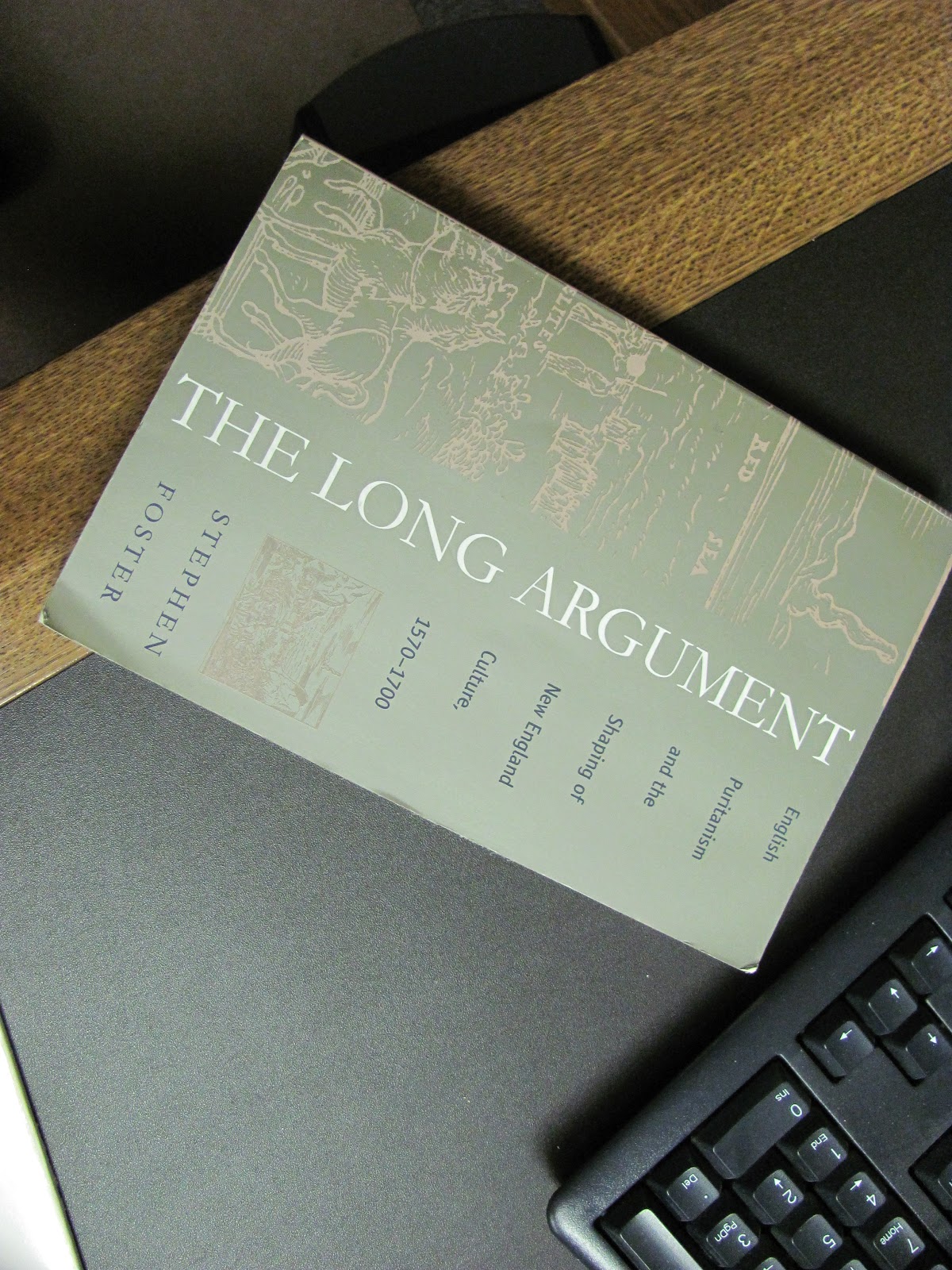
What follows is not a critical book review of Stephen Foster's, The Long Argument. At the beginning, I do say a few things about the content and significance of the book. But for the most part, I'm simply writing about some of my reflections and curiosities as I was reading.

Foster, Stephen. The Long Argument: English Puritanism and the Shaping of New England Culture, 1570-1700. Chapel Hill, NC: University of North Carolina Press, 1991.


Foster begins this fine, influential survey of Puritan history with a general observation: American historians have written as though they assumed that English migration to America represented a brand new beginning, something separate from everything else before. Whenever these historians have acknowledged transatlantic connections, invariably these have been connections to England. Along this line, the author reminds us that the Spanish established settlements in America at least as early as the English. Yet, American historians have normally called those earliest Spanish settlements “borderlands,” which are “peripheral by definition” (2).

Foster notes that Puritan studies have not avoided this common feature of American historiography. Thus, the American chapter of Puritan history has usually been isolated from its English parentage. This, says Foster, has resulted in a number of misunderstandings and poor reconstructions of the past. He observes:

Without some longer view that fuses the American and English histories of the Puritans and thereby locates enduring commitments and points of accord in decade after decade of reverses, internal divisions, and lamentations of decline the inevitable temptation has been to single out as definitive some one characteristic or another of a much broader movement and to tie the fate of a protean phenomenon to purely temporary arrangements (4).

Given that set of circumstances, Foster issues the following prescription and expectation: "Reassemble the English and American halves, examine the result over time, and with a proper regard to its settings, and the rough outline of the beast becomes visible enough" (5). With that, the author takes the reader on a masterful tour that begins during the reign of Queen Elizabeth I and ends with the First Great Awakening whose events so ruptured Puritanism that by 1800 “there was no longer a movement” (290). In telling this longer version of the story, Foster demonstrates the validity of what stands behind the main title of his book. Near the end, he explains that The Long Argument does not refer so much to disputes or even to a particular dispute, “but to the continuing narrative” of at least 130 years of Puritan history (287).

Along the way, the author provides a good number of important insights on his topic, as well as some significant additions and corrections to the secondary literature. In what follows, I will report a few of these (the ones that really struck me), and will also mention some of the daydreams and questions that occurred to me as I was reading this book.

In Chapter 1, “The Elizabethan Contribution,” Foster says that one of the early hallmarks of Puritanism was a tension according to which (a) an individual must not live a life that is random. You cannot live as you want nor do as you please. To state it positively, there must be a better, greater purpose to a person’s life than simply pursuing one's own desires. But (b), said the Puritans, the church and the secular powers are failing in their duties to promote and enforce this ideal (9). I was especially interested in a related section where Foster describes how English Puritans had a stock literary character: the decent person who is really not engaged in religious matters. He is disinterested and ignorant. Yet he assumes he has nothing to worry about. After all, he’s really not much worse than anyone else (38-39).

I was intrigued by this because, looking back from the time of the Puritans, the impulse just described appears to be a theme among the followers of John Wyclif. I am aware that having studied a little about the Lollards, I am susceptible to seeing their influence everywhere. Still, we have the following statement from Foster himself:

The Lollards do merit a place in the prehistory of Puritanism because they persisted as an exclusively popular heresy for several generations after the authorities had frightened off the movement's original university-based leadership and its knightly supporters and because in some undetermined and perhaps indeterminable way they contributed to the Reformation itself (7).

So I wonder: in the Puritan trope identified above, are we looking at something that is at least in part a vestige of Lollardy? In his informal heresy trial before Archbishop Thomas Arundel, for example, the Lollard priest William Thorpe laments what “a great pity and sorrow” it is “that many men and women do their own wayward will; nor busy them not to know nor to do the pleasant will of God” (103). Later, Thorpe complains to Arundel that religion in England is so confused that those regarded to be out of the faith are really in, and vice versa. Remarkably, at least in this part of the examination, Thorpe does not distinguish the two groups along the lines of propositional truth. Instead, his accusation against people who are wrongly considered true members of Christ’s Church has more to do with their neglect of the things that matter most. According to Thorpe, these people “neither know nor have will to know nor to occupy their wits truly and effectuously in the right faith of Holy Church” (122). [The text used here is found in Alfred W. Pollard, FifteenthCentury Prose and Verse (New York: Cooper Square, 1964), 101-67]. Of course, it would take much more than this to demonstrate a line of historical influence. But to my ears, Foster’s description and Thorpe’s accusation sound very similar.

Moving forward from the time of the Puritans, I think about some of my own experiences growing up going to church. A minor theme in the sermons I heard back then was, if you’re going to be God’s person, then you must necessarily rise above the ordinary. The world being what it is, to be average is to be displeasing to God. More frequently, I heard that sincerity is not enough. One can be sincerely wrong. And, balancing bad deeds with good will not work. Good deeds are not the antidote to sin.

In Chapter 2, “Continuity and Ambiguity, ‘The Gospel Doing,’ 1590-1630” Foster tells us about Robert Cawdry, a radical Puritan of the late sixteenth century. Cawdry produced and refined “the first monolingual English dictionary” as a means of helping the common people to learn more from the sermons they heard (66). Clear definition, he believed, was basic to growing in knowledge. There is a lot of truth to that, of course. But here’s what really struck me as I read about Cawdry’s project: In the sermons I heard growing up, the dictionary was almost as likely to be quoted as the Bible. Not as often, of course. Usually, if the dictionary (almost always, Webster’s) was cited in a sermon, then that citation came at the beginning (much in the way of debates, where defining terms was a basic part of the first speech). In my experience, some theological definitions were mentioned so often, we came to memorize them. The first mention of “grace” almost always came with the reminder that this word means “unmerited favor ” (a definition that, strangely, is true enough while not really getting to the heart of the Christian message, which offers forgiveness in spite of demerits). And then there were these sort of folksy definitions that weren’t really accurate. But because they were so memorable, so preachable, ministers found them irresistible. For example, “justified” meant “just as if I’d” never sinned. Break up the word “atonement” and you get “at one ment,” and so on.

When reading about Cawdry and his dictionary, I also thought about Sherman, Texas, during the first half of 1904. That was the scene of T. B. Larimore’s gospel meeting that lasted six months. Larimore preached at two services every day, and three times on Sunday: fifteen sermons a week. David Lipscomb, then editor of the Gospel Advocate in Nashville, took an interest in the extraordinary meeting and wrote to Larimore asking him to report. Larimore’s reply includes this tidbit: “What books do I consult? The Bible, Webster's Dictionary, and the Bible--these three, and no more.” For more about this famous Churches of Christ episode, see an earlier blog post of mine.

In Chapter 5, Foster describes the circumstances in New England which led to the so-called Halfway Covenant. This is an example of where a longer treatment can be significantly more revealing. I say this because, although Edmund Morgan discusses the same episode in his book Visible Saints, he does not describe the particulars, at least not to the extent that Foster does.

Foster makes the case that at least two things led to the development of the Halfway Covenant: First, in New England, the descendants of the Puritans who migrated to New England did not have the same volume and quality of religious sources that their forefathers had had in England; not as many pamphlets, books, sermons, etc.

Second, as the population in New England grew larger, it grew younger. The percentage of very young people, all of them born in America, and all of them without the benefit of the religious “means” known in England, was remarkably high. To their parents and grandparents, they seemed hopelessly irreligious.

Foster explains that the Halfway Covenant,developed in 1656-57, essentially said that these young people who had come of age (16 or older) were still members of the church. However, until they could convince their congregations that they had had the experience of saving grace, they were not considered in communion with the church. Therefore, they could not participate in the Lord’s Supper and were not permitted to vote. And he makes it a special point to say that “all of the seventeen clergymen at the assembly were English-born; all but two were English-educated and had come to America as adults” (187-88). Foster’s description went a long way in helping me to get a feel for what was to Puritans of the time a situation that had to be dealt with.

Wednesday, February 08, 2012

Edmund Morgan on the Puritans of New England

Morgan, Edmund S. Visible Saints: The History of a Puritan Idea. New York: New York University Press, 1963.

In this book, Edmund Morgan traces the history of the Puritans from their beginnings in sixteenth-century England through developments in seventeenth-century New England. He gives special attention to their quest to purify the church so that its membership would more closely approximate the true and perfect church of Christ.

Morgan tells us that his title, Visible Saints, is a term that occurs frequently in the writings of the Puritans. More than that, quoting Geoffrey Nuttall, he asserts that this phrase “was undoubtedly their controlling idea and provides the key to what they were after” (vii-viii). Morgan explains that the fundamental question the Puritans raised actually goes back at least as far as the ancient church and the Donatist schism. The Donatists tried to relieve the tension between the ideal and the real by establishing and maintaining what they asserted were "holy" Christian communities. Famously, Augustine responded by insisting that there are at all times, in fact, two churches: one is pure, unmixed, but invisible, while the other is visible, but mixed and impure. In other words, although the Lord knows those who are his, the church doesn’t. With a few radical exceptions, says Morgan, the Puritans “never repudiated St. Augustine’s distinction between the visible and invisible church. They all insisted on the impossibility of a church without blemish in this world” (33). They nevertheless carried out a unique attempt to further the reformation of the visible church so that it would more closely resemble the invisible.

Eventually, there emerged among the Puritans two distinct groups: nonseparatists, who sought ecclesiastical reform while retaining membership in the Church of England, and separatists, who believed that their national church was hopelessly corrupt and that, above all, it lacked the essential quality of the true visible church: namely, the capacity of a congregation to discipline itself under the Word of God.

Among separatists, one question in particular naturally arose: who is worthy to belong to the church? What should be the terms of membership? At first, the conditions of membership appear to be a simple renunciation of the English Church and a promise not to attend the parish congregation. However, although all Puritans assumed that the invisible church was made up precisely of those people who had experienced the saving grace of God, early separatists made no attempt to determine the religious experiences of prospective members. The standards of membership were orthodox faith, voluntary submission to the discipline of the congregation, and the absence of obvious, gross sin.

In time, all Puritans eventually developed an ideal and practice of church membership which tested every candidate's experience of saving grace. The author notes that historians have typically believed that this practice was followed by the separatists who fled to Holland, and that it came in 1620 with the Pilgrims who, in turn, influenced later arrivals. Morgan's thesis disagrees with this traditional account:

My contention is that the practice came, not from Plymouth to Massachusetts as initially supposed, nor from England or Holland as presently assumed, but that it originated in Massachusetts among the nonseparating Puritans there and spread from Massachusetts to Plymouth, Connecticut, New Haven, and back to England (65-66).

Regarding Puritanism in America, Morgan says that in the 1620s and even the 1630s, membership in both separatist and nonseparatist churches did not require a description and test of a prospective member's experience of saving grace. Yet, around 1640 and afterwards, this procedure was the norm. If the new system was well established in the 1640s, but was not known in 1629, how did it come to be? Morgan suggests that the idea was likely developed by George Phillips, minister at Watertown who came to America with John Winthrop in 1630. At any rate, within a few years the practice was forcefully advocated by John Cotton so that, by 1635, it was the norm in New England. There, churches "held it a duty to exclude from the church everyone who failed to persuade them in speech or writing that he possessed saving grace" (93).

Morgan points out how his thesis helps to explain other developments in the history of early New England Puritanism. For example, the uniquely-American movements and episodes associated with Roger Williams and Anne Hutchinson were radical extensions of the emergent New England religion. Hutchinson and her followers believed that God had granted them the ability to judge perfectly the professions offered by candidates for membership so that, in their community, the visible and invisible churches were one and the same.

The development of the so-called "the halfway covenant" can also be traced back to the standards of membership first recognized in New England. Morgan explains:

The absence of ties between the unregenerate part of the community and the church gave the latter an unprecedented purity, but it also placed the very life of the church in jeopardy. The members of the New England churches had themselves come from imperfect churches, in which they had learned the doctrines of Christianity, had taken the sacraments and received the experience of grace that qualified them for membership in the proper churches of New England. But how would the mass of men who had come to New England unqualified for membership ever become qualified? (122).

What ultimately forced the question of the church's responsibility to outsiders was the next generation, the children of New England Puritans. They had grown up baptized members of the church. But according to the new standards developed in America, many of them lacked the experience that would qualify them for membership. And what of their children, the grandchildren of founding members? "The Puritans had in fact moved the church so far from the world that it would no longer fit the biological facts of life" (128).

A 1662 synod attempted to remedy the problem. The proceedings from the synod said that church members' adult children who had not experienced saving grace should continue to be regarded as members of the church, and that they could bring their own children to be baptized, provided that the family did not live an outwardly scandalous life. Such members could not, however, vote. Nor could they participate in the Lord's Supper. This odd arrangement, generated by Puritan commitment to both infant baptism and a church made up entirely of saints, epitomized and reinforced a tension in American Puritanism that, as late as the mid-eighteenth century, lacked any real resolution.

In the “Preface,” Morgan explains that his book “originated as the Anson G. Phelps Lectures, delivered at New York University, in February and March, 1962” (viii). From beginning to end, Visible Saints retains a good bit of the engaging style of a fine set of lectures. Occasional comments in the text as well as footnoted sources indicate that Morgan conducted extensive and, in many cases, exhaustive research in the relevant primary sources available to him. The result of his careful and logical analysis is a convincing and delightful little book that has apparently become a classic in Puritan studies.