Showing posts with label European history. Show all posts

Thursday, January 05, 2017

Demons, Baseball, Skynyrd and More! My Sweet Sixteen Books of 2016

For someone pursuing a doctorate in History, I really didn't do that much reading last year. Much of the time I was skimming books by the dozens and reading lots of reviews. Still, I did manage to read from cover to cover a good number of books that I simply should have read, some of which I actually wanted to read. On occasion, I was pleasantly surprised to find out that a title I had been avoiding was much more engaging than I thought it would be. And, I wound up reading a few books that had almost nothing to do with my academic program. Anyway, out of that group of titles I thoroughly digested last year, here are sixteen of my favorites:

European History

1. Roland H. Bainton, Here I Stand: A Life of Martin Luther (Abingdon Press, 1950). Back in the day when I was hanging out at Yale Divinity School, people uttered the name Roland Bainton with something like reverence. The name plate below his giant portrait might just as well have read Solomon or Paul. After reading this book, I understand a bit more about why. Here I Stand was likely the twentieth century's best biography of Martin Luther in English. It was certainly the most popular and influential. Yes, it represents old-school historiography. More recent works, for example, rightly emphasize that Luther was no Lone Ranger of the Reformation. Without other leaders and places like Zwingli in Zurich and Calvin in Geneva, nothing from Luther's legacy would ever have worked out the way it did. But in an age when Europeans and Americans were more comfortable with the idea of a singular, patrician leader like Franklin Roosevelt, this book was the perfect biography. It's still a great read.

2. Michael Baxandall, Painting and Experience in Fifteenth Century Italy: A Primer in the Social History of Pictorial Style (Clarendon Press, 1972). The author begins this contemporary classic with a basic assertion: "the style of pictures is a proper material of social history." In other words, paintings do not simply illustrate history once it is established by documents. Instead, paintings should be thought of and used as primary sources, along with documents. Or, as the author concludes, "the visual is  . . . the proper complementary to the verbal." This book goes a long way in establishing works of art as primary sources for understanding history. Baxandall's reflection at the end of the book about the actual primacy of the visual is by itself worth the price of admission. More historians should know this book.

3. Jerry Brotton, The Renaissance: A Very Short Introduction (Oxford University Press, 2006). The Very Short Introductions series keeps reeling me back in. A year goes by, I forget everything I didn't like about the last volume I read, and I wind up trying out some other title. It's not that the authors of the series aren't great scholars. They are. The problem, in my opinion, is the format. The small size of these introductions means they're more than an article, less than a complete survey. It's a tough awkward job for any author. However, with this particular volume, Jerry Brotton manages to pull it off. His coverage of the Renaissance begins with a good survey of the historiography, and then proceeds with sections on art, literature, humanism, religious reformation(s), women, exploration, etc. If you don't read any other book on the topic, read this one.

4. George Huppert, After the Black Death: A Social History of Early Modern Europe, 2nd edition (Indiana University Press, 1998). Huppert specifies that his chronological coverage runs from the first outbreak of the Black Death in Europe in 1347 to its last appearance at Marseilles in 1721. Why this periodization? He explains: "After the Black Death had done its work, the survivors became more prudent. They did not allow themselves the luxury of multiplying again to the point of outstripping their resources as dramatically as they once had. To forestall famine, they learned to control population growth" (ix). This is the organizing theme for what has to be one of the most engaging social histories of the period. For students of Early Modern Europe, this is a must read.

5. Giovanni Levi, Inheriting Power: The Story of an Exorcist (University of Chicago Press, 1988). Don't be fooled by the sexy title. This book really isn't about an exorcist. It's about the complex world of a small-town priest in northwestern Italy in the 1690s. Along with a few other Italian historians, author Giovanni Levi is one of the founding fathers of a sub-discipline known as microhistory. No, that word doesn't refer to a tiny topic or bite-sized history. As Carlo Ginzburg explains it, think instead of what you do with a microscope: intense, detailed analysis. That's exactly what Levi gives the reader. If you want to learn about the history of exorcism, read something else. If you're interested in the detailed reasons why, for example, people in the early modern era sometimes got a much higher price when selling land to a family member as opposed to a complete stranger, then Inheriting Power might be for you. Just don't take it to the beach. It's not that kind of book.

6. Gary K. Waite, Eradicating the Devil’s Minions: Anabaptists and Witches in Reformation Europe, 1525-1600 (University of Toronto Press, 2007). According to the author, this work “examines the rhetoric used against Anabaptists and their specific treatment by churchmen, interrogators, and executioners in the light of the magical world view that we know dominated the culture of the sixteenth-century populace.” In other words, Eradicating the Devil’s Minions compares the persecution of religious dissidents with that of the largely fictitious sect of devil-worshipping, magic-performing witches. Bottom line: in the era of the early Reformation, some people treated religious devotees as though they were witches, and vice versa. Seems like that sort of thing has a way of coming back around.

American Religion

7. Paul Johnson, A Shopkeeper’s Millennium: Society and Revivals in Rochester, New York, 1815-1837, 25th-Anniversary edition (Hill and Wang, 2004). The early-nineteenth century Protestant revivals collectively known as the Second Great Awakening have deeply influenced American religion from the antebellum period to the present day. Because of its broad, long-lasting significance, historians have raised questions about how the Awakening began, what contributed to its rise, and what its essential character was. Some time around the 1960s, historians began probing the possibility that the revivals involved something more than just religion. For example, were there social, economic, and cultural contexts to the revivals? First published in 1978, A Shopkeeper's Millennium is one of the seminal works along this line of study. We get a taste of what Johnson is up to when he writes: “Revivals were a means of building order and a sense of common purpose among sovereign, footloose, and money-hungry individualists." Some religious people who have read Johnson's work have accused him of being reductionistic. They think that Johnson has taken a thoroughly-religious episode in American history and has turned it into something else entirely. I'm not sure that that criticism will stick. Read it and see what you think. Either way, like many others, you'll probably be pulled in by this engaging book.

8. Michael J. Lee, The Erosion of Biblical Certainty: Battles over Authority and Interpretation in America (Palgrave Macmillan, 2013). As the author describes it, this book "examines how learned Americans dealt with the new and often unsettling ideas" coming out of Europe in the early eighteenth century, and that raised critical questions about the status of the Christian Scriptures and how they should be understood. Lee argues that by taking up evidentialist challenges to conventional views and literal interpretations of the Bible, American biblical scholars "gradually became increasingly naturalistic in their understanding of revelation." In effect, they conceded "that the Bible was accountable to outside authorities and needed to be reconciled to new fields of knowledge." The majority of English rational Protestants were confident that true reason would never contradict what the Bible affirmed. They believed that, if anything, rational inquiry would always confirm the Scriptures. Their American counterparts agreed. But neither group seems to have anticipated that their latitudinarian approach would subject revelation to independent investigation to test its veracity. In effect, the assumptions and presuppositions of the debate turned out to be the sources of the decline of traditional positions during the nineteenth century.

9. Ussama Makdisi, Artillery of Heaven: American Missionaries and the Failed Conversion of the Middle East (Cornell University Press, 2008). On one level, Artillery of Heaven simply tells the story of American Protestant missionaries and one As’ad Shidyaq. Born in 1798, Shidyaq lived in that part of the Ottoman Empire now known as the Lebanese Republic. His life forever changed when he became the first convert to Protestant Christianity in that part of the world, and was subsequently tortured and killed. He thus became the first Protestant martyr of the American mission to the Middle East. As interesting and significant as this story is, Makdisi has received special notice for how he tells it. In general, most historical accounts of Christian missionary work are examples of institutional, denominational history. This is only natural since those producing the historiography are members of the community of faith that conceived and conducted the mission activities they describe. Makdisi presents another possibility. As he puts it, "[t]he only way to tell a story of a cross-cultural encounter involving Americans and Arabs is to enlarge dramatically the conventional scope of inquiry."

10. George M. Marsden, Fundamentalism and American Culture. New edition (Oxford University Press, 2006). The first edition of this book appeared in 1980 and instantly became a classic of American religious history. Marsden's basic conclusion was that fundamentalists of the late-19th and early-20th centuries  "experienced profound ambivalence toward the surrounding culture." He acknowledges that such is true of many distinct groups and movements. But, he notes, conservative Protestants in the U.S. went from being respectable in the 1870s to being peripheral and a laughingstock by the 1920s. What happened? Marsden answers that historians can only respond to such questions not by proving anything—not scientifically, anyway—but by an illumination that comes by way of what he calls "sympathetic insight." In his description of fundamentalism in America, Marsden begins by insisting that the phenomenon was essentially a religious movement. At the same time, like all other religious movements, fundamentalism lived within and responded to a distinctive culture. And that has everything to do with its character.

11. Mark R. Stoll, Inherit the Holy Mountain: Religion and the Rise of American Environmentalism (Oxford University Press, 2015). This book begins with an important historical footnote: back in 1967 Lynn White Jr. published an essay in Science magazine "claiming that Christianity had caused the environmental crisis." As Stoll points out, White's idea is one that lingers "in the back of a lot of people's minds when they think about religion and the environment." The author noticed, however, that many figures in the history of American environmentalism grew up in either Congregational or Presbyterian churches, both types "in the Calvinist tradition." What was the connection? Starting with questions like that, Stoll has written a unique book, one that "overlays American environmental history on American religious history." He makes a solid case that, in fact, religion had everything to do with the rise of American environmentalism, and that a person's formative religious outlook brings with it a controlling theology and view of the world, facets of thought that always make a difference in the way a person considers nature. Our environmental crises would not improve with the disappearance of religion, but it might improve with a religious tradition that could, like the old Calvinists, bring about systemic change for the better.

12. Molly Worthen, Apostles of Reason: The Crisis of Authority in American Evangelicalism (Oxford University Press, 2014). This book is an intellectual history of conservative Protestantism in America from the end of the Second World War to the early years of the twenty-first century. Worthen defends her approach by pointing out that while not all thoughts and thinkers are equally good, scholars must take into account "that all people think, and that material forces alone cannot explain human experience." Though not herself an evangelical, Worthen evinces a real appreciation for her subjects and what she calls their crisis of authority. So, what does she believe is the crisis? In order to hear her answer, we must first understand her idea that the identity of American evangelicals is revealed not so much by their beliefs, but by their struggles. Worthen insists that what unites modern evangelicals is not their doctrinal conformity--which they have never been able to achieve--but their shared questions "borne out of their peculiar relationship to the convulsions of the early modern era." In other words, if we want to comprehend who evangelicals are, we should listen not to their confident affirmations, but to the questions and doubts with which they constantly wrestle.

American Political and Cultural History

13. Karen Halttunen, Confidence Men and Painted Women: A Study of Middle-class Culture in America, 1830-1870 (Yale University Press, 1982). Ever wondered why charades is a well-known game in America? As Karen Halttunen explains, it has something to do with cultural changes that unfolded in the U.S. beginning in the 1830s. The so-called Market Revolution and the growth of cities in America generated a new social phenomenon: anonymity, the problem (and potential) of becoming a face in the crowd. In a sprawling city unknown by the young man who had recently moved there seeking a job, who could he trust? America's response to this question was to establish certain habits, manners, and clothing that would make up the look and the way of respectable people. These kinds of social and cultural markers would indicate, it was hoped, who the good people were. The weakness of the plan, of course, was that when motivated by some less-than-virtuous desire, bad people could adopt the look just as well as good folks could. There are reasons why con men often succeed.

14. Jill Lepore, New York Burning: Liberty, Slavery, and Conspiracy in Eighteenth-Century Manhattan (Knopf, 2005). Grave suspicions about slave insurrections. The heartless treatment of black people: falsely accused, arrested, jailed, beaten, falsely convicted, and then burned at the stake or hanged, one after the other. It's all the stuff of the antebellum South, right? Not always. In this case, such horrors were perpetrated in pre-Revolutionary New York City! Read it and weep. The detail of this book will engage and impress you. The episode it relates will make you wonder about bigger questions: How is it that we human beings justify inhumanity? How do we legitimize incredible violence? Lepore is one of the most popular American historians of our day, and with good reason. She has an eye for great stories and tales that have yet to be really told.

15. Mark Ribowsky, Whiskey Bottles and Brand New Cars: The Fast Life and Sudden Death of Lynyrd Skynyrd (Chicago Review Press, 2015). Disclaimer: If you check out the Amazon reviews of this book, you'll hear it panned and pummeled again and again. Informed fans and self-appointed sleuths love to hate it. I decided to read it anyway, as a sort of guilty pleasure. Ribowsky is a good writer, maybe a bit too "good," as he often uses sappy language and way too many words for my taste. Sometimes, reading Ribowsky is like watching a B-rate movie that you just can't pull yourself away from. Sure it's kind of cheesy, but you don't want to miss what comes next. He emphasizes the essential and central role played by Ronnie Van Zandt. The band was always his band. In fact, Ribowsky convincingly argues that without Ronnie, there would never have been anything like Lynyrd Skynyrd.

16. George Vecsey, Baseball: A History of America's Favorite Game (Modern Library, 2006). If you're a long-time, well-versed fan of baseball, this book won't tell you much that you didn't already know. On the other hand, if you're more like me--someone who likes baseball, who keeps up with a certain team, but who doesn't know that much about the history of the game--then this book is for you. Vecsey is a veteran New York Times sports columnist who writes chapters as though they were long magazine articles. Some of his chapters tell stories of dark episodes (for example, "The Black Sox" and "Four Scandals"). Other chapters focus on the life and times of incredible players and personalities ("The Babe" and "Jackie Robinson"). Vecsey has a serious crush on almost all of his subjects, but he doesn't allow love to get in the way of insight. Above all, he knows how to write. The result is a book that, if you care anything about baseball, you'll wind up savoring like a good cup of coffee or a favorite dessert.

So, what were some of the better things you read in 2016? Has anyone else read the titles (or authors) I've listed here? And, what's on your reading agenda for 2017?

Thursday, March 17, 2016

Seeing Through Fifteenth-Century Eyes

Michael Baxandall, Painting and Experience in Fifteenth Century Italy: A Primer in the Social History of Pictorial Style. Oxford: Clarendon Press, 1972.

Baxandall begins his contemporary classic with a basic assertion: "the style of pictures is a proper material of social history" (Preface). In other words, paintings do not simply illustrate history once it is established by documents. Instead, in addition to documents, paintings should be thought of and used as primary sources. Or, as the author concludes, "the visual is  . . . the proper complementary to the verbal" (153). In order to show how this works in connection with fifteenth-century painting in Italy, he presents his case in three parts.

In Part I, "Conditions of Trade," Baxandall identifies a fundamental point of departure: "Money is very important in the history of art" (1). Artists have to put food on the table. Consequently, art is among other things a business. In fifteenth-century Italy, a painting was the result of a contractual relationship between an artist and his wealthy client. Baxandall quotes extensively from intriguing letters that reveal this relationship. He notes that as the fifteenth century progressed a change unfolded. Early in the century, clients were most interested in the quality of the painter's materials. They especially valued shiny gold and silver, and a blue color known as ultramarine, which came in several grades of varying cost. Later in the century, the emphasis shifted from the quality of materials to the quality of the painting itself. In other words, clients no longer cared so much about the value of the materials. Instead, they cared about the skill of the artist. The author concludes Part I by raising the question of how people determined the relative skill of a painter and quality of a painting. Upon what basis did people make such distinctions?

Masaccio (1401-1428), St. Peter Distributing Alms
In Part II, "The Period Eye," Baxandall identifies how painters and public "attended to visual experience" in ways that were distinct to fifteenth-century Italy, and "how the quality of this attention became a part of their pictorial style" (27). He notes that, above all, painters cared about the opinions of the people who cared the most about art and who took the greatest pleasure in it, "the patronizing classes" (38). So, then, how were the assumptions and cognitive skills of these viewers related to what painters actually did? In other words, how did expectations about what viewers knew, and might want, make a difference in how painters did their work? (40). In reply, Baxandall points out that we moderns simply cannot have the same kinds of experiences with fifteenth-century paintings that people at that time surely had. Why? Because the artists knew and shared what people of their own time would bring to a painting--their experiences, knowledge, skill sets--and painters did their work in conscious relationship to them (48). For example, because people in fifteenth-century Italy grew up in a Christianized society and had heard the sermons of popular preachers, painters could be certain that everyone would recognize a biblical story. Painters could also include distinct hand gestures that people of the time would instantly recognize.

Other commonplaces of the culture were also factors. The author describes, for example, the relationship between fifteenth-century painters and dramatic productions of the day. Some characters or narrators in contemporary drama never left the stage. They merely sat until it was time for them to speak again. Not surprisingly, such characters appear in contemporary paintings as well. Too, some painters depicted subjects performing certain dances that were well-known at the time. To provide yet another example, Baxandall explains that Italian school boys learned a very practical mathematics they would use throughout life. At the time, no staple items came packaged in a standardized quantity. Consequently, it was important to be able to figure the surface or the volume of something being considered for purchase or trade. Unique barrels and jars meant that one needed to be able to take a measurement or two and, using geometry and mathematics, quantify the volume or surface of an object. This became second nature to most men. Baxandall suggests that painters appealed to their viewers by displaying hats, bodies, columns, etc. in ways that would provoke this sort of calculating on the part of viewers and, thus, draw them in.

Finally, in Part III, "Pictures and Categories," Baxandall addresses the question of just how well his idealized fifteenth-century Italian man represents historical reality. He implies that, in fact, many people of the time possessed the essential "equipment for looking at Quattrocento paintings" (111). In 1480, Cristoforo Landino provided a summary of this "equipment" when he set out to write an overview of the paintings of his time. A paragraph from Landino's text includes sixteen terms he used to describe four Florentine painters. These sixteen terms provide the outline for Baxandall's discussion. Throughout, he identifies the links between these terms and their contemporary cultural values.

As he concludes, Baxandall circles back to the beginning of his book. He started "by emphasizing that the forms and styles of painting respond to social circumstances." Now, he ends the book "by reversing the equation--to suggest that the forms and styles of painting may sharpen our perception of the society" (151). So much of history depends upon texts, words. But as every historian can attest, these do not often reveal the past as well as we would like. Baxandall concludes that because "visual sense is the main organ of experience," pictures certainly can and should be considered "documents as valid as any charter or parish roll." In this particular case, "they offer an insight into what it was like, intellectually and sensibly, to be a Quattrocento person" (152).

Wednesday, January 20, 2016

The Historiography of the English Reformation (Part 4 of 4)

This post is my fourth and final installment in a series designed to size up what modern historians have said about the English Reformation. It's been a long while since I last posted about any of this. So here are links to Part 1, Part 2, and Part 3.

In 1992, Eamon Duffy published The Stripping of the Altars: Traditional Religion in England c. 1400-c. 1580, a bombshell of a book that quickly established itself as one of the most substantial and significant works produced by any of the revisionists. [1] The first of two main parts of The Stripping of the Altars describes in great detail the relative glories of England’s traditional religion during the century leading up to the reign of King Henry VIII. Duffy attempts to demonstrate “that late medieval Catholicism exerted an enormously strong, diverse, and vigorous hold over the imagination and the loyalty of the people up to the very moment of the Reformation.” [2] In the second part of his book, Duffy details what he portrays as the disruptive reforms that took place during the reigns of Henry VIII, Edward VI, and Elizabeth I. He argues that the short reign of Mary with its restoration of tradition was a success welcomed by the large majority of the laity. Duffy cites a wide array of primary sources, including wills, church-wardens’ accounts, primers, and parish records. In addition, he includes several impressive images of paintings, monuments, sepulchers, stained-glass church windows, and carvings, all of which he uses to underscore his principle contention: “into the 1530s the vigour, richness, and creativity of late medieval religion was undiminished, and continued to hold the imagination and elicit the loyalty of the majority of the population.” [3]

Since he first published his seminal work, Duffy has taken on the task of reinforcing his basic thesis. In a 2001 book, Voices of Morebath: Reformation & Rebellion in an English Village, Duffy provides a case study that illustrates the general claims of his magnum opus. The book is about “a sixteenth-century country priest,” Sir Christopher Trychay, who served the people of Morebath, a village of Devon twenty-five miles north of Exeter. Two things about Trychay stand out. First, he was vicar of Morebath for over a half century, “from 1520 until his death in 1574.” Second, he “wrote everything down.” Consequently, Trychay’s accounts “offer a unique window into a rural world in crisis, as the progress of the Reformation inexorably dismantled the structures of Morebath’s corporate life, and pillaged its assets.” Duffy acknowledges that if someone wrote a similar book with Essex or Suffolk as its setting, that book “would look very different.” He seems content simply to offer an engaging example of how it was that in some parts of England compliance and conformity were not the rule. In Morebath, Sir Christopher publicly opposed the Reformation and thanked God for the reign and reforms of Queen Mary. Members of his congregation died in the Prayer Book rebellion of 1549. Duffy disavows that his book supports any thesis. But in view of his previous work, that sort of disclaimer sounds odd. [4]

If Eamon Duffy's The Stripping of the Altars has been the revisionists’ most significant book, Christopher Haigh has been their strongest, most engaging, and perhaps most judicious champion. In his 1993 book, English Reformations: Religion, Politics, and Society under the Tudors, Haigh set out to demonstrate that England's pre-Reformation religious tradition was both popular and strong. At the same time, he committed himself to acknowledging and accounting for the genuine diversity of religious life in pre-Reformation England. “We need a version of religious conflict and transformation which includes both sides of the fence—and those who sat on the fence, those who could not find, it, and those who did not see why there was such a fuss about the fence.” [5] Much like Scarisbrick and Duffy, Haigh argues that “it was the break with Rome which was to cause the decline of Catholicism, not the decline of Catholicism which led to the break with Rome.” [6] As a result of its enforced Reformation, England was populated by “parish Anglicans” who were “de-catholicized but un-protestantized." [7]

Sometime after the basic thesis associated with the names A. G. Dickens and G. R. Elton was seriously challenged, if not demolished, by the likes of Haigh, Scarisbrick, and Duffy, a few scholars began to wonder what might be next. The revisionist program had succeeded in what seems to have been a mission of correction. So then what was the next step? If the thesis of the Whig-Protestants had been effectively contradicted by the antithesis put forward by the revisionists, what might be a satisfying synthesis? Of course, that question assumes that a synthesis might be needed. Since sometime near the beginning of the twenty-first century, many scholars have agreed that one is needed. Why? It is because of something that Patrick Collinson in 2003 referred to as “the riddle of compliance.” By way of explanation he wrote, “We may be forced to construct the following syllogism: a religious change so drastic and so unwelcome cannot have happened: but it did happen; ergo, it cannot have been all that drastic and unwelcome.” At that point, Collinson referred to the then-emerging, post-revisionist historiography of the English Reformation: "Among those who believe that there was a great change, there is a consensus that it must be understood in terms of interplay of what have been called 'from above' and 'from below' factors and forces. Neither top-down nor bottom-up explanations will work on their own. [8]

Ethan H. Shagan’s 2003 book, Popular Politics and the English Reformation provides a good example of the post-revisionism of which Collinson spoke. Shagan actually begins with the riddle of compliance, the contradiction that begs to be solved. English society in the early modern period was conservative. Consequently, that society would likely resist a radical changeover from Roman Catholicism to beliefs and religious practices that were in line with principles of reform. So then, how did the English Reformation take root as quickly as it apparently did? Or as Shagan puts it, “Why would a revolution have been accepted or embraced by a population so heavily invested in the very belief system that the revolutionaries sought to disturb?” [9] He responds by suggesting that “an analysis of popular politics allows us to understand the English Reformation—and, mutatis mutandis, the European Reformation more generally—in fundamentally new and more satisfying ways.” Though revisionists were right to identify strong popular resistance to the English Reformation, their version of the story left unexplained “the remarkable penetration of England’s ‘Reformation from above.’ ” In other words, revisionist accounts of the English Reformation never explained how that episode could leave behind what Christopher Haigh so memorably described as “a Protestant nation, but not a nation of Protestants.” [10]

Shagan points out that, unlike Saul of Tarsus and Augustine of Hippo, no society, especially not English society in the early modern period, experiences religious conversion in a single moment. Societies do not have religious conversions like individuals do. Yet, that was something like the story told by Whig-Protestant historians. Then came revisionism, officially beginning in the 1970s. By any measure, a simple comparison would have to conclude that revisionism won, and rightly so. Yet, says Shagan, “for all its benefits, the revisionist model remains no less imprisoned than its predecessor in a paradigm defined by the phantasmagoric goal of ‘national conversion’.” Was the English Reformation essentially about the religious conversions of individuals? Shagan insists that “the whole meta-narrative of conversion which historians have used to conceptualise the Reformation has impeded our ability to ask a different set of questions, to see the Reformation not in globalizing terms but as a more piecemeal process in which politics and spiritual change were irrevocably intertwined.” Thus, his analysis “concentrates on the majority who neither wholly accepted nor wholly opposed the Reformation.” It argues that “the amphibiousness and ambidexterity of new religious ideas is exactly what allowed them to penetrate English culture, seeping into the myriad crevices in the dominant belief system where ideas and practices were not fully aligned.” [11] But what exactly constituted resistance to and collaboration with the English Reformation? For one thing, Shagan says, there were instances where individuals, out of personal animosity, turned in a neighbor who was suspected of practicing an illegal religion. Interestingly, he compares England during the Reformation to Nazi-occupied countries in Europe and to those socialist republics that were dominated by the Soviet Union. He points out that even in a monarchy, government requires a measure of consent from the governed. [12] In sum, Popular Politics and the English Reformation is “an analysis of how ordinary English subjects received, interpreted, debated and influenced the process of religious change in the first quarter century of the English Reformation.” [13]

Responding to the questions created by the new era and sizing up the field of inquiry was the apparent goal of a 2009 article by scholar Peter Marshall titled, “(Re)defining the English Reformation.” Marshall noted that due to the arguments forcefully advanced by the revisionists, “most scholars now accept that the Reformation in England was a thorny and protracted process and by no means straightforwardly unidirectional.” Notwithstanding the success of the revisionist project, however, “the study of the Reformation has now discernibly passed into a post-revisionist phase.” [14] Indeed, Marshall even cites the revisionists themselves as they have recently claimed to be post-revisionists. In a review published in 2000, Haigh made the suggestion that “we are (almost) all post-revisionists now.” And, in a survey article published in 2006, “The English Reformation after Revisionism,” Duffy said much the same for himself. [15] Marshall observes that now that such ambiguity has been so firmly established, students should not have been surprised when a collection of presentations, edited by Nicholas Tyacke and published in 1998, should appear under a title like England's Long Reformation, 1500-1800. [16] Having dispensed with the notion that the English Reformation occurred in a matter of decades, scholars now seem unable to name the century when it came to a close. Yet, the year 1640 appears to be the “workaday consensus” that has emerged. Either way, Marshall still wants to know, “What, then, is the sensible way forward?” [17]

However one might answer that question, there does seem to be some continuity among the post-revisionists. A title published in 2014, Reformation Unbound: Protestant Visions of Reform in England, 1525-1590, by Karl Gunther, provides an example of this. As noted above, the author’s mentor, Ethan Shagan, chose to focus on the first twenty-five years of the English Reformation. And, again, the volume edited by Tyacke lengthens the episode at both ends, using the dates 1500-1800. In a way that appears to match that trend, Gunther makes an argument about the beginnings of radical Protestantism in England. He observes that in the context of our subject, traditionally the word radicalism has been reserved to speak first of Puritanism. Thus, radicalism emerged roughly a half century after England was first introduced to Reformation ideas. As the author notes, radical religious impulses have been “typically treated as later developments in the course of the English Reformation.” [18] Citing a few manuscripts and a large number of printed works from the period, Gunther sets out to show that from earliest times in the English Reformation, at least some proponents advocated the restructuring of church polity and leadership, for example, according to the teaching of the Scriptures. As Gunther puts it, those calls did not wait for “the coming of the Presbyterians in the 1570s.” In fact, “they had been issued by evangelicals in the late 1520 and 1530s.” [19] Thus, according to Gunther, when various Puritan teachings emerged in the 1570s, we may be more accurate to describe that action as a re-emergence. In short, as a result of what post-revisionists have taught us so far, the English Reformation seems longer and more complex than was once imagined.

My survey of some important titles in the recent historiography of the English Reformation leaves me with at least two very general observations. First, if we simply trace the history of various schools of interpretation, we might come away with a mental picture of thick, high walls standing between the different positions. However, when reading the acknowledgements and noting the personal connections among many of the authors cited above, I did not imagine high walls, but something more like a portrait of a large extended family. In other words, while historiographical surveys tend to highlight differences and discontinuity, actually reading the books and articles reveals connections and fitting admiration. Those connections relate not only to academic tutelage and personal experiences, they also relate to the level of ideas. For example, when reading historiographical outlines of the topic, one might never guess that A. G. Dickens paid attention to social as well as to institutional contours of the English Reformation. Moreover, one can easily detect in Dickens an appreciation for the real complexity of the story he attempts to relate. In that sense, his work and the work of others in his generation does not appear to be so much the foil, but more like the foundation of later interpretations.

Second, in regard to Roger B. Manning’s categories of official, theological, and popular aspects of the English Reformation, scholars almost always focus on some aspect found within just one of those three areas, especially when writing articles and monographs. That is to be expected. Yet, I cannot help noticing that the religious and theological history of the English Reformation seems to have been relegated mostly to scholars who teach in divinity schools and seminaries. Why does so much of the historiography on this topic refer so little to the Bible and contemporary theological debate? Is it mere coincidence that Karl Gunther has identified very early radicalism in the English Reformation while paying attention to people like William Tyndale, to issues like adiaphora, and to books like an old commentary on Haggai? If not, then it might be time to move the divinity school down the hill and place it in the same building that houses the history department.
__________________________

[1] Eamon Duffy, The Stripping of the Altars: Traditional Religion in England c. 1400-c. 1580 (New Haven, CT: Yale University Press, 1992).

[2] Ibid., 4.

[3] Ibid., 479.

[4] Eamon Duffy, The Voices of Morebath: Reformation and Rebellion in An English Village (New Haven, CT: Yale University Press, 2001), xiii-xv.

[5] Christopher Haigh, English Reformations: Religion, Politics, and Society under the Tudors (Oxford: Clarendon Press, 1993), 335.

[6] Ibid., 28.

[7] Ibid., 290.

[8] Collinson, The Reformation: A History, 129.

[9] Ethan H. Shagan, Popular Politics and the English Reformation (Cambridge: Cambridge University Press, 2003), 1.

[10] Ibid., 2. Shagan cites Haigh, English Reformations, 279-281.

[11] Shagan, Popular Politics, 3-7.

[12] Ibid., 12-20.

[13] Ibid., 22.

[14] Peter Marshall, “(Re)defining the English Reformation,” Journal of British Studies 48 (July 2009), 565.

[15] Ibid., 565, n. 7.

[16] Ibid. See Nicholas Tyacke, ed. England’s Long Reformation, 1500-1800 (London: Taylor and Francis, 1998).

[17] Marshall, “(Re)defining the English Reformation,” 568.

[18] Karl Gunther, Reformation Unbound: Protestant Visions of Reform in England, 1525-1590 (Cambridge: Cambridge University Press, 2014), 6.

[19] Ibid., 254.

Saturday, July 11, 2015

Who's Who? Identity and Peasant Life in Early Modern Europe

Davis, Natalie Zemon. The Return of Martin Guerre. Cambridge, MA: Harvard University Press, 1983.

In this book, Natalie Zemon Davis retells the often-told story of Martin Guerre. But as the extensive bibliography and notes suggest, this is the thoroughly-researched, historian's version of the tale (pages 127-57). It is offered, in part, as a reflection on "the significance of identity in the sixteenth century" (viii).

Zemon Davis relates the story as follows: Martin Guerre was a peasant who lived in "the Pyrenean village of Artigat" (vii). In 1538, he was married to Bertrande de Rols, who was also from Artigat. At the time of their wedding, Martin was about fourteen years old, and Bertrande was either nine or ten (16, n.). Apparently, the marriage remained unconsummated for several years. During that time, Martin was subjected to public ridicule due to his impotence. However, several years later Bertrande gave birth to a son named Sanxi (21). In 1548, ten years after the wedding and when Martin was around 24 years old, he was accused of stealing grain from his father. Humiliated for years, and now embarrassed and afraid, Martin abandoned his family and the place he had always known.

Eight years later, "in the summer of 1556," a man presented himself "as the long-lost Martin Guerre. Previously he had been known as Arnaud du Tilh, alias Pansette" (34). Interestingly, the villagers, including Bertrande, welcomed du Tilh as though he were Martin Guerre. Soon, he settled into a peasant's life filled with farm work and family obligation. By all accounts, he and Bertrande enjoyed a blissful relationship. She became pregnant twice more. One of the children, a daughter, survived infancy.

Trouble came four years after the return of "Martin," when he proposed the sale of some of the land that was part of his inheritance, a violation of the Basque norms that his family had always observed. Martin's Guerre's uncle and Bertrande's stepfather, Pierre, had sometimes been uncertain about the identity of the imposter. Once questions about land and money entered the picture, Pierre became the man's determined nemesis. With Bertrande now on his side, Pierre brought the accusation that generated both civil and criminal charges against the impostor.

At his trial, in 1560, the dozens of witnesses were divided on whether the accused was Martin Guerre. However, the impostor was found guilty. On appeal, that decision was nearly reversed. Arnaud du Tilh as Martin Guerre defended himself in what must have been one of the greatest court performances in legal history. Playing up the obvious conflict of interest of Pierre and his family, the impostor was able to provide answers and recite details regarding matters that, seemingly, only the real Martin Guerre would know. For every question, he had a plausible and sometimes even cogent response.

But as fate would have it, just as the appellate court was about to reverse the original decision, the real Martin Guerre appeared. Having "had his leg shot off at the battle of Saint-Quentin" fighting for Spain, Martin Guerre now had a wooden leg (82). Of course, the impostor's charade came crashing down. Having been spared an incorrect judgment, the court then found Arnaud du Tilh guilty of "imposture and false supposition of name and person and of adultery" (86). Within days, he was hanged in front of the Guerre home in Artigat, and his body was burned.

Zemon Davis takes up the question of how the reunited couple might have managed in the years that followed the execution of the impostor. She notes that both of them were culpable: Martin had abandoned his wife and child, and Bertrande had played the wife of a man she must have known was not her husband. The author concludes with this reflection: "The story of Martin Guerre is told and retold because it reminds us that astonishing things are possible. Even for the historian who has deciphered it, it retains a stubborn vitality. I think I have uncovered the true face of the past--or has Pansette done it once again?" (125).

Thursday, May 28, 2015

The Historiography of the English Reformation (Part 3)

The previous post described how "Whig-Protestant" historians of the English Reformation agreed that Protestantism took hold in England rather quickly in the sixteenth century. Some historians, like G. R. Elton, said this was a result of decisive action at the highest levels of government. Yes, it was assumed, the English people wanted religious reformation. But Elton emphasized that change came about as a result of an act of state. Other historians, like A. G. Dickens, said that religious change came because the Reformation was immediately embraced by the majority of the people. In other words, while Elton argued for a top-down English Reformation imposed by government, Dickens said that the movement was bottom-up, a popular phenomenon.

Continuing on with Christopher Haigh's characterization of the historiography, a third group of scholars presented yet a different picture. Like the first group, they were confident that reform came from above. Yet the authorities were able to produce only slow, gradual change. Pointing to earlier works, Haigh noted a 1941 book by A. L. Rowse, Tudor Cornwall, and an essay by Roger B. Manning, published in 1970. [1] In Tudor Cornwall, Rowse had in a real sense anticipated revisionist historians of the English Reformation. Just as Christopher Haigh's 1975 book focused on Lancashire, for example, so Rowse, a third of a century before, had focused on Cornwall, the southwestern tip of England. In his study of the county, Rowse wanted to explore several related questions: “what was the Reformation when you come to study it under the microscope? what did it mean? what did it do and how did it work? what were its effects upon the development of our society?” [2] Again, as Haigh would later reveal about Lancashire, so Rowse produced evidence that Cornwall had stoutly resisted reformation and that Catholicism had survived there. But, again, the question of the extent to which Cornish Catholics might reflect the rest of England outside of London and its environs was not completely answered.

In his 1970 article, “The Spread of the Popular Reformation in England,” Manning began with a simple observation. Although many scholars like G. R. Elton had assumed and asserted that the English Reformation was a successful act of state, they tended to overlook that while laws are one thing, enforcement and compliance are something else entirely. Manning theorized that “the social conditions that facilitated the diffusion of popular Protestantism did not fully ripen until the reign of Elizabeth.” Along the way to making his point, he provided a critical and helpful set of distinctions. As he put it, we should think of the English Reformation as “a conglomeration of several movements.” First, there was official reformation, associated with the state and featuring names like Henry VIII and Elizabeth I. There was also, secondly, theological reformation, which highlights places like the White Horse Inn at Cambridge and people like William Tyndale, Thomas Cromwell, and the Marian exiles. Finally, said Manning, there was popular reformation, a name that points to the untold number of common people who first turned anti-papal, and only later, Protestant. [3] Regarding official reformation, he suggested that “the reason for the failure of Protestantism to spread more extensively in the mid-Tudor period is the frequency with which the various religious settlements were made and unmade.” For example, much of the Edwardian Reformation involved religious leaders doing more or less what the state instructed them to do. Tellingly, when the Marian restoration came about, those same leaders followed opposite instructions. [4]

But the heart of Manning’s interpretation relates to popular reformation. There were, he said, several reasons why the movement was slow in taking root. The evidence of wills suggests that outside of London and the southeastern part of the country, it took a long time for reforming impulses and directives to make a real difference in much of England. Many clergy of the sixteenth century were conservative. Sometimes, dueling Protestant spokesmen, because they could not get along, gave the movement a bad name. In Wales, the spread of Protestantism foundered simply for lack of ministers who could speak Welsh. In general, the clergy were poorly supported. Most had received minimal training, if that. Some were downright ignorant. For many years, schools were not Protestant, but continued as they had before with chantry priests doing what they had always done. The system remained broken until change began to come as a result of legislation like the 1570 Act for the Ministers of the Church to be of sound Religion. [5] Only then did universities begin to train a sufficient number of learned preachers to accomplish the protestantization of England. Thus, England had to develop a Protestant educational system before anyone might have expected ideas and sentiments to change. [6] In addition to the universities, wrote Manning, the rise of Puritanism generated any number of ad hoc seminaries that were often conducted in homes. Some well-to-do Puritans endowed lectureships. These factors, combined with the astonishing mobility of many Puritans, led to greater dissemination of Reformation teaching and ways. [7]

Finally, according to Haigh, a fourth quadrant of the field of interpretation advanced what might be called a slow-from-below point of view. Scholars and their books representing this position included Patrick Collinson’s 1967 work, The Elizabethan Puritan Movement, which was a revision of the author’s 1957 doctoral dissertation. Noting that there is a difference between “real” reform versus the merely “formal,” Collinson said that the history of Puritanism during the reign of Queen Elizabeth was a history of frustration. As Puritans saw things, the Reformation in England “had been arrested halfway.” Of course, there were a few, separating Puritans who were uninterested in any attempt to reform the Church of England. They devoted themselves, instead, to the reconstitution of the church of Christ on strictly biblical grounds. By contrast, non-separating Puritans fully intended to reform the existing church so as to complete the English Reformation. But, said Collinson, they were deflected by Elizabeth and some of her archbishops. From this vantage point, one would surmise that the Puritans had tried and failed. Nor did the Elizabethan settlement settle everything. Thus, Collinson asserted, “English protestantism was a gathering force from the mid-sixteenth century far into the seventeenth.” [8]

Collinson expressed the hope that his survey might be followed by a number of focused, local studies which could offer more detail and fill in the specifics that his work simply could not include. [9] Presumably, these would reinforce his thesis. His wish partly describes a 1974 book by Margaret Spufford, Contrasting Communities: English Villagers in the Sixteenth and Seventeenth Centuries. The contrasting communities about which she writes are Chippenham, Willingham, and Orwell, villages of Cambridgeshire in East Anglia, each one lying on a significantly different topography. The book includes dozens of maps, tables, graphs, and even facsimiles of a few handwritten wills from the period. Together, these reflect a tremendous amount of painstaking research and provide an instructive level of detail. Convinced that villagers of the period had been overlooked or simply caricatured by historians, Spufford says that her book “represents an attempt not merely to give an account of the way the villager lived his life in the sixteenth and seventeenth centuries, but also his literacy and religious attitudes, his reactions and beliefs.” She wants to present a picture of how it was that “the microcosm of the village reflected, and often interpreted after its own fashion, intellectual and doctrinal movements higher in society.” [10]

In “Parishioners and their Religion,” the last major section of her book, Spufford explores what was then a mostly unanswered question regarding the social status of people who became religious nonconformists. How did Cambridgeshire villagers respond to religious ideas that circulated between 1500 and 1700? By the mid-seventeenth century, in Cambridgeshire there were Baptists, Quakers, Presbyterians, Congregationalists, and Muggletonians. How did such a variety emerge? Had these various believers been converted by the great rhetorical power of evangelists? Or was growth more a matter of grassroots support from the time that these persuasions first arrived? Spufford answers that radical religious ideas were actually fairly common in Cambridgeshire at a relatively early time, and that adherents to these views included people of humble background. Strangely, though, at this juncture she makes no reference to the possibility of the survival of Lollard ideas and impulses in Cambridgeshire. Spufford concludes that religion was often an extended-family affair. Thus, her thesis includes the idea that religious persuasion does not have to do so much with what one knows. It is, instead, more a matter of who one knows. This matches up nicely with the fact that there is no statistically-significant evidence to show that schooling and dissent went together. Spufford intimates that the adoption of the Reformation and nonconformity in Cambridgeshire has every appearance of having been a slow, organic process. Moreover, that someone could read and perhaps even write does not seem to have made him or her more likely to accept some version of Word-oriented Protestantism.

Still another title that Haigh mentioned in this category was W. J. Sheils, The Puritans of the Diocese of Peterborough, 1558-1610, published in 1979, a book that began as a doctoral thesis written under the guidance of Patrick Collinson at the University of London. As the author explains, the broad subject of his book is the inherent tension within Puritanism between “the ‘democratic’ tendencies of local initiative” versus the impulse to order and to develop Christian life within a solid ecclesiastical structure, a church of Christ worthy of the name. [11] As this story unfolds, readers discover that by the 1580s Puritanism had put down strong roots in the diocese. Yet, the movement was not well organized and consistent at first. It was, instead, heterogeneous. Although the Sheils’s topic is Elizabethan and early Stuart Puritanism in a particular diocese, for our purposes his work reveals the slow progress of Protestantism in Peterborough, where the movement was not well-represented before Elizabeth’s accession in 1558. Again, tellingly, in 1982 Haigh remarked that this fourth quadrant seemed to be “the natural conclusion of trends in recent historiography.” [12] In short, in opposition to the Whig-Protestant view, a “revisionist” school of interpretation had been conceived and born. Next, it would rapidly grow.
____________________________

[1] Haigh, “The Recent Historiography of the English Reformation.” Historical Journal 25, no. 4 (December 1982), http://www.jstor.org/stable/2638647 (accessed February 11, 2015).

[2] A. L. Rowse, Tudor Cornwall: Portrait of a Society (London: Jonathan Cape, 1941), 9.

[3]Roger B. Manning, “The Spread of the Popular Reformation in England,” Sixteenth Century Essays and Studies 1 (January 1970): 35-36.

[4] Ibid., 37.

[5] Ibid., 37-40.

[6] Ibid., 43-44.

[7] Ibid., 46-50.

[8] Patrick Collinson, The Elizabethan Puritan Movement (Berkeley: University of California Press, 1967), 12-15.

[9] Ibid., 15.

[10] Margaret Spufford, Contrasting Communities: English Villagers in the Sixteenth and Seventeenth Centuries (London: Cambridge University Press, 1974), xxii-xxiii.

[11] W. J. Sheils, The Puritans in the Diocese of Peterborough 1558-1610 (Northampton: Northampton Record Society, 1979), 3.

[12] Haigh, “The Recent Historiography of the English Reformation."

Friday, May 22, 2015

The Historiography of the English Reformation (Part 2)

In the previous post on this topic, we introduced the old Whig-Protestant reading of the English Reformation, some version of which, reaching back all the way to the sixteenth century, was dominant. Sometime in the late twentieth century, however, the dominance of this version of the story of the English Reformation began to unravel, giving way to what would eventually be called the revisionist school of interpretation.

In 1975, a former student of G. R. Elton’s, Christopher Haigh, published an expansion of his Ph.D. dissertation under the title Reformation and Resistance in Tudor Lancashire. Using public records and private papers he found in six English archives, Haigh was able to create a portrait according to which the county of Lancashire was hardly impacted at all by Lollardy, and remained happily isolated from most of the reforming influence and pressures of the sixteenth century. Historians had always known, wrote Haigh, that Lancashire had especially resisted reformation. There, “religious change was a slow and far from unimpeded process.” He acknowledged that things were different in other parts of England. However, he suspected that “the contrast is between Lancashire and what the conventional wisdom tells us happened elsewhere, rather than between Lancashire and what actually took place in the rest of England." [1] Naturally, such a comment provokes the question of exactly how representative Lancashire, with all of its admitted differences, might be. At any rate, remarking on Haigh's title, Peter Marshall recently observed that the book had rather more to say about resistance than reformation. At the same time, Marshall acknowledged that Haigh forcefully argued that “the church before the 1530s commanded very widespread allegiance,” that “Protestantism only ever made a small number of converts,” and that “Catholic practices long continued in defiance of the law.” Consequently, Haigh’s 1975 book did much to generate new interest in and discussion of the historiography of the English Reformation. [2]

In the early 1980s, J. J. Scarisbrick joined the campaign against the standard view with the publication of The Reformation and the English People. As Scarisbrick explains, his book represents the series of Ford Lectures which he had delivered at Oxford University in 1982. Using testamentary records and the accounts of churchwardens among other sources, he argues that the Reformation in England was “implemented from ‘above’ by statute, proclamation and royal commission.” Moreover, “on the whole, English men and women did not want the Reformation and most of them were slow to accept it when it came." [3] Scarisbrick acknowledges that though some parishioners were godly and devout, not all of them were. Yet, he says, we should recognize a distinction between indifference and hostility, and the impressive construction and refurbishment of churches during the early decades of the sixteenth century suggest widespread approval and support of England’s traditional religion. 

As early as 1982, the same year that Scarisbrick delivered his lectures, Haigh published a landmark article in which he set out to explain what was then “The Recent Historiography of the English Reformation.” The article was especially significant for two reasons. First, Haigh accounted for a wide range and large number of works that had been published during the previous half-century. Second, he provided a template according to which those books and articles might be organized. The various interpretations could be grouped, he said, “in relation to two matrices.” The first of these related to “the motive force behind the progress of Protestantism.” Haigh observed that “at one extreme, it could be suggested that Protestant advance was entirely the result of official coercion, while at the other extreme it could be said that the new religion spread horizontally by conversions among the people.” The second matrix related to the pace of religious change. While some scholars had concluded “that Protestantism made real progress at an early date and had become a powerful force by the death of Edward VI,” others asserted that very little had changed in the first half of the sixteenth century and that “the main task of protestantizing the people had to be undertaken in the reign of Elizabeth." [4] In what was surely an oversimplification, and yet a helpful one, Haigh went on to identify four sectors of the interpretive field. First, there were those scholars who saw what they believed was rapid, top-down reform. This traditional interpretation, he wrote, was best represented by G. R. Elton. In his book, Reform and Reformation: England 1509-1558, and in an earlier title, the 1972 work, Policy and Police: The Enforcement of the Reformation in the Age of Thomas Cromwell, Elton emphasized the effectiveness of Cromwell, King Henry VIII’s chief minister. A great statesman, Cromwell so masterminded the Henrician Reformation that by the time of the Act of Supremacy of 1534, England was closer to being a Protestant country than anything else. [5]

It was A. G. Dickens, the aforementioned author of The English Reformation, who served in Haigh’s formulation as the best representative of a second quadrant in the field. This was the place where interpreters agreed with the first group that the Reformation came quickly to England. Yet, again, scholars like Dickens identified religious sources of the rapid Reformation. Haigh noted against this view, however, that then-recently revealed evidence seemed to indicate the existence of a traditional religion in England that was not “moribund, dispirited and repressive." [6] This was a telling clue. It suggested that a newly-recovered body of evidence would open up a new future for the historiography of the English Reformation.


[1] Christopher Haigh, Reformation and Resistance in Tudor Lancashire (Cambridge: Cambridge University Press, 1975), vii-viii.

[2] Peter Marshall, “England,” in Reformation and Early Modern Europe: A Guide to Research, ed. David M. Whitford (Kirksville, MO: Truman State University Press, 2008), 251.

[3] J. J. Scarisbrick, The Reformation and the English People (Oxford: Basil Blackwell, 1984), vii and 1.

[4] Christopher Haigh, “The Recent Historiography of the English Reformation,” Historical Journal 25, no. 4 (December 1982), http://www.jstor.org/stable/2638647 (accessed February 11, 2015).

[5] G. R. Elton, Reform and Reformation (1977) and Policy and Police: Enforcement of the Reformation in the Age of Thomas Cromwell (Cambridge: Cambridge University Press, 1972).

[6] Haigh, “The Recent Historiography of the English Reformation,” 998.

Tuesday, May 19, 2015

The Historiography of the English Reformation (Part 1)

Sometime in late 2016, I hope to take (and pass!) my comprehensive exams in European History. So, during the past few months, I’ve tried to get up-to-speed on what has been written about the English Reformation. I went back only about fifty years or so, a half century in which scholars published a staggering amount of material. That is why I think of this little series of posts as a mere sampling. There’s just so much to read. I can’t get to it all. Be that as it may, I have given most of my attention to the most significant books and articles. No, I haven’t gotten to them all. But the works that appear in my survey tend to be well-known titles, with good reason. Anyway, here’s what I have come up with so far. Your observations are welcome.

Any summary of the history of early modern England must account for the origins of the Church of England and of the character of what was later called Anglicanism. How and why, for example, is Anglicanism distinct from those other Reformation families known as Lutheranism, Calvinism, and the Anabaptist tradition, the so-called Radical Reformation? To ask the question in a different way, why does the Church of England represent a unique expression of Protestantism? Why is the worldwide Anglican community listed as a separate branch of Protestant Christianity? Beyond the question of the origins of the Church of England, one might also ask about the continuity and character of English Catholicism, or about the nature, early beginnings, and demise of Puritanism.

From a much broader perspective, investigations of the English Reformation tend to advance or reject what Patrick Collinson once referred to as “a kind of cosmic significance” that has been claimed for events that occurred in the sixteenth and seventeenth centuries. [1] Collinson was speaking about the Reformation in general. But to take his observation and apply it specifically to our topic, one might ask if the English Reformation was a kind of crucible of modern civilization. Was it that significant? Some have thought that it was. Fifty years ago, A. G. Dickens asserted that it was “a seminal episode in world history,” a period that “changed the outlook of Englishmen even as they braced themselves to make their astonishing impact upon western civilization.” [2] According to Dickens, knowing the story of the English Reformation is essential to understanding the historic greatness of England. Was he right? Of course, the answers to such questions must appeal to the history of how the Reformation unfolded in a unique way in England.
During the past three to four decades, students of the English Reformation have done their work in a dynamic and constantly-changing field. Before the late 1970s and early 80s, the historiography of the English Reformation was relatively simple. What is now known as the Whig (or Whig-Protestant) school of interpretation, an inherited and long tradition, ruled the day. Naturally, among representative historians there was some variety. For example, in The English Reformation, a classic survey first published in 1964, A. G. Dickens focused on theology. The character of the English Reformation, he said, was religious, and the changes that occurred from 1529 to 1559 were dramatic. The Reformation’s apparently great and sudden success was due to the desire of the majority of the English people who were tired of the traditional religion. [3]

By contrast, in his 1977 book, a synthesis titled Reform and Reformation: England 1509-1558, G. R. Elton focused not on theology, but on politics, and portrayed the English Reformation as a major step toward the establishment of a modern nation-state. Elton did not argue that there was a perceived need for reformation in England at the dawn of the sixteenth century, so much as he assumed that there was. According to him, that need was met not by the whims of King Henry VIII, but by the efforts of his chief minister, Thomas Cromwell. Either way, according to Elton, the English Reformation was a much-desired and top-down radical transition enacted by royal decree. [4] Dickens and Elton highlighted different aspects of the Reformation in England. What they held in common was that the Protestant Reformation in England was welcome and refreshing. Because of its long-awaited and strong appeal to the English people, reformation took effect quickly. [5]
To gain a sense of the confidence and prevailing influence of the Whig-Protestant view of the English Reformation, one would need to look no further than Keith Thomas’s 1971 classic, Religion and the Decline of Magic. In his chapter on “The Impact of the Reformation,” for example, Thomas drew a straight line from the Lollards of the late fourteenth century to the English Reformation of the early sixteenth century. Thomas quoted and commented on an impressive series of documents ranging from “The Twelve Conclusions of the Lollards,” published in 1395, to Thomas Hobbes’ 1651 magnum opus, Leviathan. Long before the later separatists, Lollards, the religious descendants of John Wycliffe, attacked anything and everything in the traditional religion of England that seemed magical or supernatural. This was especially true of those aspects of the Roman Catholic tradition for which there was no obvious scriptural support. Above all, these proto-reformers denied the doctrine of transubstantiation and, for that matter, anything else that suggested the real presence of Christ in the Eucharist. What is significant here is that, throughout, Thomas merely assumed the popularity and lasting influence of Lollardy. When reformation came to England in the early sixteenth century, he said, “[t]he decline of old Catholic beliefs was not the result of persecution; it reflected a change in the popular conception of religion.” Thomas went so far as to compare “popular Catholicism of the Middle Ages” to “many other primitive religions." [6]
___________________________________________
[1] Patrick Collinson, The Reformation: A History (New York, Modern Library, 2003), 3. This brief survey is a splendid piece of work, written by a true master. Chapter 8, “Exceptional Cases: The Reformation in the British Isles,” was especially helpful to me in working on this project. It provides the big picture in simple narrative form, along with a few historiographical interludes.

[2] A. G. Dickens, The English Reformation (New York: Schocken Books, 1964), v.

[3] Dickens, The English Reformation.

[4] G. R. Elton, Reform and Reformation: England 1509-1558 (London: Edward Arnold, 1977).

[5] Note the end date of Elton’s subtitle: 1558. Apparently, according to Elton, in spite of the reign of Mary I, by the time of the accession of Elizabeth I reformation in England, or much of it, had been already been accomplished for good. 

[6] Keith Thomas, Religion and the Decline of Magic (New York: Charles Scribner’s Sons, 1971), 51-77, esp. 75.

Tuesday, December 02, 2014

"Early Modern Catholicism"? O'Malley's Proposal

O'Malley, John W. Trent and All That: Renaming Catholicism in the Early Modern Era. Cambridge, MA: Harvard University Press, 2000.

O'Malley begins with a simple observation: Protestantism, "the Reformation," has a name, one that people universally recognize and understand. On the other hand is the Counter Reformation, the Catholic Reformation, the Tridentine Reformation, and so on. What, exactly, is the right name for "the Catholic side"? What do these names mean?  Here, it's not so obvious. Having raised the question, O'Malley introduces his own solution:

"This book is about the problem of naming in early modern Catholicism. It proposes a solution to the problem by arguing that, first, we need to accept the multiplicity of names as a good thing, for each of them captures an important aspect of the reality. Second, for such acceptance to be fruitful, we must apply these names more reflectively than heretofore, careful to indicate precisely what we mean to convey by each of them. Third, we need to add "Early Modern Catholicism" to the list as a more comprehensive designation than the others, a designation that provides for aspects they let slip through their grasp" (5).

With that as his starting point, O'Malley traces the historiography of the problem and attempts to demonstrate the validity of his proposal.

In Chapter One, he reaches all the way back to the eleventh century, when the idea first emerged that the church itself "might be subject to reform and indeed, required it" (16). So it was that terms like reformatio and renovatio were circulated in religious contexts long before the sixteenth century. In time, of course, “the Reformation” came to refer to 1517 to 1555, the date for the Peace of Augsburg (19). The term Anti- or Counter Reformation was used for the first time in 1776 by Putter. As he saw things, Reformation meant 1517 to 1555 (again, to the time of the Peace of Augsburg) while the "Counter Reformation" lasted from 1555 to 1648 (that is, to the end of the Thirty Years War).

In the early nineteenth century, some Roman Catholic writers attempted to fight back with the term "Protestant Revolution," a name that obviously never caught on. Even later, historians began to accept the term "Catholic Reformation.” The two terms--Counter Reformation and Catholic Reformation--meant different things at different places and times in history. Above all, how those terms were heard had everything to do with the speaker and audience. Thus, for someone like Gustav Droysen, writing in the 1890s, the expression "Counter Reformation" sized up perfectly the essence of what he deemed to be reactionary and repressive Roman Catholicism (29). Coming into the twentieth century, the Catholic historian Pastor proudly used the term "Catholic Restoration." Of course, English Protestants typically preferred "Counter Reformation."

In Chapter Two, “Hubert Jedin and the Classical Position,” O’Malley contextualizes the life and work of the twentieth century’s great expert on Roman Catholicism during the sixteenth century, especially the Council of Trent. He notes that Jedin’s conclusions are so commonly known and accepted that "we never think to challenge the basic construct" (54). Yet, a crucial sentence in Jedin’s famous essay of 1946—“The Catholic Reform is the church's remembrance of the Catholic ideal of life through inner renewal, [and] the Counter Reformation is the self-assertion of the church in the struggle against Protestantism"—serves to remind us of how scholars operated in the old school, before the rise of what is called social history (55). Furthermore, the Council of Trent was something short of the "miracle" that Jedin made it out to be. Subsequent historians have observed that things were neither so bleak before Trent, nor so wonderful afterwards. And, not everything that improved within Catholicism after Trent was the result of Trent, as Jedin assumed.

Chapter Three, “England and Italy in Jedin’s Wake,” begins an exploration of the ways in which Jedin's scholarship on Catholic Reform, the Counter Reformation, and Trent inspired other scholars in various parts of Europe. H. Outram Evennett was Jedin's best-informed discussion partner from England. Unlike Jedin, Evennett did not have access to the resources of the Vatican. Still, he was able to advance the idea that what Jedin had called "Catholic Reform" was "the soul of the Catholic side" of the Reformation. The majority of this chapter focuses on Italy, where a variety of scholars, secular and religious, took up the challenge presented by Jedin's work. What was the essence of what many still called "the Catholic Reformation"? Was it Jedin's "Catholic Reform," or was it the "Counter Reformation"? And what were the sources of these: Trent, the Papacy, or the Jesuits? All of these options assumed causality "from above." But, again, twentieth century historiography turned that emphasis on its head.

The fourth chapter is titled, “France, Germany, and Beyond.” O’Malley observes that, compared to English and Italian academics, French scholars came to the question of Jedin’s work quite late. Of course, that is because they were busy changing the world. Still, as early as 1929, L. Febvre published a piece in French whose title means, "A Badly Put Question: The Origins of the French Reformation and the Problem of the Causes of the Reformation." It said that it was ridiculous to assume, as historiography did, that "revulsion at ecclesiastical abuses caused the Reformation" (95). The Reformation was about religious sentiment. To understand it, said Febvre, you have to study religion, not churches. Because he denied that "abuses" were at the root of the Reformation, he took the foundation out from underneath the old Counter Reformation and Catholic Reform. Fifteen years later, Jedin would hardly even take up Febvre's basic question. In addition to Febvre, there were others not connected with the Annales school who took much the same approach.

By contrast, in Germany Jedin became a hero after the appearance of the first two volumes of his Trent, though Protestant scholars paid little attention to him. Later, in 1976, Gottfried Maron attacked Jedin's distinctions between Catholic Reform and Counter Reformation. It seemed like a ploy to make Catholicism look better than it was (107). On a different front, E. W. Zeeden came up with a fresh approach to the period by examining confessions, the various groups that had them (Catholic, Lutheran, Calvinist/Reformed) and how the contents and processes were similar. Scholars in Italy and North America have more recently entered these conversations. By the 1990s, leading European scholars neglected the term "Counter Reformation."

In his Conclusion, O'Malley comes back to where he began. "What's in a name?" He now answers, "Very much, indeed." But, he observes, the names for "the Catholic side" have proliferated through the centuries, raising the question of their usefulness. In addition, "chronological demarcations have proliferated." Given these realities, the author acknowledges that "many of these names are here to stay" but that, often, too much has been claimed for them (120). And so it is that he offers yet another name: "Early Modern Catholicism." O’Malley suggests that this appellation does no damage to what is sublime and wondrous about the historical moment it describes. Moreover, "Catholicism with its sluggish continuities as well as its realities was bigger than what the other names intimate" (143).

Thursday, November 13, 2014

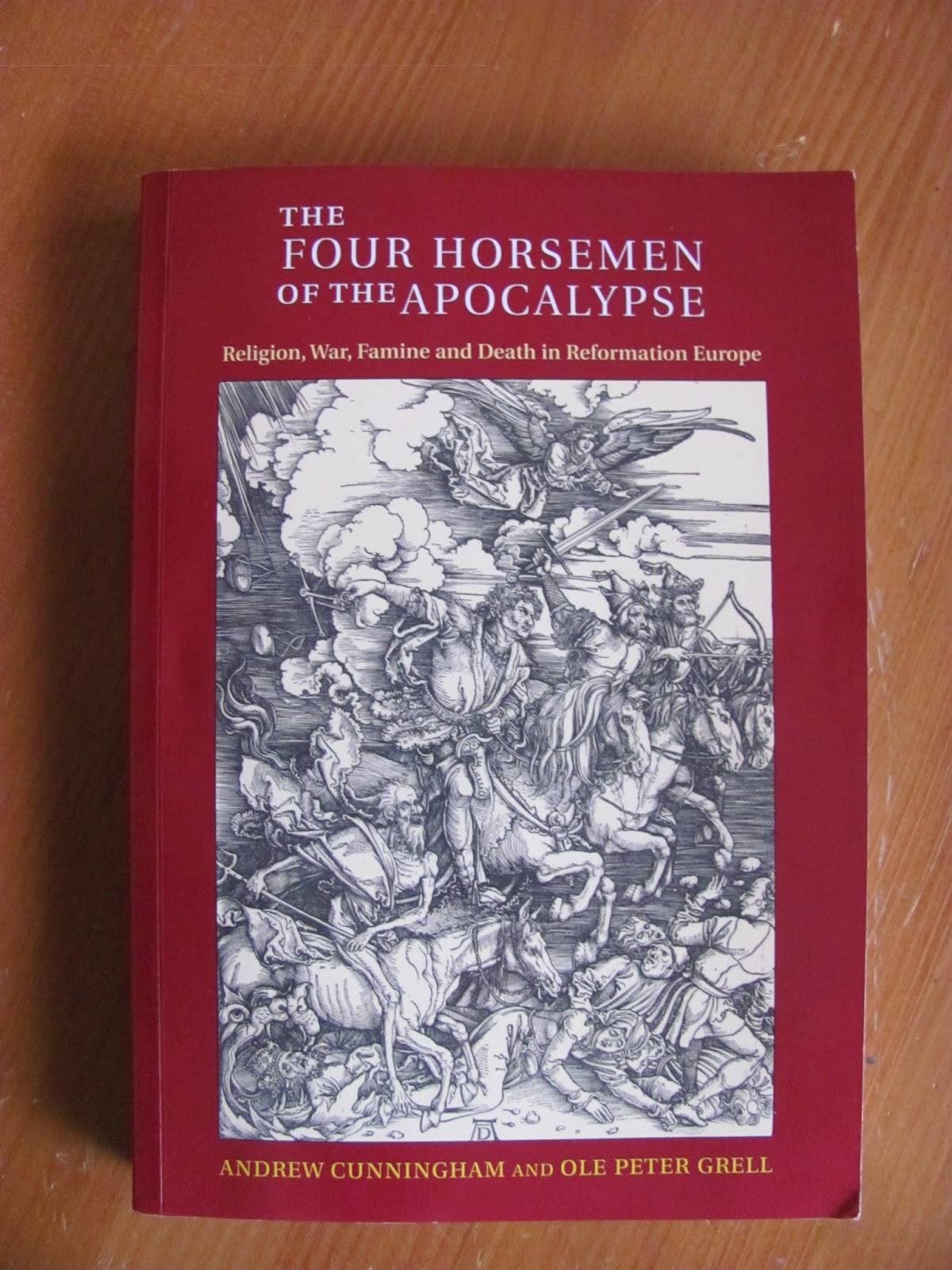
An Apocalyptic Century

Cunningham, Andrew and Ole Peter Grell. The Four Horsemen of the Apocalypse: Religion, War, Famine and Death in Reformation Europe. Cambridge: Cambridge University Press, 2000.

Andrew Cunningham is one of the more distinguished and influential writers on medicine in early modern Europe. Ole Peter Grell, his frequent collaborator, is likewise an expert in the field of early modern studies who often focuses on religion.

As the two begin this book, they note that the historiography of early modern Europe has usually followed a compartmentalized approach: scholars take up Reformation history, medical, agricultural, or social history, and so on. As valuable as those contributions are, such narrow slices tend to leave behind a certain something that can be provided only by a synthesis. That observation identifies the central goal of this book.

The decision to take on such a huge task naturally raises two basic concerns: method and sources. The authors explain that their approach includes a couple of basic moves. First, they read the story looking forward from primary sources. Second, they read the same story, this time looking backward; that is, from the vantage point of "modern specialized historiography.” The goal of such an exacting method is to understand “why an apocalyptic interpretation of events and crises in early modern life made sense to a Christian society under stress” (2). In addition, the authors suggest that historians of the period have overlooked the significance of contemporary art. So, they bring that feature of the history to the fore with over 70 illustrations in this book.

Chapter 1 is an introduction titled “An Apocalyptic Age.” Cunningham and Grell identify the period under study—1490 to 1648—and name ten episodes or developments that mark off the era as a time of “deep religious, social, political, economic” and, above all, “demographic” crisis (1). They assert that sometime after the fall of Constantinople in 1453 to the end of the Thirty Years’ War in 1648, Europe was engulfed in “apocalypticism.” This outlook expects the divinely-appointed and imminent end of the world, followed immediately by God’s judgment of all people. A favorite text of the time, “the apocalyptic period par excellence” (11), was the Book of Revelation, appropriately placed at the end of the New Testament. More specifically, Europeans drew a correspondence between their experiences and Revelation 6:1-8. The passage identifies four horses whose riders bring cataclysm to the world. Perhaps better than all the preachers combined, the artist Albrecht Dürer communicated the message with his impressive woodcut of 1498 titled, Four Horseman of the Apocalypse, which appears on the book’s front cover.

Chapter 2, “The White Horse: Religion, Revelation, and Reformation,” begins by noting that by the 1510s, more and more people associated the conqueror on the white horse with Christ himself (19). From there, the authors take up, in turn, a variety of related topics: the eschatological character of Lutheranism, the development of radical, sometimes violent, responses to growing expectations, apocalyptic elements of Calvinism, excitement over what  were thought to be astronomical portents, and assumptions about cosmic decay and the prevalence of demons and witchcraft during the Last Days.

In Chapter 3, “The Red Horse: War, Weapons and Wounds,” the authors argue that the economic growth of the period accelerated the breakdown of age-old political and social structures. Resulting skirmishes and wars, all of which were thought to have some sort of religious meaning, lead to a social preoccupation with death. Early modern Europe also witnessed the development of new, more powerful weapons and more-effective techniques in battle. Naturally, greater numbers of casualties generated a whole new era of medical treatment. For example, new procedures for amputations were developed, and artificial limbs became more common and sophisticated. Christian humanists and a few notable Puritans raised their voices against the growth of war. But they were drowned out by the large majority who believed that war could serve to advance Christ’s kingdom and hasten a welcome end to the present age.

Chapter 4, “The Black Horse: Food, F(e)ast and Famine,” begins by observing that 1498 to 1648 was a time of advanced food production in Europe. But, it was also a time of tremendous population growth. Consequently, most everyone experienced dearth, and sometimes even famine. As the reader has come to expect, all such episodes were interpreted as direct acts of God. (Regarding food shortages, the authors explicitly adopt the position of Ronald E. Seavoy, Famine in Peasant Societies, 1986. Seavoy argued that a sustained growth in population that avoids famine must be accompanied by farming that is industrial as opposed to subsistence). Although Europeans ate all sorts of food, with regional variety, the staple was some sort of grain that could be made into bread. Food might be in short supply for two reasons: man-made and natural. In the case of the former, some memorable famines resulted from the siege of a city, combining the Red and Black Horses as it were.

Appropriately, Chapter 5, the last major section of the book, focuses on “The Pale Horse: Disease, Disaster and Death.” The chapter begins with a disturbing section on “Sexual Disease.” Untold thousands of people suffered terribly in an age when syphilis was not understood and had no known cure. Many hospitals of the time were built primarily for the purpose of seeing to the needs of its victims. There were, in addition, epidemics that resulted from siege and from outbreaks of plague. The prevalence of sudden death presented early modern culture with a paradox: death was the result of divine disfavor, but hope sprang from a belief in divine grace. 

In a brief “Epilogue” Cunningham and Grell conclude: “We have argued that these [four horses and horsemen] were images which contemporaries used, not only to understand, but also to decode and give meaning to the troubles and disasters which they found themselves exposed to in the increasingly unstable and changing world of the sixteenth and early seventeenth centuries” (319). Following the end of the Thirty Years War, a post- apocalyptic era emerged on the continent of Europe. And why did things unfold in that way and at that time? First, there actually were more wars, outbreaks of epidemic disease, and famine between 1498 and 1648. Second, these were due to population growth, which was the result of “global warming” during that century and a half. It seems probable, say the authors, that these were directly related. In spite of all the death and destruction of the period, the population managed to double during the time in question. Third and finally, sometime during the early 1600s, Europe began to cool again, and population leveled off. Once population growth subsided in the early seventeenth century, the apocalypse "receded into the future" (323).

This is a splendid book, a tremendous academic achievement from which I have learned much. Though nothing like an expert in this period, I cannot help but wonder if the authors have placed too much weight on their main idea. It might be true that, historically, warming trends lead to greater food production, which leads to sustained population growth, which generates all sorts of economic, political and social problems, which produce apocalypticism in a Christianized society. But I cannot be the only reader who has thought that that explanation is a bit too neat and tidy. Not unrelated, it seems to me that the authors underestimate the extent to which apocalyptic language and themes can reverberate in a Christianized society (like post-World War II America) that is prosperous and technologically advanced, quite different from early modern Europe.