Showing posts with label singing. Show all posts

Tuesday, June 17, 2014

Report on Forrest M. McCann, "Changes in Worship Music in Churches of Christ"

McCann, Forrest M. "'Time is Filled with Swift Transition': Changes in Worship Music in Churches of Christ." Restoration Quarterly 39 (Fourth Quarter 1997): 195-202.

This article was originally a speech, delivered at Abilene Christian University in 1997. Forrest McCann, a musician and historian, identifies and describes distinct episodes in the musical history of the Churches of Christ. According to him, they are as follows:

The Nineteen Century: The Campbell Tradition

No surprise, Alexander Campbell was the most significant influence on the worship music of the Disciples movement during the nineteenth century. Campbell had been raised a Presbyterian. Consequently, he favored the "metrical versions of the Psalms" well-known among the Presbyterians. His original hymnal of 1828 was republished a number of times. And, it served as the basis for hymnals produced by the American Christian Missionary Society between 1865 and 1882.

First Major Transition: Competition

In 1882, James Henry Fillmore published a song book that was much the same as the one produced by the ACMS. But, Fillmore's book was cheaper! Consequently, Campbell's dream of the the united Disciples having just one hymnal was crushed. Too, a new era of song-book competition began. Standard Publishing produced a hymnal in 1888, and in 1889, the Gospel Advocate came out with a hymnal whose lyrics were overseen and edited by E. G. Sewell. Interestingly, there was evidently no one among the Churches of Christ at the time who was qualified to oversee the music for the Gospel Advocate hymnal. So, a Methodist musician, Rigdon M. McIntosh who was on the faculty at Vanderbilt, did the job.

Second Major Transition: Advocate Books

Following the official separation between the Christian Churches and the non-instrument, non-society Churches of Christ in 1906, hymnals produced by the Gospel Advocate always had a non-instrument, Churches of Christ text editor. But, again, there was apparently no one in the group who was qualified to oversee the musical part of the hymnal. Consequently, an "instrumental" brother or someone like the Methodist Rigdon McIntosh edited the tunes. "The sad fact is that since the 1906 separation, Churches of Christ have never been a part of the mainstream of church song in America" (196).

Third Major Transition: Competition Again

Just as there was competition among Disciples hymnals in the 1880s, the emerging Churches of Christ witnessed similar competition. There were the Gospel Advocate hymnals, which competed with hymnals produced by the Firm Foundation, plus a large number of hymnals produced by independent editors. None of these hymnals featured songs whose words and music were consistently good.

Among the many hymnals published in the early 20th century, The Wonderful Story in Song (1917), by F. L. Rowe, was more substantial than most, and had some staying power (197). Some of the song books produced by the Churches of Christ in the first half of the twentieth century were of very low quality.

West of the Mississippi, Churches of Christ typically used the hymnals produced by the Firm Foundation headquartered in Texas. Hymnals were edited by G.H.P. Showalter, editor of the Firm Foundation magazine. The content of these hymnals was heavily influenced by F. L. Eiland, "the most prominent singing-school teacher among the Churches of Christ in Texas" and his proteges (197). Eiland's own Trio Music Company and subsequent Quartet Music Company produced several small, paperback hymnals, none of which lasted very long. These were filled with the words and music of Eiland and his students, songs which no one had ever sung before (and hardly since). Especially in the west, Churches of Christ were going their own way musically. This was a regional, mediocre tradition which produced very few songs which have lasted. Eiland's best-known book was The Gospel Gleaner (1901).

(FVB's guess is that the two best-known songs from this time and place are F. L. Eiland, "Time is Filled with Swift Transition," and a song by one of Eiland's students, Will Slater, "Walking Alone at Eve").

Fourth Major Transition: Great Songs

In May 1921, E. L. Jorgenson, a trained musician, completed Great Songs of the Church. Commendations poured in and were published in Word and Work, which had produced the new hymnal. Among Churches of Christ hymnals, the quality was unprecedented. And, this hymnal "reconnected the Churches of Christ with the great historic tradition of hymns and spiritual songs" (198). The book was a combination of Christian history and more-recent music produced by the Restoration Movement. Here was the best music from Christendom and from Restorationism. The musical isolationism of the Churches of Christ was coming to an end.

In producing Great Songs of the Church, Jorgenson was heavily influenced by the lesser-known W. E. M. Hackleman. For example, like Hackleman (and Fillmore), Jorgenson divided his collection into "Hymns" and "Gospel Songs."

Fifth Major Transition: The Dominance of Great Songs

The Gospel Advocate was silent about Great Songs, which was published by Word and Work, associated with R. H. Boll and premillennialism. Nonetheless, Great Songs became the standard everywhere, apparently because of its quality and despite its connections to "Bollism." By 1958, Jorgenson could say, "Nearly three million souls, in some 10,000 churches, now sing the Saviour's praises from its pages" (200). In the 50s, Jorgeson sold his standard-note edition of the hymnal to the Christian Standard, and the shaped-noted edition to Abilene Christian University. "The result of these transactions was that for the next decade and a half the heirs of the Stone-Campbell Movement again approached Alexander Campbell's dream of one hymnal for the churches" (200).

Sixth Major Transition: Imitation

Beginning in the mid-50s, producers of song books began simply copying songs straight from Great Songs of the Church. Sometimes the new books were 50 percent reproductions of songs from Jorgenson's work. They did so with impunity and apparently came to imagine that what they were doing was right. "His work, which has greatly elevated and standardized our hymnody, is now in its death throes because of inveterate copying. Perhaps my speech today is its requiem" (201). (Seems like this section should be called "Duplication" not "Imitation").

Seventh Major Transition: Current Events

McCann clearly saw the 1990s as an era of decline. A summary of his observations:

1. Only seventeen years later, it is astonishing to read McCann's assumption that part of the answer is to keep the best hymnals in print. (How many Christians sing from a printed hymnal anymore? They sing words projected onto a screen. In many cases, there is no musical notation).

2. Publishers of song books operate on the premise that more songs makes for a better book. McCann notes that by that time, there was a hymnal with over 1000 selections.

3. The advent of "so-called praise songs."

4. A trend toward performance music, music written for choirs and other trained musicians, not for "the average worshiper" (201).

In his conclusion, MaCann hints that the introduction of more-complicated music makes the adoption of instrumental music more likely. He quotes approvingly from a 1861 article by Isaac Errett in the Millennial Harbinger, which discusses the importance of music and singing.

See also, Forrest M. McCann, "Changing Our Tune: The History of Hymnals," Gospel Advocate 140 (December 1998), 12-16.

Tuesday, July 07, 2009

Wondering about Worship

The article on John Calvin came out in Sunday's paper. Before sending it to the editor, I made a few changes and added the paragraph about executing heretics. You can see the published version here.

- - - - -

Two random thoughts about worship assemblies:

1. I think it would be better if prayer leaders finally stopped thanking the Lord that we can worship without the fear of molestation. To people under 50 years old that doesn't sound quite right. The word molest has changed in meaning since that worn-out phrase was invented. The older meaning of the word is not what teenagers think when they hear it.

2. I understand that in the Middle Ages the image of the church (or the individual Christian) being nursed by Christ was a common spiritual theme. It didn't seem weird to people who've gone before us. I suspect it was a healthy thing for them to use a feminine metaphor to speak of what the Lord means to us. When we do that, we remind ourselves that the Almighty is sexless, that God is not some cosmic male. However, as a song leader, I exclude all songs that have us singing about the breast of Jesus. If it's just one verse, I might lead the song, but will skip that verse.

What other things do we do or say in our assemblies that simply mis-communicate?

Monday, December 08, 2008

A Few Notes on Music in Churches of Christ

I've been thinking lately about the quality of singing in Churches of Christ. I don't have anything like statistical proof or scientific research to back up any of this. What I do have are my observations. What they tell me is that there are several things that sometimes work against vibrant musical worship in today's congregations. Here's a short list:

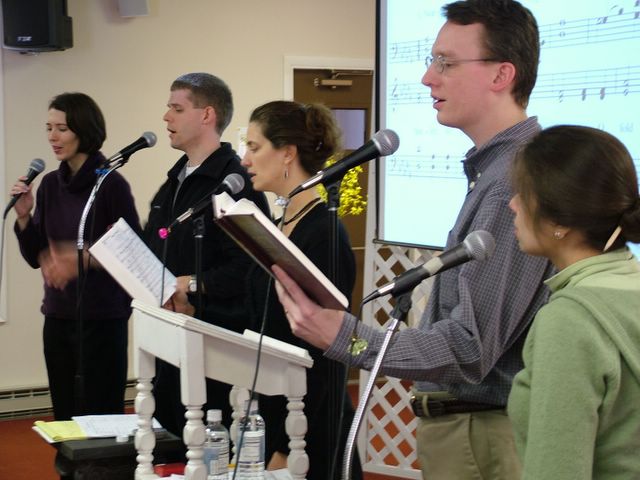
1. Poor Acoustics

Something I see (and hear) over and over again are newer, plush church facilities designed to be cost-effective and comfortable, but not to be "sung in." Carpeted floors, padded seats, noisy heating/air-conditioning units, and porous ceiling tiles conspire to create a worship space that sucks up sound. Some church leaders, aware of these kinds of problems with their buildings, have made changes to worship areas so that the setting will be more conducive to genuine worship. Good for them.

2. Praise Teams

I have no theological or aesthetic objection to praise teams. But I do think that they can be a barrier to the participation of the whole assembly. In some of my experience, it seemed to me that the praise team was a little too loud. The distinctive, amplified voice of the team was saying, "Listen to the performance" rather than "Sing along with us." Sometimes this feel is compounded by the on-stage music minister/worship leader who doesn't acknowledge the assembly, encouraging them to sing, but who constantly looks to and directs only the team. These sights and sounds combine to communicate: "We're going to sing for you. Just sit and listen." When it comes to good congregational song, I think that praise teams can be most effective when their amplification is subtle, their presence is inconspicuous, and when the worship leader looks to and leads the entire congregation.

3. Performance Music

That Christian recording artists sound great singing their songs on the radio is no reason to try to get a congregation to sing the same songs. Sometimes the differences make a huge difference. For example, sometimes music performed by Christian entertainers requires a vocal range that most people just don't have. Sometimes a song is just too complex for a group of non-specialists. Too, sometimes the rhythm and feel of performance music is generated by instruments, a major problem in most Churches of Christ. I realize that many of the traditional songs sung in congregations include moving parts, alto leads, etc. But those songs were introduced and learned at a time when a good number of Christians attended annual singing schools and when the musical training of a congregation was much more of a priority than it is today.

4. Unfamiliar Songs

Every well-known song was once brand new. Some of today's newer songs can be worthy additions to the church's repertoire. But new songs should not be sprung on the church in the context of Sunday-morning worship. Small groups, Bible classes, and Sunday-evening worship times can be the setting in which new songs can occasionally be tried out and learned.

5. Lowered Expectations

It seems like singing in worship is no longer understood to be a religious responsibility. Does anyone under twenty years old sing in worship anymore? In some churches, it seems like the musical part of worship is a time to look around, talk to the person next to you, watch the music minister and praise team, etc., but not sing. Not so long ago, there was a time in Churches of Christ when not singing was about as unacceptable as "forsaking the assembly" (that is, not going to church). After all, the same New Testament that said "not forsaking the assembling our ourselves together . . ." also said "speaking to yourselves in songs, hymns, and spiritual songs." Case closed. Singing was considered an act of worship that God required. So you either had strep throat, bronchitis, or laryngitis plus a doctor's note, or you sang. Looking back on that time in my life, I happily realize that sometimes the theology of our mostly-borrowed songs was actually more-balanced than the theology of our pulpits. Consequently, we sometimes sang our way into a truer way of seeing. But what if we hadn't sung?

These are some of my observations. What do you think?

Tuesday, June 10, 2008

Two Weekends in New England

My week and a day in Connecticut went by so fast.

Yesterday was my twelve-hour travel day back to Amarillo. That's not the funnest experience (and, yes, funnest is a word), but it was sweet to see Michele when I got off that last plane.

Quick question: Does Chicago's Midway Airport just have short runways, or what? Landing there always feels like we're coming down on an aircraft carrier.

Anyway, here are just a few of the highlights from my trip, in random order and varying levels of importance:

1. As things turned out, I didn't take the course on "Judaism in the Time of Jesus." Sorry, nothing to report about that. However, if you go to the link for that course, you'll see another link that will take you to the syllabus, which is worth a look for those interested.

I hadn't realized until Monday morning that "Judaism . . ." was being offered as an afternoon class. I would have loved that one. But what I really needed was a morning class. I finally wound up going to a great alternative for me, a class called Reel Presence: Explorations in Liturgy and Film, taught by Dr. Teresa Berger.

Wow, what an interesting teacher. She's a German, Roman Catholic scholar, with two earned doctorates, who specializes in liturgical (worship) studies. As you might have guessed, everyone else in the class came from either Catholic or mainline Protestant backgrounds (Lutheran, Episcopalian, etc.). That's something I can count on at the Divinity School: always meeting up with people who come from places that are quite different from the places I know. That can be an education all by itself.

So, as it turned out, the movie buff in me got to learn a little more about reflecting theologically on the films we tend to watch as mere entertainment. Maybe I'll talk about that sometime. By the way, although most of what we actually watched in class were movie clips, one film we watched all the way through is called Whale Rider. Anyone else seen it? That could be a provocative one for churches, to say the least.

2. While in Connecticut, my kids and I got to visit some of our favorite places to eat, including this gourmet vegetarian place in downtown New Haven called Claire's Corner Copia. We followed that up with ice cream dessert at Ashley's. Woobie Doobie.

3. Over the weekend, Friday and Saturday, my boy and I got to attend the Northeastern States Men's Retreat, held annually at the Kent School up in the northwestern corner of Connecticut.

This year's speaker was J. J. Turner, a long-time leader among Churches of Christ and, yes, John Alan's dad. J. J. spoke about "activating Acts in the 21st century." In addition to presenting so many great reminders, he put his quick sense of humor to good use. It was good for me to hear those lessons, to sing with 250 other Christian men, to introduce my son to that experience, to see again so many church leaders from the Northeast.

Oh, and speaking of bloggers, late Saturday morning, as I worked my way through most of the items at the Kent Public Library book sale, I just happened to meet The Blog Prophet himself, Brian Nicklaus. Very cool.

4. Finally, last Sunday I had the exquisite pleasure of baptizing my son, Benjamin, into Christ. This was something he'd had on his mind for a long time, something we had talked about and prayed about and planned. How sweet. Photos to follow (when I can figure out how to copy them).

Monday, September 24, 2007

The Beauty and Power of Congregational Song

I want to tell you about Darryl Tippens' booklet "That's Why We Sing," subtitled, "Reclaiming the Wonder of Congregational Singing" (Abilene, TX: Leafwood, 2007).

There aren't many items I might put on a list of required reading for elders, preachers, and worship leaders among the Churches of Christ. But this is one of them. Tippens starts out with these words:

"When I think of my most memorable moments in church, the times I have felt closest to God, almost always they involve hymns. When I was a small boy, I recall my mother going forward to receive Christ in baptism, as we sang:

Trust and obey,
For there's no other way
To be happy in Jesus
But to trust and obey.

Whether it was through exuberant gospel songs in Sunday worship, devotional songs around a campfire, or Christmas carols sung heartily with family and friends--the joy of divine love and the wonder of forgiveness reached my head and my heart largely through music." (p. 5)

Following a short, rousing introduction, Tippens talks about his purposes:

"In the pages that follow, I wish to do two things: first, to recall some of the main reasons why singing is central in the life of the church; and, second, to offer some suggestions for its preservation and renewal." (p. 8) He accomplishes those goals so very well, it's hard to imagine how it might be done better. A few more quotes.

On the capacity of singing to connect us to God:

In the free church tradition, of which Churches of Christ are a part, a suspicion of sacrament and mystery is common. We have tended to emphasize knowing the right things (doctrine) and doing the right things (ethics and conduct). As one wit has put it, we're good at doing worship 'from the neck up.' Thinking, doctrine, and ethics are very important, of course; but we must admit the obvious; they alone are not sufficient to sustain our faith. One can know the right things, but falter. Our hearts cry out for more, a divine encounter. We want to enter Bethel (the house of God) and shout, 'Surely the Lord is in this place!' (Genesis 28:16). We don't just want memories of a God who once touched his creation; we want communion with him today. (p. 9)

On the power of singing to teach:

Hymns . . . rehearse the stories of Scripture. In word and melody we experience Gethsemane, the cross, and the resurrection. We remember our sinfulness, our need for redemption, our duty to our neighbor, and the promise of eternal life. In a time when people have a diminished capacity to absorb long sermons, hymns stand ready to offer important inspirational and didactic service to the church, as they have done for millennia. (p. 15)

On accentuating the positive:

Many of us reared in Churches of Christ have heard a number of arguments for a cappella singing that seem to carry far less weight than they once did. It is perhaps time to consider other ways of approaching the subject. Many of the old arguments were negative in nature--why instrumental accompaniment is wrong. I suggest that we would receive a better reception if we offered positive arguments for unaccompanied singing. (p. 19)

On congregations learning new songs:

Unfortunately, some song leaders alienate segments of the congregation because they fail to consider that many do not know the new songs. Many older members appreciate the new hymns, but they sometimes feel left out since no one took time to teach the new songs before making them a part of the worship service. (Compounding the problem, often there is no musical notation to give struggling worshippers any help.) The resulting alienation is unnecessary. In singing there is an intimate intertwining of the minds, hearts, and spirits of the worshipers. Singing is not only for God, it is for one another; but when a segment of the worshipers cannot participate because of basic unfamiliarity, the possibility of joyous transcendence is blocked. Worship would greatly benefit from a simple commitment to introduce new songs as a part of the church's teaching program (p. 24).

Preachers and teachers, before your next sermon or lesson called "Sing His Praise!" or "Our Worship in Song" etc., you'll want to read this fine little work. With stories and quotations from Augustine and Karl Barth all the way to Kathleen Norris and Anne Lamont, "That's Why We Sing" will both inspire and inform you. Above all, Churches of Christ should take to heart and put into practice its message.

Monday, May 14, 2007

Monday Medley

Our Weekend:
We have a little amusement park here in Amarillo: "Wonderland!" We'd never been there before, but Aubrey's school band was going last Saturday. Michele and I wound up going as non-paying chaperones. In spite of our free admission and the chaperone title, we had basically no responsibilities. Woohoo!

By late afternoon, the three of us were on our way to Altus, Oklahoma. We spent the night with my folks and went to worship with them Sunday morning. My years in Connecticut didn't afford many opportunities for me to be with my mother on Mothers' Day. I was so glad I got to be with her yesterday.

The Demise of Dogma?
"The only church of Christ is the Catholic Church governed by the successor of Peter" --Pope Benedict, speaking last week to the bishops of Brazil, as quoted on last Saturday's broadcast of "NPR Religion."

The Bible and Tattoos
The same chapter of the Bible that says, "You shall love your neighbor as yourself" (Leviticus 19:18) also says, "You shall not tattoo yourselves" (v. 28).

No believer that I know of has argued against the positive statement found in verse 18, especially since Jesus repeated it and said it was super important. On the other hand, any number of believers have violated the letter of the prohibition found in verse 28. Have they violated the will of God?

Old Testament specialists tells us that tattooing (or painting) the body in the ancient world was an explicitly pagan thing. It may have been done to ward off evil spirits, or to identify a person as belonging to a certain pagan group. Either way, the very appearance of a tattoo would have meant a rununciation of what the Bible affirms: that there is only one true God and those who are faithful to him will not be harmed but will, instead, be secure. These days, tattoos don't necessarily mean the same thing. So, while I'm not a fan of tattoos, neither do I believe that they are against the will of God.

The Authority of the Old Testament
The question of how Christians might apply the teaching of, say, Leviticus 19 was part of what we talked about in the last class session of the Old Testament course. I gave the students a copy of the question as it's worded in a classic book by John Bright:

" [People who affirm] that the Old Testament is in each of its texts inspired of God and affords in all its parts a revelation of his character, purpose and will . . . must still face the question: How are these ancient laws, institutions, and concepts, these ancient narratives, sayings and expressions . . . to be taken as authoritative over the faith and life of the believer, and how proclaimed as such?"

How can, how should, the Old Testament function as a word from God within the church? What principles of interpretation, for example, serve to open up that part of the Bible as a word on target for Christians?

The Church Sings!
"The Christian church sings. It is not a choral society. Its singing is not a concert. But from inner, material necessity it sings. Singing is the highest form of human expression....What we can and must say quite confidently is that the church which does not sing is not the church. And where...it does not really sing but sighs and mumbles spasmodically, shamefacedly and with an ill grace, it can be at best only a troubled community which is not sure of its cause and of whose ministry and witness there can be no great expectation....The praise of God which finds its concrete culmination in the singing of the community is one of the indispensable forms of the ministry of the church." -- Karl Barth, in Church Dogmatics, Vol. IV, part 3, chapter 16, par. 72, #4.

Friday, December 23, 2005

Scriptures and Songs for Christmas

For nearly eleven years, I served as the preacher for the Ward Street Church in Wallingford, Connecticut. That meant I got to plan and preside at a remembrance and celebration of the coming of Christ.

A blessed time, it was always on the Sunday evening just before (or of) the 25th. We'd listen to words familiar but ever-new. And then, beneath that metal ceiling, surrounded by those plaster walls, and warmed by old steam radiators and the eternal love of God, we'd sing with gusto, and sometimes softness, those songs that practically sing themselves.

The following order of worship was typical. I post it as a fond remembrance of those gatherings, and as a starting place for someone who might be planning a similar time of praise:
__________________________

Call to Worship, Time of Prayer

Matthew 1:18-2:12

"O Come, All Ye Faithful"

"O Little Town of Bethlehem"

Luke 2:1-7

"Away in a Manger"

Luke 2:8-20

"It Came Upon a Midnight Clear"

"Silent Night"

"Hark! the Hearld Angels Sing"

Philippians 2:5-11

"Fairest Lord Jesus"

"My Jesus, I Love Thee"

Concluding Words of Encouragement

"To God be the Glory"

Wednesday, October 26, 2005

Shoes and the Psalms

It's been a while since my last post. That's mainly because I've been doing a lot of non-blog writing of late. I know, some of you were thinking the delay was all about the Redbirds losing out to the Astros. Actually, following a good cry, I had intended to say my congratulations to Houston and that I was pulling for the National League Champions. But before I could get the words out, the Astros promptly lost the first three games of the World Series! Baseball: the perfect blend of sport and the Book of Ecclesiastes. "Time and chance happen to them all."

- - - - - - - -

When I was in my late teens and early twenties--say, 1978 to 1984--if contemporary music was like plankton, then I was like a very large aquatic animal. It was during those years that I happened upon a group that in my book qualifies to win the "Best Band that Never Hit it Big" Award. In fact, I just invented that award and proudly present it to, . . . drum roll, please . . . Shoes.

That's right, Shoes. Four guys from Zion, Illinois. You've probably never heard them, or of them. But they were good.

Their "Boomerang" album, released by Elektra Records in 1982, wasn't their first. But it was my introduction to the band, and I've loved that collection ever since. With some tunes, like one called "Mayday," the sound is a nice blend of classic rock and then-popular New Wave (think, The Cars). Other songs, like "The Summer Rain" I would describe as melodic with a moderate beat (think, Bryan Adams).

I don't understand the popular music industry, then or now, so I'm not sure why Shoes didn't make it big (assuming they really wanted to). But I can guess. Very few of their songs have that sure-hit sound, although several of them could with just a little tweaking. The music is plenty good, but the recordings come across as spare and understated, begging to be a little fuller and brassier. But then, why critique a group that just received an award?

So tell me, who would you nominate for "Best Band that Never Hit it Big"? Who's your favorite no-name act? Oh, and you can listen to Shoes here.

- - - - - - -

For me, life doesn't get any better than reading from the Psalms and singing traditional hymns that repeat their words and reflect their meaning. In our worship time last Sunday night, we read and sang the following:

Psalm 100

"All People That on Earth Do Dwell"

Psalm 148

"Hallelujah, Praise Jehovah"

Psalm 23

"The Lord's My Shepherd"

Psalm 133

"How Sweet, How Heavenly" (We held hands while singing this one)

I'd be interested to hear about the churchly experiences of others, especially well-planned times of worship and praise.

Wednesday, March 16, 2005

A Day of Song


(Left to Right) Amy and Wes Wilson, Michelle Coletta, and Rich and Cindy Davies helped and encouraged us to make music in our hearts to the Lord.

Last weekend, Michele and I drove to Clifton Park, New York (just north of Albany) to attend the "Singing Workshop" hosted by the Clifton Park and Malta Churches of Christ.

The Saturday sessions included a review of "Oldies but Goodies" and featured introductions to some of the newer worship and praise songs. In the afternoon, participants got to choose among several different classes on things like "Worship Planning" and "Song Conducting."

We were blessed to make new acquaintances, and to learn some songs we didn't know before. It was good to be with brothers and sisters for whom worship to God in song is a priority and a joy.

Special thanks to the workshop leaders and to those who helped in the planning and organization.
Posted by Hello