Showing posts with label music. Show all posts

Tuesday, June 17, 2014

Report on Forrest M. McCann, "Changes in Worship Music in Churches of Christ"

McCann, Forrest M. "'Time is Filled with Swift Transition': Changes in Worship Music in Churches of Christ." Restoration Quarterly 39 (Fourth Quarter 1997): 195-202.

This article was originally a speech, delivered at Abilene Christian University in 1997. Forrest McCann, a musician and historian, identifies and describes distinct episodes in the musical history of the Churches of Christ. According to him, they are as follows:

The Nineteen Century: The Campbell Tradition

No surprise, Alexander Campbell was the most significant influence on the worship music of the Disciples movement during the nineteenth century. Campbell had been raised a Presbyterian. Consequently, he favored the "metrical versions of the Psalms" well-known among the Presbyterians. His original hymnal of 1828 was republished a number of times. And, it served as the basis for hymnals produced by the American Christian Missionary Society between 1865 and 1882.

First Major Transition: Competition

In 1882, James Henry Fillmore published a song book that was much the same as the one produced by the ACMS. But, Fillmore's book was cheaper! Consequently, Campbell's dream of the the united Disciples having just one hymnal was crushed. Too, a new era of song-book competition began. Standard Publishing produced a hymnal in 1888, and in 1889, the Gospel Advocate came out with a hymnal whose lyrics were overseen and edited by E. G. Sewell. Interestingly, there was evidently no one among the Churches of Christ at the time who was qualified to oversee the music for the Gospel Advocate hymnal. So, a Methodist musician, Rigdon M. McIntosh who was on the faculty at Vanderbilt, did the job.

Second Major Transition: Advocate Books

Following the official separation between the Christian Churches and the non-instrument, non-society Churches of Christ in 1906, hymnals produced by the Gospel Advocate always had a non-instrument, Churches of Christ text editor. But, again, there was apparently no one in the group who was qualified to oversee the musical part of the hymnal. Consequently, an "instrumental" brother or someone like the Methodist Rigdon McIntosh edited the tunes. "The sad fact is that since the 1906 separation, Churches of Christ have never been a part of the mainstream of church song in America" (196).

Third Major Transition: Competition Again

Just as there was competition among Disciples hymnals in the 1880s, the emerging Churches of Christ witnessed similar competition. There were the Gospel Advocate hymnals, which competed with hymnals produced by the Firm Foundation, plus a large number of hymnals produced by independent editors. None of these hymnals featured songs whose words and music were consistently good.

Among the many hymnals published in the early 20th century, The Wonderful Story in Song (1917), by F. L. Rowe, was more substantial than most, and had some staying power (197). Some of the song books produced by the Churches of Christ in the first half of the twentieth century were of very low quality.

West of the Mississippi, Churches of Christ typically used the hymnals produced by the Firm Foundation headquartered in Texas. Hymnals were edited by G.H.P. Showalter, editor of the Firm Foundation magazine. The content of these hymnals was heavily influenced by F. L. Eiland, "the most prominent singing-school teacher among the Churches of Christ in Texas" and his proteges (197). Eiland's own Trio Music Company and subsequent Quartet Music Company produced several small, paperback hymnals, none of which lasted very long. These were filled with the words and music of Eiland and his students, songs which no one had ever sung before (and hardly since). Especially in the west, Churches of Christ were going their own way musically. This was a regional, mediocre tradition which produced very few songs which have lasted. Eiland's best-known book was The Gospel Gleaner (1901).

(FVB's guess is that the two best-known songs from this time and place are F. L. Eiland, "Time is Filled with Swift Transition," and a song by one of Eiland's students, Will Slater, "Walking Alone at Eve").

Fourth Major Transition: Great Songs

In May 1921, E. L. Jorgenson, a trained musician, completed Great Songs of the Church. Commendations poured in and were published in Word and Work, which had produced the new hymnal. Among Churches of Christ hymnals, the quality was unprecedented. And, this hymnal "reconnected the Churches of Christ with the great historic tradition of hymns and spiritual songs" (198). The book was a combination of Christian history and more-recent music produced by the Restoration Movement. Here was the best music from Christendom and from Restorationism. The musical isolationism of the Churches of Christ was coming to an end.

In producing Great Songs of the Church, Jorgenson was heavily influenced by the lesser-known W. E. M. Hackleman. For example, like Hackleman (and Fillmore), Jorgenson divided his collection into "Hymns" and "Gospel Songs."

Fifth Major Transition: The Dominance of Great Songs

The Gospel Advocate was silent about Great Songs, which was published by Word and Work, associated with R. H. Boll and premillennialism. Nonetheless, Great Songs became the standard everywhere, apparently because of its quality and despite its connections to "Bollism." By 1958, Jorgenson could say, "Nearly three million souls, in some 10,000 churches, now sing the Saviour's praises from its pages" (200). In the 50s, Jorgeson sold his standard-note edition of the hymnal to the Christian Standard, and the shaped-noted edition to Abilene Christian University. "The result of these transactions was that for the next decade and a half the heirs of the Stone-Campbell Movement again approached Alexander Campbell's dream of one hymnal for the churches" (200).

Sixth Major Transition: Imitation

Beginning in the mid-50s, producers of song books began simply copying songs straight from Great Songs of the Church. Sometimes the new books were 50 percent reproductions of songs from Jorgenson's work. They did so with impunity and apparently came to imagine that what they were doing was right. "His work, which has greatly elevated and standardized our hymnody, is now in its death throes because of inveterate copying. Perhaps my speech today is its requiem" (201). (Seems like this section should be called "Duplication" not "Imitation").

Seventh Major Transition: Current Events

McCann clearly saw the 1990s as an era of decline. A summary of his observations:

1. Only seventeen years later, it is astonishing to read McCann's assumption that part of the answer is to keep the best hymnals in print. (How many Christians sing from a printed hymnal anymore? They sing words projected onto a screen. In many cases, there is no musical notation).

2. Publishers of song books operate on the premise that more songs makes for a better book. McCann notes that by that time, there was a hymnal with over 1000 selections.

3. The advent of "so-called praise songs."

4. A trend toward performance music, music written for choirs and other trained musicians, not for "the average worshiper" (201).

In his conclusion, MaCann hints that the introduction of more-complicated music makes the adoption of instrumental music more likely. He quotes approvingly from a 1861 article by Isaac Errett in the Millennial Harbinger, which discusses the importance of music and singing.

See also, Forrest M. McCann, "Changing Our Tune: The History of Hymnals," Gospel Advocate 140 (December 1998), 12-16.

Friday, October 18, 2013

The Wills Family Comes to Amarillo

We were encouraged and inspired this evening. The Wills Family visited the Church of Christ at the Colonies here in Amarillo. This family has been blessed with incredible talent. And they sing their hearts out, in that great tradition called Southern Gospel, so that God will be honored, and His people blessed. Special thanks to Darrell Bledsoe, music minister at the Colonies, for arranging this time of praise.

Friday, August 14, 2009

So Long to the Legendary Les Paul

Anyone who's ever picked up and played a solid-body electric guitar has had the great Les Paul to thank for having done so much to bring that wonder into the world.

But "Red-Hot Red," who died yesterday at the age of 94, was more than an inventor. At different stages in his life, he was a sound guru, a recording artist, and, above all, a performer. In fact, he was still playing two shows, one night a week, until earlier this year. Few people have lived such a full life.

Back in 2005, I traveled with my daughter Chloe and some other musicians from her high school to see him play at the Iridium Jazz Club in Manhattan. What a night! So glad we went.

Tuesday, June 02, 2009

Rock Around the Block

I did it again last night. Before I drove home, I circled around my neighborhood for a few minutes. Why? Because just before I made it home, I was flipping through the local radio stations and heard the very beginning of Sultans of Swing by Dire Straits.

Now, if you're one of those people who can turn off a car and just get out midway through a song like that, I will never be able to understand you. However, I will acknowledge that this sort of behavior demands a little explanation.

For example, why didn't I just go home and sit in the car while listening to the end of the song? How can one possibly justify the wasted gas, extra miles on the old car, etc.? At least three reasons come to mind:

1. If you come home to someone, and they realize you're there, they don't always appreciate what's happening at that point. This is especially true if they don't care that much for the song or the kind of music you happen to be listening to. "But, Honey, it was Sultans of Swing!" I don't even like to think about where that one would go.

2. What if you're, say, a Bible Chair director, . . . and you're sitting in the garage or driveway with the volume turned all the way up . . . and your neighbors happen to be outside? "Okay, lemme me get this straight. You're a holy man and a headbanger?" All such cognitive dissonance can be easily avoided by finishing the song before going home.

3. I believe that there's some sort of left-brain, right-brain link between our enjoyment of a song on the car radio and our experience of driving. Do you sense this too? I mean, isn't it a lot better when you're on the open road, with room to, . . . well, . . . accelerate, when that special song comes on? Compare that to being stuck in traffic and hearing the same song. It's just not the same. At that point, you need to drive. I know, National Public Radio has coined the expression "Driveway Moments." But they're talking about documentary-type radio, not Led Zeppelin.

Anyway, are you also one of those take-the-long-way-home people? Oh, and what are some of the songs that will delay you every single time?

Monday, December 08, 2008

A Few Notes on Music in Churches of Christ

I've been thinking lately about the quality of singing in Churches of Christ. I don't have anything like statistical proof or scientific research to back up any of this. What I do have are my observations. What they tell me is that there are several things that sometimes work against vibrant musical worship in today's congregations. Here's a short list:
1. Poor Acoustics

Something I see (and hear) over and over again are newer, plush church facilities designed to be cost-effective and comfortable, but not to be "sung in." Carpeted floors, padded seats, noisy heating/air-conditioning units, and porous ceiling tiles conspire to create a worship space that sucks up sound. Some church leaders, aware of these kinds of problems with their buildings, have made changes to worship areas so that the setting will be more conducive to genuine worship. Good for them.

2. Praise Teams

I have no theological or aesthetic objection to praise teams. But I do think that they can be a barrier to the participation of the whole assembly. In some of my experience, it seemed to me that the praise team was a little too loud. The distinctive, amplified voice of the team was saying, "Listen to the performance" rather than "Sing along with us." Sometimes this feel is compounded by the on-stage music minister/worship leader who doesn't acknowledge the assembly, encouraging them to sing, but who constantly looks to and directs only the team. These sights and sounds combine to communicate: "We're going to sing for you. Just sit and listen." When it comes to good congregational song, I think that praise teams can be most effective when their amplification is subtle, their presence is inconspicuous, and when the worship leader looks to and leads the entire congregation.

3. Performance Music

That Christian recording artists sound great singing their songs on the radio is no reason to try to get a congregation to sing the same songs. Sometimes the differences make a huge difference. For example, sometimes music performed by Christian entertainers requires a vocal range that most people just don't have. Sometimes a song is just too complex for a group of non-specialists. Too, sometimes the rhythm and feel of performance music is generated by instruments, a major problem in most Churches of Christ. I realize that many of the traditional songs sung in congregations include moving parts, alto leads, etc. But those songs were introduced and learned at a time when a good number of Christians attended annual singing schools and when the musical training of a congregation was much more of a priority than it is today.

4. Unfamiliar Songs

Every well-known song was once brand new. Some of today's newer songs can be worthy additions to the church's repertoire. But new songs should not be sprung on the church in the context of Sunday-morning worship. Small groups, Bible classes, and Sunday-evening worship times can be the setting in which new songs can occasionally be tried out and learned.

5. Lowered Expectations

It seems like singing in worship is no longer understood to be a religious responsibility. Does anyone under twenty years old sing in worship anymore? In some churches, it seems like the musical part of worship is a time to look around, talk to the person next to you, watch the music minister and praise team, etc., but not sing. Not so long ago, there was a time in Churches of Christ when not singing was about as unacceptable as "forsaking the assembly" (that is, not going to church). After all, the same New Testament that said "not forsaking the assembling our ourselves together . . ." also said "speaking to yourselves in songs, hymns, and spiritual songs." Case closed. Singing was considered an act of worship that God required. So you either had strep throat, bronchitis, or laryngitis plus a doctor's note, or you sang. Looking back on that time in my life, I happily realize that sometimes the theology of our mostly-borrowed songs was actually more-balanced than the theology of our pulpits. Consequently, we sometimes sang our way into a truer way of seeing. But what if we hadn't sung?

These are some of my observations. What do you think?

Monday, September 24, 2007

The Beauty and Power of Congregational Song

I want to tell you about Darryl Tippens' booklet "That's Why We Sing," subtitled, "Reclaiming the Wonder of Congregational Singing" (Abilene, TX: Leafwood, 2007).

There aren't many items I might put on a list of required reading for elders, preachers, and worship leaders among the Churches of Christ. But this is one of them. Tippens starts out with these words:

"When I think of my most memorable moments in church, the times I have felt closest to God, almost always they involve hymns. When I was a small boy, I recall my mother going forward to receive Christ in baptism, as we sang:

Trust and obey,
For there's no other way
To be happy in Jesus
But to trust and obey.

Whether it was through exuberant gospel songs in Sunday worship, devotional songs around a campfire, or Christmas carols sung heartily with family and friends--the joy of divine love and the wonder of forgiveness reached my head and my heart largely through music." (p. 5)

Following a short, rousing introduction, Tippens talks about his purposes:

"In the pages that follow, I wish to do two things: first, to recall some of the main reasons why singing is central in the life of the church; and, second, to offer some suggestions for its preservation and renewal." (p. 8) He accomplishes those goals so very well, it's hard to imagine how it might be done better. A few more quotes.

On the capacity of singing to connect us to God:

In the free church tradition, of which Churches of Christ are a part, a suspicion of sacrament and mystery is common. We have tended to emphasize knowing the right things (doctrine) and doing the right things (ethics and conduct). As one wit has put it, we're good at doing worship 'from the neck up.' Thinking, doctrine, and ethics are very important, of course; but we must admit the obvious; they alone are not sufficient to sustain our faith. One can know the right things, but falter. Our hearts cry out for more, a divine encounter. We want to enter Bethel (the house of God) and shout, 'Surely the Lord is in this place!' (Genesis 28:16). We don't just want memories of a God who once touched his creation; we want communion with him today. (p. 9)

On the power of singing to teach:

Hymns . . . rehearse the stories of Scripture. In word and melody we experience Gethsemane, the cross, and the resurrection. We remember our sinfulness, our need for redemption, our duty to our neighbor, and the promise of eternal life. In a time when people have a diminished capacity to absorb long sermons, hymns stand ready to offer important inspirational and didactic service to the church, as they have done for millennia. (p. 15)

On accentuating the positive:

Many of us reared in Churches of Christ have heard a number of arguments for a cappella singing that seem to carry far less weight than they once did. It is perhaps time to consider other ways of approaching the subject. Many of the old arguments were negative in nature--why instrumental accompaniment is wrong. I suggest that we would receive a better reception if we offered positive arguments for unaccompanied singing. (p. 19)

On congregations learning new songs:

Unfortunately, some song leaders alienate segments of the congregation because they fail to consider that many do not know the new songs. Many older members appreciate the new hymns, but they sometimes feel left out since no one took time to teach the new songs before making them a part of the worship service. (Compounding the problem, often there is no musical notation to give struggling worshippers any help.) The resulting alienation is unnecessary. In singing there is an intimate intertwining of the minds, hearts, and spirits of the worshipers. Singing is not only for God, it is for one another; but when a segment of the worshipers cannot participate because of basic unfamiliarity, the possibility of joyous transcendence is blocked. Worship would greatly benefit from a simple commitment to introduce new songs as a part of the church's teaching program (p. 24).

Preachers and teachers, before your next sermon or lesson called "Sing His Praise!" or "Our Worship in Song" etc., you'll want to read this fine little work. With stories and quotations from Augustine and Karl Barth all the way to Kathleen Norris and Anne Lamont, "That's Why We Sing" will both inspire and inform you. Above all, Churches of Christ should take to heart and put into practice its message.

Thursday, June 16, 2005

Random Stuff

Okay, I know that Tuesday's post was more than a little on the depressing side. But that's what I was reading and thinking about at the time.

I know, . . . not everything that's read and thought about should be posted. But I decided to pass along those words from Fatherless America for the same reason that Blankenhorn wrote them in the first place: the idea of happy and successful shared parenting between two divorced people is more a fantasy of adults than it is a reality for children. We ought to say so. And with that, I'm done with the subject for a while.
____________________________

Like a lot of other people, I'd have to say that music is a big part of who I am and what I love. Can you imagine life without it? I got to thinking the other day about recordings and songs that never fail to have their impact on me. Instead of growing old and dull, they just get better and deeper and more fun as we age together. Got some responses for the following categories? I'd love to hear them . . . .

Something that always makes me laugh: The "jungle interlude" of "Funk #49" by the James Gang. It's good to be a guy.

Something that always makes me cry: M. Janus, J. Schop, J. S. Bach, "Jesu, Joy of Man's Desiring" (that is, words AND music).

Sometimes I cry when I hear Gladys Knight sing, "Midnight Train to Georgia." . . . "Ooh, ya'll." When I don't cry, it's because I'm wondering about the word "pip."

Favorite Hymn: If I had to pick just one, it would be J. Zundel, Charles Wesley, "Love Divine."

Something that seems like it might have been cliche by now, but isn't: Harry Chapin, "Cat's in the Cradle"

Since that's all I'm doing on this one so far, feel free to add categories as well as your nominations.
____________________________

Speaking of music, the more I listen to The Beatles, the more I'm impressed at how brilliant they were. I rarely miss the syndicated radio show, "Beatle Brunch," which in my neck of the woods airs on Sunday mornings, which makes it sort of the last step in my sermon preparation.

One more category, then.

Favorite Beatle song: Today, "Penny Lane."

Wednesday, March 16, 2005

A Day of Song


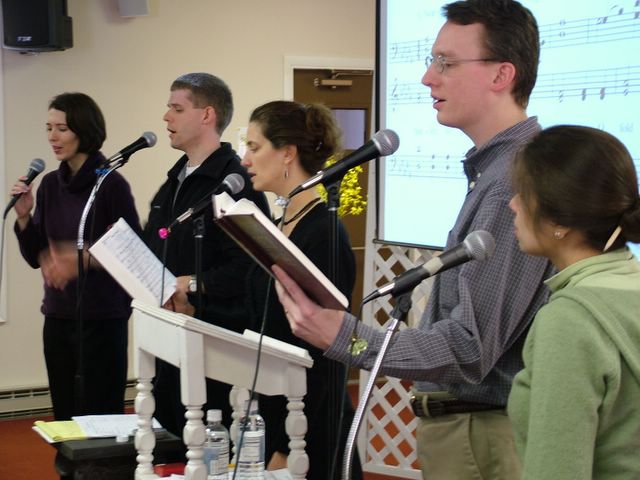
(Left to Right) Amy and Wes Wilson, Michelle Coletta, and Rich and Cindy Davies helped and encouraged us to make music in our hearts to the Lord.

Last weekend, Michele and I drove to Clifton Park, New York (just north of Albany) to attend the "Singing Workshop" hosted by the Clifton Park and Malta Churches of Christ.

The Saturday sessions included a review of "Oldies but Goodies" and featured introductions to some of the newer worship and praise songs. In the afternoon, participants got to choose among several different classes on things like "Worship Planning" and "Song Conducting."

We were blessed to make new acquaintances, and to learn some songs we didn't know before. It was good to be with brothers and sisters for whom worship to God in song is a priority and a joy.

Special thanks to the workshop leaders and to those who helped in the planning and organization.
Posted by Hello