Showing posts with label Altus. Show all posts

Saturday, December 20, 2025

Mary the Mother of Jesus (1)

Many years ago I was struggling to learn how to preach. It was around then that the elders of my home church in Altus, Oklahoma, invited me to deliver the Sunday-evening sermon.

I have no memory of what that sermon was about. That's probably good. The more I remember about my sermons back then, the more I feel a little embarrassed. There is a true sense in which ignorance is bliss.

What I do remember about that evening is not what I said, but what someone else said afterwards. After the final "Amen," after many of the people had left, I was talking with a woman who said something I haven't forgotten.

Before I tell you what she said, let me describe her to you. She was a widow, about seventy years old, in good health, very active for someone her age. She always looked nice, was soft-spoken, unassuming, kind-hearted, and just a fine person.

We were standing near the back of the auditorium, when she said to me, "I was so glad to hear you mention Mary tonight in your sermon. I don't think you know this about me, but before I became a member of the Church of Christ, I belonged to the Roman Catholic Church."

"No, I didn't know that."

She said, "After I became a member of the Church of Christ, one of the first things I noticed was, it was as if Mary had never lived. The preachers and teachers didn't talk about Mary, which was a shock because, in the Catholic Church, I heard about Mary all the time." 

Then she said, "I understand: the Catholic Church has made her out to be something she isn't. But, you know, there's quite a bit in the New Testament about her. And she was a great person. I sort of miss Mary, and wish I heard more about her."

As you would guess, the lady who said that to me isn't with us anymore. But I like to think of my posts about Mary as being partly for that good Christian woman. More later.

Saturday, June 14, 2025

Pre-History of Jackson County, Oklahoma (3)

By 1891, a few short years after its founding, the town of Frazer was home to several businesses. These included a hotel, drug store, a general merchandise store, and even a jewelry store. A medical doctor, J. E. Fowler, and his family lived in the drug store. The proprietor of the general store was C. C. Hightower, for whom the Altus High School football stadium is named: Hightower Memorial Stadium. In 1887, J. R. McMahan came to Frazer and became the first school teacher in Greer County, Texas. Eventually, he would replace Mrs. P. H. Holt as postmaster.[1]

Residents of Frazer likely knew their town was in a vulnerable spot. Although it was nice to have the Frazer River (known today as the Salt Fork of the Red River) and Bitter Creek nearby, Frazer stood where the creek and the river met. The dangerous potential turned into reality in 1891. On the night of June 4, torrential rains fell just north of Frazer, in the area that feeds Bitter Creek and the Salt Fork. The two currents overflowed and formed one very wide and swift river running at least three feet deep. Decades later, Dr. Fowler's daughter, only four years old in 1891, recalled: "I remember Mama walking from bed to bed on chairs because there was so much water on the floor." Townspeople got up in the middle of the night, gathered what they could, and moved to safety on higher ground. For many years after the flood, old-timers would say, "The average rainfall here is twenty inches a year and I remember the day it fell."[2]

When residents of Frazer fled their homes, they knew of a higher settlement just two and a half miles to the east-northeast. A post office had been established there the year before, in 1890. At some point, W. R. Baucum, who had formerly lived in Altus, Arkansas, and who knew the Latin word Altus meant "high," suggested that name for the new town.[3]

This traditional telling of the story about how and why Altus got its name leaves a question: if a post office was established there the year before the flood at Frazer, then what was the name of Altus prior to that event? The story assumes that Altus was given that name only after the people of Frazer moved to "higher ground." However, every U.S. post office has a registered name. So, again, what was the name of Altus in 1890, the year before the flood? If the original name of the settlement was Altus, then the story about the town being given that name after the flood doesn't add up.

Notes

[1] Chesser, Across the Lonely Years, 139, 179; Barbara Kay Shelton, "Altus on the Hill Above Frazer in Old Greer County," Chronicles of Oklahoma 40, no, 4 (Winter 1962-63): 390-92.

[2] Chesser, Across the Lonely Years, 139-40; Shelton, "Altus on the Hill Above Frazer," 392.

[3] George H. Shirk, Oklahoma Place Names, 2nd ed. (Norman: University of Oklahoma Press, 1974), 8; Chesser, Across the Lonely Years, 141.

Friday, May 16, 2025

Pre-History of Jackson County, Oklahoma (1)

Spanish explorers were the first Europeans to arrive in what is now southwest Oklahoma. But they were not in the region to stay. They were just passing through. Later, in the nineteenth century, members of the U.S. Army also came to this place. One of them was George Armstrong Custer, who traveled through what is now Jackson County in 1869. It was not until the 1870s that people began to take interest in permanently settling in what was then Greer County, Texas.[1]

Around that time, the Western Trail began to replace the Chisholm as the best, most direct route for cattle drives going from Texas to railheads in Kansas and Nebraska. The Western Trail was blazed by John T. Lytle in 1874. It crossed the Red River ten miles north of Vernon, Texas. Cowboys who came through on cattle drives that followed the Western Trail noticed the potential of present-day Jackson County, Oklahoma.[2]

Cattle ranchers came to southwest Oklahoma more than a quarter century before Jackson County was established. As early as 1881, L. Z. Eddleman started the Cross S Ranch around present-day Olustee. Around the same time, Cornelius T. Herring began the Herring Ranch near what is now Navajoe. Another operation, the H Cross N Ranch, was established south of present-day Altus.[3] In 1885, the Day Land and Cattle Company leased 203,000 acres in Greer County, Texas (which eventually formed Jackson, Greer, Harmon, and parts of Tillman and Beckham Counties in today's Oklahoma). Livestock was becoming one of America's largest industries, and Greer County, Texas, was home to some 60,000 cattle.[4]

Notes

[1] Cecil R. Chesser, Across the Lonely Years: The Story of Jackson County (Altus, OK: Altus Printing Company, 1971), 137-38; Webb L. Moore, "Greer County,," Handbook of Texas Online, accessed May 5, 2025. https://www.tshaonline.org/handbook/entries/greer-county.

[2] Chesser, Across the Lonely Years, 137; Carl N. Tyson, “Western Trail,” The Encyclopedia of Oklahoma History and Culture, https://www.okhistory.org/publications/enc/entry?entry=WE025.

[3] Linda D. Wilson, "Jackson County," Encyclopedia of Oklahoma History and Culture, https://www.okhistory.org/publications/enc/entry?entry=JA001; Cecil R. Chesser, Across the Lonely Years, 137.

[4Anonymous, “Day Land and Cattle Company,” Handbook of Texas Online, accessed May 15, 2025, https://www.tshaonline.org/handbook/entries/day-land-and-cattle-company; John D. Heisch, “Old Greer County,” The Encyclopedia of Oklahoma History and Culture, https://www.okhistory.org/publications/enc/entry?entry=OL002; Moore, “Greer County."

Friday, October 25, 2019

Sources on Frazer, Greer County TX, and Altus, OK

Handbook of Texas Online, Webb L. Moore, "GREER COUNTY," accessed October 25, 2019,

Frances Herron, "Altus," The Encyclopedia of Oklahoma History and Culturehttps://www.okhistory.org/publications/enc/entry.php?entry=AL013.

Frazer Cemetery chronicle:

Barbara Kay Shelton, "Altus on the Hill above Frazer in Old Greer County," Chronicles of Oklahoma 40, no.4.

Tuesday, October 22, 2019

Frazer Cemetery and Bitter Creek, SW Oklahoma

On Friday, October 18, I submitted final grades for the first 8-week Fall semester at Amarillo College and headed east to Oklahoma. My mother was in the hospital at Altus. Over the weekend, my dad and I took turns staying with her. She's doing better now and has been discharged from the hospital.

Before leaving Altus on Sunday, going back west toward Amarillo, I stopped by a few places of interest to me.

One of the earliest white settlements in the area was a place called Frazer (alternately spelled Frazier), a forerunner of present-day Altus. A post office was established at Frazer in February 1886. That was ten years before the Supreme Court of the United States ruled that the U.S., not Texas, owned the territory south and west of the North Fork of the Red River. So, from the time people began living at Frazer, until the settlement was destroyed by a flood in June 1891, it was always a part of Greer County, Texas. Today, the same region (which comprises Jackson, Greer, and Harmon Counties, and part of Beckham County, Oklahoma) is known as "Old Greer County."  

Residents of Frazer buried their dead in a cemetery that lay perhaps to the north and east of the settlement (and to the west of present-day Altus). I visited the Frazer Cemetery and took a few photos:

According to online sources I found, there are approximately 63 graves in Frazer Cemetery. The cemetery is located west of Altus, on County Road 202, about a half mile south of U.S. Route 62. 
On Sunday afternoon, October 20, the big sky was quite a scene looking to the north and east.
If gravestones like these ones date to 1891, they must have been crafted somewhere else in Texas and brought to Frazer by wagon.


Frazer was located near the confluence of Bitter Creek and the Salt Fork of the Red River. These two streams flow south-southeast towards the Red River, and are located west of Altus. When heavy rains flooded both streams in June 1891, flowing water covered all of the land in and around Frazer. Residents woke up with water up to their beds. In the middle of the night they started making their way north and east toward a place that came to be called Altus, a Latin term that means "high."

This sign greets travelers on U.S. Route 62 heading east.
Under the bridge, I was surprised to find a good bit of water. The creek was flowing and frogs were jumping. After a minute or two, I smelled a skunk and got out of there. My shoes and jeans were covered with stickers.

Friday, January 08, 2016

Betty Jo Osborne, 1926-2014

Betty Osborne died two years ago today. The following is an excerpt from the funeral message.  . . .

The author of Ecclesiastes reminds us that, “To everything there is a season; and a time for every purpose under heaven.” How well we know that today, for in the words of one of the author's many phrases, “there is a time to be born, and a time to die.” Here we are because Betty was born, and now has died. So we’ve gathered in this place to remember, and to give thanks to Almighty God for her life, for our time with her.

We never know when death will come, which is precisely why the Bible encourages us to always be ready to meet our Maker. Betty Osborne was ready. She loved the Lord. She lived according to His Word. She walked in the footsteps of Jesus, and she served him whole-heartedly.

Betty Osborne was one of the finest people I have ever known, a great example of what a Christian should be. She and Bill were such a dynamic couple. I never met them until they moved to Altus in 1979, when Bill became the new preacher for the congregation that meets in this place. In a short time, the two of them made an indelible impression on me. One of the things that always stood out was that Betty and Bill Osborne were masters of building up other people. They edified and encouraged and blessed those they came in contact with. Only heaven knows the amount of good that the two of them did together during 67 years of marriage.

Betty’s life stands as a testimony to the power of faith and perseverance, the power of trusting and obeying the Lord. Proverbs 10, verse 7 says “The memory of the righteous is a blessing.” I know that her memory will be a blessing to you for the rest of your lives.

Sunday, December 28, 2014

Christmastime in Texas and Oklahoma

Just a quick note from my home here in Tulia, Swisher County, Texas. It's Sunday evening, December 28. The last few days have been full and fun. But I'm so glad to be home now, taking it easy.

On Thursday, both Ben and Aubrey drove down from Amarillo to spend Christmas with me and Michele. We exchanged gifts and, of course, ate a bit too much. (But it was so good, thanks to Michele).

Ben, Aubrey, and Michele. Christmas Day 2014

Friday, the 26th, was a long day for Abigail, me, and Michele. Ab started the day with an early-morning flight out of Hartford, CT. She changed planes at Midway in Chicago, and landed before noon in Oklahoma City. Michele and I had also gotten up early that morning to drive from Tulia to OKC.

After the three of us shared lunch, we drove to Wellington, Texas, for a wedding rehearsal. My niece, Larkin Davis, was getting married to Ory Johnson the next day. And I was one of the officiants! 

Larkin and her dad, Keith Davis. Wedding rehearsal dinner, Dec. 26, 2014
After rehearsal and dinner in Wellington, the three of us were back in the car headed to Tulia, where we spent the night. Whew! We were so tired.

We got to sleep in the next morning. The wedding wasn't until 2 o'clock in the afternoon, and we didn't need to be back in Wellington until about 1. That was nice. The wedding went off without a hitch. The other officiant in the ceremony, Judge Les Hatch from Lubbock, is a great guy and did a fine job. It was so good to be with most of my family that day.

After the wedding reception, Michele and Abigail and I decided that we hadn't gotten to spend near enough time with my kid sister, Vicky Crews, and her family. They had just come in from Arkansas the night before. They would be staying the night in Altus, OK before returning to their home on Sunday, the 28th. So we all loaded up and went to Altus together. 

We met at my parent's house and got to catch up a bit. When the folks started getting weary, we went to the motel and took over the lobby until late into the night. 

Joy, Abigail, and Frank H. Bellizzi at the Davis-Johnson wedding, Dec. 27
With my parents, two great people

Wednesday, June 18, 2014

Church of Christ in Altus, Oklahoma: Some Photos from the Archives

Ground-breaking for the Hudson and Elm Church of Christ building, c. 1925. The façade indicates the building was completed in 1926. From left to right: 1. ?  2. Hilton Stacy  3. ?  4. J. C. Chisum  5. not wearing a hat, J. A. Cullum, preacher for the congregation  6. D. C. Oliver  7. W. A. Chisum  8. J. R. McMahan, who reportedly donated the land.
Silas and Willie Howell, c. 1936. Silas was then preacher for the congregation.
A closer look at Silas and Willie Howell

October 2, 1966. The photographer's notes on the photo identify two people. Wallace Gooch, preacher for the congregation at the time, is on the first row, second from the left (head tilted to his right side). Don Hayes, song director, is on the first row, first to the left of the aisle.  Full-time preachers for the congregation included the following:
1927-34 W. Claude Hall (left when invited by N. B. Hardeman to come back to F-HC)...
1934-37 Silas Howell
1937-41 Glenn Green
1941-43 Frank B. Shepherd
1943-46 Wallace Layton
1947-50 G. C. Abbott
1950-53 W. S. Boyett
Mack Lyon
Claude Robertson
Don Kern
L. N. Moody
Wallace Gooch
Gary Colley
Gene Gilmore
Wayne Price
Bill Osborne
Others who preached from this pulpit: Foy E. Wallace, Jr., G. C. Brewer, Ernest Highers, O. C. Lambert, V. E. Howard, Maxie Boren, Jimmy Allen, S. H. Hall, J. D. Tant, Horace Busby, Jesse B. Sewell, Delmar Owens, N. B. Hardeman, Roy Cogdill, Homer Hailey, John Bannister, C. E. McGaughey, George DeHoff, Perry Cotham.

Saturday, February 02, 2013

A. C. Huff: A Brief Biography

The first full-time preacher for the Church of Christ in Altus, Oklahoma was A. C. Huff. By the time he arrived in Altus in 1907, he was forty-three years old and brought with him over twenty years of preaching experience. The congregation paid him $60 a month, which was roughly equivalent to $1550 by 2013 standards.

A.C. Huff was born in 1864 in Halletsville, Texas, a little town in Lavaca County, about halfway between Houston and San Antonio. His mother died when he was just three years old. As tragic and sad as that was, the little boy was fortunate in that he had four older sisters who mothered him.

Growing up during those difficult years just after the Civil War, he had very few opportunities to receive any formal education. At the outbreak of the War, many schools across the South closed. It was years later before public schools were common. However, when he was sixteen he was able to attend school regularly for a time at Brownwood, Texas.

We know very little about the religious background of his family. We do know that he was baptized into Christ by W. E. Hawkins in 1882, and that he began preaching two years later, when he was twenty years old.

From that time on, for over 80 years, A. C. Huff preached the gospel of Christ and taught the truth of the Bible! He lived from 1864 to 1967--from Civil War to Civil Rights--and died at the age of 103. If he had lived two more months, he would have turned 104. During those 80-plus years of ministry, he was instrumental in planting congregations at Tucumcari and Raton, New Mexico; at Vega, Dodson, and Bronte, Texas; and at Lacey Chapel, Oklahoma. He preached in countless places, engaged in four religious debates that we know of, fathered twelve children, and delivered a 40-minute sermon on the day he turned 101.

Apparently, he spent less than a year in Altus. Our best records indicate that he worked with the church there in 1907, and with the church in Hollis, Oklahoma in 1910. It is a testimony to his preaching in Altus that since those days, there have only been a few short times when the Church of Christ did not support a regular preacher.

A. C. Huff passed from this life on December 8, 1967 in Del City, Oklahoma. The next morning, John R. Stewart conducted his funeral there and accompanied the casket to McLean, Texas, where a memorial service was held at 3 p.m., and where the old preacher lies buried until the resurrection.

Bibliography

Baxter, Batsell Barrett and M. Norvel Young, eds. Preachers of Today: A Book of Brief Biographical Sketches and Pictures of Living Gospel Preachers. Nashville: Christian Press, 1952.

Burns, Thelma. "Church History: Church of Christ, Altus, Oklahoma 1898-1980." Unpublished document, 1980. The best written source for the broad sweep of the history of the Hudson and Elm congregation.

Hall, W. Claude, "Congregational Growth and Expansion: Altus, Oklahoma," Firm Foundation September 13, 1927. An indispensable source for the early history of what was at that time the only congregation of the Church of Christ in Altus. Includes photos.

Lambert, Gussie. In Memoriam. Shreveport, LA: Gussie Lambert, 1988. Contains a four-page biography of Huff and a photo.

Stewart, John R. "Huff, A. C.," Gospel Advocate January 11, 1968. Huff's obituary, written shortly after his death by the man who conducted his funeral.

Wilhite, J. Porter. The Trail Blazers: Heroes of the Faith. Shreveport, LA: Lambert Book House, 1965. Includes a brief biography of Huff and the notes for one of his sermons.

Wilson, Linda D. Encyclopedia of Oklahoma History & Culture, s.v. "Schools, Subscription." http://digital.library.okstate.edu/encyclopedia/entries/S/SC005.html (accessed January 30, 2013). I found this article helpful for understanding a reference to the little formal education that A. C. Huff received at a "subscription school."

Sunday, January 27, 2013

A. C. Huff according to J. Porter Wilhite

A. C. HUFF

"Abraham Conn Huff was born February 8, 1864, in Texas, where he lived most of his life. After some country schools, which he attended only about six weeks; at the age of sixteen, he attended in Brownwood, Texas, and was able to teach school for some time. He also was a singing school teacher in those days. He did a lot of mission work wherever it was needed, leading his own singing in many meetings. This work was because of the love of God, and the souls of mankind; because support was practically nothing. Brother Huff began preaching at the age of twenty (1884). This being 1965, he now has preached longer than any living gospel preacher--81 years and still preaching--and preached forty minutes on his birthday this year. This is amazing! He had four debates! He reared twelve children, four sons, each an elder or a preacher of the gospel. WONDERFUL! Preached 81 years."

In J. Porter Wilhite, The Trail Blazers: Heroes of the Faith (Shreveport, LA: Lambert Book House, 1965), 72.

Saturday, January 19, 2013

A. C. Huff, preacher, Church of Christ, Altus, OK, Gospel Advocate obituary

Huff, A. C.

A. C. Huff was born February 8, 1864, in Halletsville, Texas, and departed this life December 8, 1967, at the age of 103 years and ten months.

Brother Huff preached the gospel of Christ eighty years, and was a faithful member of the church of Christ. He had been a member of the Del City congregation during the past few years.

He preached regularly for the church in McLean, Texas, four years, and preached for approximately six years in Montoya, N. M. Also, he preached for several months for the church in Penrose, Colo., thirty-three miles South West of Colorado Springs, Colorado. However, most of his preaching throughout the years was evangelistic preaching. Brother Huff engaged in several debates during his preaching career.

He is survived by four sons and four daughters in the immediate family. The sons are: Thomas B. Huff, Dallas, Texas; Otto A. Huff, Pea Ridge, Arkansas; Gus J. Huff, Henderson, Texas; Leslie G. Huff, Austin, Texas. The daughters are: Mrs. Peter Fullbright, McLean, Texas; Lena Burk, Midwest City, Oklahoma; Eunice Dennis, Midwest City, Oklahoma; Leola Horrell, Midwest City, Oklahoma. Also surviving are: forty grandchildren, 100 great grandchildren, and forty-two great great grandchildren.

A memorial service was held for Brother Huff in Del City, December 9, 1967. The writer preached the funeral sermon. A singing group from the Del City congregation sang some hymns of comfort.

At 3 P.M., Dec. 9, another memorial service was held in McLean, Texas by the writer and assisted there by Brother Smith the local preacher. The body was laid to rest in the McLean cemetery.

John R. Stewart.

Gospel Advocate, January 11, 1968, page 31.
________________________________________

According to an article about the Church of Christ in Altus, Oklahoma, by W. Claude Hall, in Firm Foundation (September 13, 1927), A. C. Huff was the first full-time preacher for the congregation. He began around 1907 "at a salary of $60.00 per month."

According to the find-a-grave website, his full name was Abraham Conn Huff.

A related website indicates that his father, Thomas M. Huff, is buried at Manchaca, Texas, which is near Austin.
_________________________________________

I took these photos in May 2013, a few months after the original post here. Michele and I stopped and had supper at the Red River Steakhouse before going out to the cemetery in McLean, TX. We were on our way to Edmond and Oklahoma City, where I was planning to do some research.


Monday, March 12, 2012

A Trip to Turkey on the Trail of R. W. Officer

For a few years now, I've wanted to travel to two Turkeys. I've now visited one. That country in Asia? The scene of some of the most impressive growth experienced by the first-century Church? That'll have to wait for another time. This time, last Friday, March 9, 2012 to be exact, I went to the other Turkey, a small town located in the southwest corner of Hall County, Texas.

And why did I want to visit this Turkey? Mainly because it is the last home and the resting place of one R. W. Officer, a most impressive historical figure. Born in 1845 in Georgia, Officer was a veteran of the Civil War who later became a preacher, writer, debater, and a renown missionary in Indian Territory (part of what is now Oklahoma). Early on, Officer was a Baptist. But for the big majority of his career as a Christian leader, he was connected to the Churches of Christ. The following are some of my notes about Turkey and my search for him and his family.

It's sort of a rite of passage now. To get to R. W. Officer, you first have to meet someone else. Entering town from the north, visitors are greeted by this sign paying tribute to Turkey's favorite son, Bob Wills, "the King of Western Swing." Check out the detail of the silhouettes on this sign. Impressive! Incidentally, Bob Wills is one of the few (or, the only?) to be inducted into both the Country Music Hall of Fame (1968) and the Rock and Roll Hall of Fame (1999). I've only recently begun listening to his music. What an interesting, charismatic person he was. He epitomizes the unmistakable spirit of West Texas, the one that says, "Life is what you make it!" I can only imagine the hundreds of thousands of people who had to smile when they heard his songs. He was one-of-a-kind. And, before Wills became famous it's very likely that he was R. W. Officer's barber.
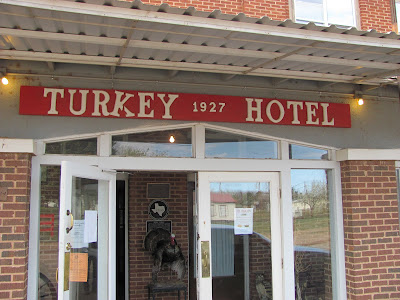
Just one block north of Main Street (Highway 86), on 3rd Street stands the historic Hotel Turkey. Yes, that's a mounted turkey on the front porch. My understanding is that the original settlement was called "Turkey Roost." Just behind the bird are two plaques on the wall . . .


Pictured here is Cody Bell, a friendly guy and the owner of the hotel. When I met him in the lobby, he took an immediate interest in my research and provided me with a good bit of information about the town and its history. In the early 1900s, both sets of his grandparents, the Bells and the Meachams, were early settlers in Turkey. Cody confirmed that President George W. Bush has spent a night or two at the hotel. I know, you Democrats will think that explains the name.

The hotel features an very good restaurant. I thoroughly enjoyed my grilled chicken sandwich, one of the best ever!

After lunch, before I went out to the cemetery Cody took me over to the old school building that houses the public library and the Bob Wills Museum. Pictured above is just one of the many wall-sized photos in the museum. Fans should make time to visit this place. When you do, be sure to watch the video. The annual Bob Wills celebration in Turkey is held each year on the last Saturday in April. Just one more reason to go back.

Dreamland Cemetery is a few miles south and east of town. Take Highway 70 south to Farm to Market Road 656. A sign on 70 directs you toward the cemetery. From the highway, the road runs east and then curves to the south. The road divides the cemetery. A newer section lies to the east. The older graves, including Officer's, are on the west side.

Both Laurence W. Scott (Texas Pulpit, 1888, p. 384) and F. D. Srygley (Biographies and Sermons, 1898, p. 309) tell us that R. W. Officer's first wife was Lota Venable of Winchester, Tennessee, and that the two were married on Christmas Day 1870. Srygley, writing near the end of the 1800s, says that the two were still married at the time.

At this point, my assumption is that Alice Gist Officer was R. W.'s second wife. I don't know of any other wives. According to Earl I. West, (Search for the Ancient Order, vol. III, p. 134), Lota Venable Officer died January 30, 1900. I don't know where she is buried. Likely in Paris or Gainesville, Texas, or somewhere in Oklahoma. Another mystery: Alice Gist Officer's tombstone provides no dates. Silas Shotwell, an authority on Officer now living at Fort Sumner, New Mexico, tells me that when Alice died, her husband R. W., then 85 years old, remarked that he was ready to go. Within a few days, he died. So, the presumed date of death for Alice Gist is 1930.

Sometimes, seeing a place for yourself makes a real difference. And here we have a case in point. According to this source, Leon Officer is "the only family member of note in the plot." From that, one would never guess that R. W.'s wife lies buried in the very next grave, a strange oversight.

People still living who grew up in Turkey speak of a "Mrs. Officer" who was a "tough" school teacher. Because these people would have gone to school after 1930, my assumption is that this "Mrs Officer" was not Alice Gist Officer. Was the school teacher Leon's widow, R. W.'s daughter-in-law? Or was she R.W.'s daughter or granddaughter? Also, piecing together the available evidence, it is clear that Alice Gist Officer was not Leon's mother. Yet, "Mother" is her epitaph. So who was her child?

According to my best information, Leon V. Officer (1877-1922) was R. W.'s son, born when the father was 32 years old. Leon never reached his 45th birthday. Remarkably, the father made it to his 85th. Does Leon's middle initial stand for "Venable," the maiden name of Officer's first wife, Lota? I wonder.


I have found a place in West Texas where we are almost unknown for several counties. They have called me. There is no use to go there to stay a few days and return. On July 1, I am going to stay. The Indian Territory is coming in. It will be settled by white people, and my work there is done. I am off again for another waste, or neglected place, trusting God's promise and the brethren. (R.W. Officer, writing in the Gospel Advocate, as quoted in Earl I. West, Vol. III, p. 134).

Clearly, the marker for R. W. Officer's grave does not go back to 1930. I have no information on who provided this stone or when it was set. I'm told that this stone was most likely crafted in Clarendon, Texas, a larger town about 40 miles north of Turkey. The quality of the surface and the style of font suggest that the stone does not go back very far. What is clear, however, is that the Methodist Clergy badge that was attached to this marker at one time has since been removed. Note the two holes at the top right of the stone. No, I'm not the one who removed the badge. But attaching it to this headstone does seem to have been inappropriate.

A block or two north and east of the Hotel Turkey stands the meeting house of the Church of Christ. Along with Cody, I shared lunch with the preacher for the congregation, Stuart Smith. Stuart impresses me as being a fine guy. In addition to serving as a minister, he is a teacher and coach in the local school system. He has worked there in Turkey for 21 years. It was apparent to me that Stuart, his wife, and their family are highly respected in the community.

From Turkey, I traveled north and east to Memphis. From there I went over to Altus, Oklahoma to spend the weekend with my folks. On Saturday, it gently rained the better part of the day. So we stayed in, except for a visit with Betty Osborne, the widow of the late Bill Osborne. The two of them were a dynamic team. For many years, Bill, who possessed a unique mixture of homespun humor and Christian charisma, served as minister of the Elm and Hudson Church of Christ in Altus. Betty was the congregation's secretary. No one was better at encouraging and building up other people than the Osbornes. I'll always be grateful to the Lord for their remarkable service to His church.

On Sunday morning, it was a joy to visit my home congregation, to worship the Lord sitting next to my parents. In his lesson that morning, Tom Bailey emphasized that God is good.
---------------
Special note: I began this weblog in January 2005. Since then, I've had a few regular readers and a lot who have dropped by every now and then. I'm really thankful for the long-distance relationships that have begun, and for the reconnections I've made with people I have known in various places through the years. Special thanks to those who have commented. Like all bloggers, I'm always thrilled to get meaningful feedback. I'm writing this note mainly because this post just happens to be my 600th.

Yes, I plan to keep going. But not because of I have thousands of followers. I don't. Fact is, there have only been a few times that I even considered what makes a blog popular: Ten Things about this current topic, or Five Ways to do something everybody wished they did. No, from the first post until now my main interest has been getting down in print some of the things that were on my mind at the time. For me, this is a matter of talking about something I'm currently into, sorting out something that's running through my mind. If you truly understand something, then you can clearly say something about it. If you can't, then maybe you should reconsider your assumption that you understand it. So for me, blogging is a matter of making sure I have some level of understanding. Like I said, for me that's been a big part of the motivation.

Saturday, May 08, 2010

Rock-n-Rumble in Altus U.S.A.

The weather was mild in Southwest Oklahoma today, just right for the annual Rock-n-Rumble Car Show in Altus. As my dad and I were looking around at all the custom cars, we met up with Kae Myers. He and his wife, Margaret, are parents to Allan and Neil Myers, two guys I knew well growing up. The photo is of Kae and me and his 1933 Willys custom street rod. Under the hood is a small block Chevy engine with dual 4-barrel carburetors and a supercharger on top. The photo doesn't do the car justice. It's something else. After the show, the cars did a cruise up and down Main Street. Kae invited me to go on the first run with him. What a blast.

Monday, May 14, 2007

Monday Medley

Our Weekend:
We have a little amusement park here in Amarillo: "Wonderland!" We'd never been there before, but Aubrey's school band was going last Saturday. Michele and I wound up going as non-paying chaperones. In spite of our free admission and the chaperone title, we had basically no responsibilities. Woohoo!

By late afternoon, the three of us were on our way to Altus, Oklahoma. We spent the night with my folks and went to worship with them Sunday morning. My years in Connecticut didn't afford many opportunities for me to be with my mother on Mothers' Day. I was so glad I got to be with her yesterday.

The Demise of Dogma?
"The only church of Christ is the Catholic Church governed by the successor of Peter" --Pope Benedict, speaking last week to the bishops of Brazil, as quoted on last Saturday's broadcast of "NPR Religion."

The Bible and Tattoos
The same chapter of the Bible that says, "You shall love your neighbor as yourself" (Leviticus 19:18) also says, "You shall not tattoo yourselves" (v. 28).

No believer that I know of has argued against the positive statement found in verse 18, especially since Jesus repeated it and said it was super important. On the other hand, any number of believers have violated the letter of the prohibition found in verse 28. Have they violated the will of God?

Old Testament specialists tells us that tattooing (or painting) the body in the ancient world was an explicitly pagan thing. It may have been done to ward off evil spirits, or to identify a person as belonging to a certain pagan group. Either way, the very appearance of a tattoo would have meant a rununciation of what the Bible affirms: that there is only one true God and those who are faithful to him will not be harmed but will, instead, be secure. These days, tattoos don't necessarily mean the same thing. So, while I'm not a fan of tattoos, neither do I believe that they are against the will of God.

The Authority of the Old Testament
The question of how Christians might apply the teaching of, say, Leviticus 19 was part of what we talked about in the last class session of the Old Testament course. I gave the students a copy of the question as it's worded in a classic book by John Bright:

" [People who affirm] that the Old Testament is in each of its texts inspired of God and affords in all its parts a revelation of his character, purpose and will . . . must still face the question: How are these ancient laws, institutions, and concepts, these ancient narratives, sayings and expressions . . . to be taken as authoritative over the faith and life of the believer, and how proclaimed as such?"

How can, how should, the Old Testament function as a word from God within the church? What principles of interpretation, for example, serve to open up that part of the Bible as a word on target for Christians?

The Church Sings!
"The Christian church sings. It is not a choral society. Its singing is not a concert. But from inner, material necessity it sings. Singing is the highest form of human expression....What we can and must say quite confidently is that the church which does not sing is not the church. And where...it does not really sing but sighs and mumbles spasmodically, shamefacedly and with an ill grace, it can be at best only a troubled community which is not sure of its cause and of whose ministry and witness there can be no great expectation....The praise of God which finds its concrete culmination in the singing of the community is one of the indispensable forms of the ministry of the church." -- Karl Barth, in Church Dogmatics, Vol. IV, part 3, chapter 16, par. 72, #4.

Monday, January 22, 2007

Tagged, Tellin', Taggin'

I got “tagged” by Wade Tannehill. Now I’m supposed to tell about five odd or interesting things about me that people would not ordinarily know. Here goes:

1. For starters: Some of the more interesting-or-odd things about me I just won’t tell here because they involve me breaking the law, acting immorally, being idiotic, or some combination thereof.

I sometimes think that God sends out Jack Bauer-type angels to protect young men during those high-testosterone years. (Their show would be called “At Least 24 Months”). Suffice it to say that one of the most interesting-and-odd things about me is that, thank God, I’m still alive.

2. Privilege and Accomplishment: From the ignoble to the proud. My second graduate degree is from Yale Divinity School, which looks like this.

I really loved the time I was able to spend at Yale. One of the neatest things was I got in on the last classes ever taught there by Abraham Malherbe, Brevard Childs, and Leander Keck. Along with colleagues like Robert Wilson, Wayne Meeks, and Christopher Seitz, they made up one of the best Bible Departments in the world. (Not that the School suffered when the next generation arrived: John J. Collins, Adela Yarbro Collins, Harry Attridge, Miroslav Volf, et al).

One of the University’s best-kept secrets is Victoria Hoffer, the lady who taught me Hebrew. A brilliant person and the mother of five, she’s one of those folks who can work on fifteen projects at once and get them all done on time, with flair, while smiling and well-dressed. Not to mention that she’s a terrific teacher and that she literally wrote the book on Biblical Hebrew. I’ll always thank God for her.

I should do more posts about my teachers. I didn’t say anything here about that other great school. No, not Harvard. It’s HARDING Graduate.

3. Bad habit: I’m what you might call “a hoarding messy.” (Try saying that with a high British accent). I irrationally hang on to all kinds of things. In fact, just about everything that comes into my possession I keep. And I don’t organize it very well. My wife will not allow my messy collections to take over the house, and I’ve actually developed some fairly-tidy habits there. But at my work office the demon runs wild. As I write this, my desk is piled about 4 inches deep in papers, folders, notebooks, etc., and there are nearly as many books stacked on the floor as there are on the shelves.

Now, that’s not particularly interesting, but there is an odd part here: there are pockets of my life where everything is immaculate. I’m very picky, for example, about what I eat, what I wear, written work, and presentations.

I sometimes comfort myself by remembering that people like me are said to be unusually creative. But most of the time, I just wish I would get a handle on my sloppy ways. And I worry. I worry about what this glaring bad habit says about my character and my inner world. I’m trying to do better.

4. Unforgettable experience: In the summer of 1985, I took five consecutive flights, over a period of 24 hours, and my ears wouldn’t clear. One flight attendant told me that giving me an aspirin was a no-no. At one point the pain was so terrible, I asked the Lord to just let me die.

Having made it from Manaus, Brazil to Altus, Oklahoma in that fashion, the next day I went to the doctor who gasped when he got a look at the raging infection in both of my ears. The day before my excruciating series of flights, I had gone with a group out onto the Amazon River. At the end of several hours on the water, the tour guide and captain stopped the boat’s engine and told us that if we wanted to tell our friends that we’d gone swimming in the Amazon, this was the time and place. I was one of the first to jump in.

Of course, not planning to swim in the river from which we had earlier pulled piranhas, none of us had a towel. I never thought to dry my ears. The big bad bugs of the Amazon went to work overnight, and I wound up learning some important lessons.

My ears got better. My life was forever changed by my experiences with the churches in Manaus and especially Belo Horizonte, Brazil.

5. Jobs: One of my first real jobs had me operating two commercial radio stations—one AM, one FM—for hours on end . . . by myself . . . for $3.50/hour. Hard to believe, but it’s true.

The AM was a Country & Western format--“KWHW 1450”--one of the truly great institutions of Altus. The FM was an automated Top 40. The intros and music for that station were purchased pre-recorded on these giant reel-to-reel tapes.

I would come to work at about 4:00 p.m. and record local news, sports, and weather, as well as the few commercials they’d let me do. Then, I’d put the carts into just the right slots in one of three huge carousels. The tapes and the carts had inaudible signals that tripped whatever was supposed to play next. That system for the FM station worked perfectly, almost all of the time.

At 6:00 p.m. I’d start a six-hour board shift on the AM, while minding the automated FM station that was broadcasting from literally the next room. For all of that time, I was the only person in the building (except for a couple of times I let a current girlfriend come in and check out the world of Mr. DJ; every job has its perks).

Long after midnight, the time when both stations signed off, I’d still be cleaning the machines, changing the tapes, and then setting up everything on the AM side for the morning man (the morning people are the prima Donnas of radio).

After several months of that, I told the program manager I was more than ready for that promised-but-overdue raise to $4.00/hour. With all the grace of a train wreck he let me know that I really hadn’t come along like he hoped I would and that he was reneging. I gave my two weeks notice on the spot. And so ended my glorious career in radio.

And here’s the tag: Ken Danley, Arlene Kasselman, Steve Duer, Greg Newton, and Royce Ogle? Yur-rit!

Sunday, August 07, 2005


The Bellizzis at my parents' 50th wedding anniversary celebration, July 31st, 2005 Posted by Picasa