During the nineteenth century, Americans could hardly fail to notice that although Protestant Christianity was officially non-established, it was the unofficially-established religion of the United States. Most American Jews and Roman Catholics simply tolerated its dominance.[1] The supremacy of Protestantism showed up at every turn. Buildings that belonged to Baptists, Congregationalists, Presbyterians, and Methodists could be seen on street corners in virtually every town in America. Members of these and other sizable Protestant groups, like Lutherans and Episcopalians, participated in countless inter-denominational and non-denominational voluntary associations. These included the American Bible Society (established in 1816), the American Sunday School Union (1824), and the Evangelical Alliance (formed in the U.S. in 1867). In addition, a wide variety of educational and journalistic institutions served to reinforce the cultural influence of Protestantism. For example, from the 1636 founding of Harvard, America's first college, until the late nineteenth century Protestant higher education was nearly synonymous with American higher education. Even state universities operated much like Protestant schools. Finally, extended networks of business owners, ministers, educators, government officials, and benefactors created a sort of Protestant fabric that covered the entire country.[2]
Nineteenth-century Christian Churches and Churches of Christ--congregations affiliated with of the Stone-Campbell Movement--were part of that tapestry. It is true that some of these churches were prone to a sectarian spirit, and that the strict independence of all those churches created a situation in which congregations were so autonomous the movement was nearly anonymous. Yet they still made up a part of American Protestantism.
Notes
[1] William R. Hutchison, Religious Pluralism in America: The Contentious History of a Founding Ideal (New Haven, CT: Yale University Press, 2003), 59-60.
[2] Ibid., 61. See also W. C. Ringenberg, “Higher Education, Protestant,” in Dictionary of Christianity in America, ed. Daniel G. Reid (Downers Grove, IL: InterVarsity Press, 1990), 530-32.
Showing posts with label William R. Hutchison. Show all posts
Showing posts with label William R. Hutchison. Show all posts
Sunday, September 08, 2019


Wednesday, August 13, 2014
From Toleration to Participation: Hutchison's Vision for Religious/Political History in America
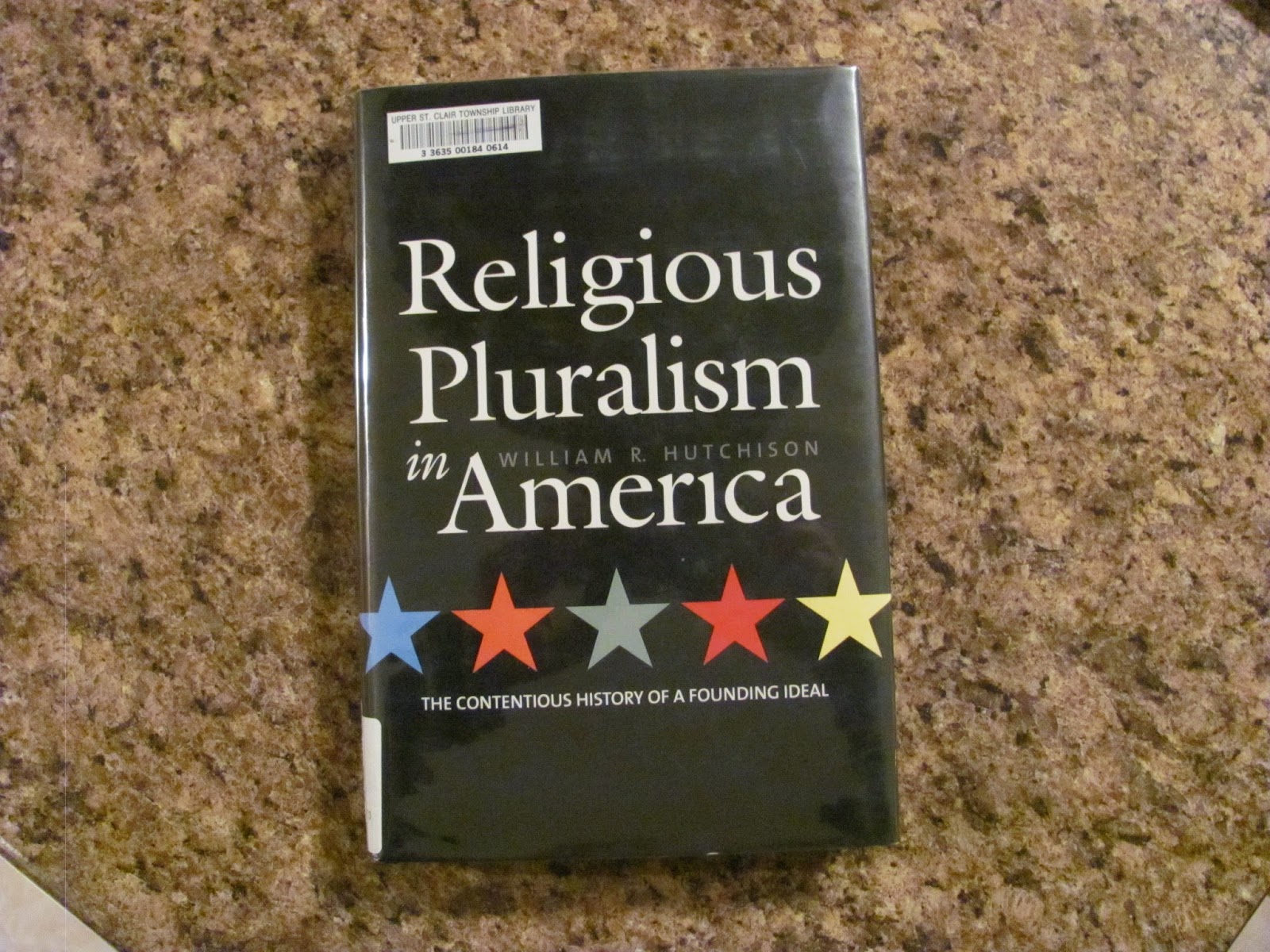
Throughout, Hutchison focuses on the presence of religious subcultures in the United States, and emphasizes that acknowledging diversity is something different from embracing pluralism.
Hutchison identifies three stages of what he calls religious pluralism in America: toleration, inclusion, and participation. He defines "toleration" as the mere legal and social tolerance of religiously deviant persons and groups. Even before the American revolution, the British colonies were known for their religious diversity and tolerance. Throughout much of the nineteenth century, Americans who identified with the dominant culture of Anglo-Calvinist Protestantism typically assumed that newly arrived immigrants, like Irish Catholics and German Lutherans, had the right to exist. Yet these groups were denied any sort of cultural authority. Often, toleration amounted to little more than the "absence of persecution" (6). This was in exchange for the absence of any socially threatening behavior on the part of the new immigrants.
By the end of the nineteenth century, says Hutchison, a growing number of Americans were coming to see mere toleration as inadequate, both morally and practically. Their dissatisfaction led to what Hutchison calls "inclusion," an impulse that represented a step towards a stronger form of pluralism. The middle chapters of the book reveal that inclusion resulted from a three-way collaboration: it was initiated by the leadership of the reigning Protestant liberals, and was claimed by Catholics and Jews. Still, inclusion rarely granted to the newly included "an equal or proportional right to share in the exercise of cultural authority" (6).
Hutchison depicts the years following the First World War as a time of steady march towards his third stage, "participation." By that term he means a social mandate according to which all sorts of individuals and groups (including groups defined by ethnicity, race, or gender as well as religion) "share responsibility for the forming and implementing of society's agenda" (7). The author is quick to acknowledge that during the early twentieth century there were still signs of intolerance, like anti-immigrant legislation and the Ku Klux Klan. At the same time, there also emerged significant signs of greater participation. For example, religious leaders established the National Council of Christians and Jews in 1928. National Brotherhood Week was first observed in 1934.
At least three public-policy landmarks of the 1950s and 60s hastened the advance of inclusion. First, although it was in some ways xenophobic, the McCurran-Walter Act of 1952 lifted the ban on immigration from Asia and the Pacific. Second, and even more important, was the Brown v. Board of Education decision handed down in 1954. Finally, the Immigration and Nationality Act of 1965 "abolished the quota system that had kept immigration from Asia to a minimum" (224).
Hutchison ends on a note of hope. The words of the Founders, he intimates, rather than their inconsistent examples, will finally win the day in America. That is still to be seen, and it is still unclear what that sort of victory, if achieved, will look like.
Subscribe to:
Posts (Atom)
