Showing posts with label American history. Show all posts

Saturday, November 22, 2025

Popular Sports in America during the 1920s

I put this post together for my HIST 1302 course. It explains how in the 1920s the United States started becoming more and more the sports-crazy nation it is today.

The 1920s, often referred to as the Roaring Twenties, was a decade marked by significant economic growth, cultural change, and the rise of mass entertainment. Sports became a major part of American popular culture during this period. In fact, the current sports craziness of American society really began in the 1920s, with several sports gaining widespread popularity.

1. Baseball

Baseball was undoubtedly the most popular sport of the decade, often called “America’s Pastime.” The 1920s is considered the Golden Age of Baseball, with legendary players like Babe Ruth and Lou Gehrig making headlines. Babe Ruth’s power-hitting prowess changed the game forever, especially after joining the New York Yankees in 1920. Yankee Stadium, dubbed "The House That Ruth Built," opened in 1923, further cementing baseball’s dominance in American sports culture.

Babe Ruth and Lou Gehrig at West Point, NY, 1927 (Click on photo for a better view)

2. Boxing

Boxing, sometimes called prize fighting, was immensely popular throughout the 1920s, particularly due to the charismatic Jack Dempsey, who held the heavyweight championship from 1919 to 1926. His fights attracted enormous audiences both in person and via radio broadcasts. The match between Dempsey and Gene Tunney in 1927, remains one of the most famous boxing events in history.

Jack Dempsey, c. 1921

3. College Football

College football was more popular than professional football during this era. Teams like Notre Dame, led by the iconic coach Knute Rockne and star player George Gipp, captured the nation’s attention. The use of radio broadcasts to cover games significantly increased the sport’s popularity, making it accessible to a nationwide audience.

4. Horse Racing

Horse racing continued to draw large crowds throughout the decade. The Kentucky Derby, in particular, was a highlight of the sporting calendar, with fans flocking to the tracks and placing bets. The excitement of betting on races contributed to the sport’s immense popularity.

Helen Wills, 1926
5. Tennis

Tennis saw considerable growth during the 1920s, especially thanks to players like Bill Tilden, who dominated the sport throughout the decade. Women’s tennis also gained attention, with stars like Helen Wills Moody emerging as champions.

6. Golf

Golf’s popularity soared, largely due to the success of outstanding players like Bobby Jones. Jones became the first golfer to win all four major championships in a single year (1930), an achievement known as the Grand Slam. The sport became more accessible to the general public during this time.

7. Basketball

Though not as popular as baseball or football, basketball was growing in popularity, particularly at the college level and within industrial leagues. The sport was still developing but laid the groundwork for its eventual rise to prominence.

8. Ice Hockey

Ice hockey began to gain traction, particularly in northern cities. The National Hockey League (NHL), founded in 1917, expanded its reach in the U.S. during the 1920s.

Conclusion

The 1920s saw sports become a central aspect of American culture, with advancements in radio broadcasting and media coverage helping to spread their appeal. Figures like Babe Ruth, Jack Dempsey, and Bobby Jones became national heroes, showcasing how sports could captivate the public’s imagination.

Some Sources:

Davies, Richard O. Sports in American Life: A History. 3rd ed. Hoboken, NJ: Wiley-Blackwell, 2017.

Guttmann, Allen. Sports: The First Five Millennia. Amherst: University of Massachusetts Press, 2005.

Friday, December 03, 2021

OERs: Right for Community Colleges (2) Things I Like about The American Yawp

I began teaching American History at Amarillo College in the Fall of 2018. Not long after that, I adopted The American Yawp as the textbook for the two-semester survey. There were several reasons behind that decision.

First, as I mentioned in the previous post, The AY is an online OER. It's freely available to anyone with a connection to the Internet.

Second, the textbook was written by credentialed American historians. So it's a legitimate survey, a worthy synthesis of what we know about America's past.

Third, after this resource became widely-used, Stanford University Press saw fit to print the secondary (textbook) material in two separate volumes. Chapters 1-15 of The AY correspond to the "first half" (up to 1877) of American history. Chapters 16-30 correspond to the "second half" (since 1877). The two printed volumes match up with that division. Again, they include all of what the historian-authors of this textbook wrote. So, if a student prefers or needs to read print on paper, the print edition is available at a reasonable cost. 

However, what the print volumes do not include are the primary sources featured in every chapter of the book. Those are available only in the online edition. To illustrate, the print edition contains all of the text that's visible when you access the online edition of Chapter 1.  But, the top of the chapter table of contents, note that section VI. is titled "Primary Sources." Clicking on that link takes the reader to a list of nine primary sources keyed to the subject matter of Chapter 1. Here's the link to the Chapter 1 Primary Sources. None of these appear in the online edition. So, when an instructor assigns some of the primary sources, those can be read only in the online edition.

Saturday, May 06, 2017

The Indian Frontier, 1846-1890, by Robert M. Utley

Robert M. Utley, The Indian Frontier, 1846-1890. Revised Edition. Albuquerque: University of New Mexico Press, 2003. Pp. xix, 325.

First published in 1984, The Indian Frontier, 1846-1890 was revised and then reissued in 2003. The revised edition is part of the Histories of the American Frontier Series published by the University of New Mexico Press. The rich narrative is supplemented by 99 illustrations and 12 useful maps.

According to the back cover, author Robert M. Utley is "a retired Chief Historian of the National Park Service and has written over fifteen books on a variety of aspects of history of the American West." In his Foreword, the eminent historian Howard R. Lamar called Utley "one of the most popular and productive historians of the American West" (xiii).

Of course, no historian who writes about the American frontier can avoid Frederick Jackson Turner's thesis first presented in 1893. In his Preface, Utley explains that as Turner saw things, experiences on the frontier--"a trader's frontier, farmer's frontier, rancher's frontier, miner's frontier"--are what made Americans and America exceptional. Turner did not completely neglect the Indians on the American frontier. However, he did treat them merely as "an influence in shaping the special American character" (xv). In other words, as Turner described things, Indians were not characters on the stage that was the American West. They were more like props in a drama that kept the spotlight on whites who were moving west. Nevertheless, unlike some other historians who regard "frontier" as just another f-word, Utley refuses to reject the Turner thesis. He prefers instead to treat it as "a conceptual framework, however simplistic, within which to develop themes of western American history" (xv). By design, Utley's work revises, qualifies, and supplements Turner's outlook. That is the book's most prominent feature from the standpoint of theoretical perspective. How could anyone move west in nineteenth-century America without encountering and dealing with Indians? Utley brings the obvious answer to that question into this exploration of the American frontier. Hence the title of his book.

What follows here is my summary, chapter by chapter. I made fuller notes for some parts more than for others. So, some chapter summaries are quite long, while others are much more concise.

Chapter One: The Indian West at Midcentury

Utley begins with the growing presence of white people in the Indian country during the 1840s. With the annexation of Texas in 1845 and the ensuing U.S.-Mexico War, American citizens moved further west into newly acquired lands. "[T]he United States at midcentury boasted a population of more than 20 million, a counting utterly beyond the comprehension of the western natives. By 1860, 1.4 million would live in the West; by 1890, 8.5 million" (4). The author discusses various influences that forever changed the Indian frontier: European diseases, the horse, and the gun. Dependence upon the gun changed balances of power and, of course, meant that Indians were dependent on the white man for gun "powder, lead, and repairs" (14). And, all such impact meant environmental change, what William Cronon has called Changes in the Land.

First contact between Indians and white men was almost always due to the arrival of a trader. This created new tastes and wants, especially liquor. The trader was most often the first white person an Indian ever saw, as opposed to a missionary. Utley summarizes a central point of this chapter as follows: Many natives of the Trans-Mississippi West had changed in response to the arrival and presence of white people "in or near their world." However, until the 1840s, "the changes had been evolutionary and mostly within the bounds of traditional culture. Henceforth they would be revolutionary and finally destructive of traditional culture" (26).

Chapter Two: Foundations of a New Indian Policy, 1846-1860

White imagination saw Indians in basically two ways: There was the good Indian, the noble savage, to be destroyed by civilizing him. Then, there was the bad Indian, the ignoble savage, to be destroyed by killing him. Either way, as part of the landscape of the frontier, Indians would have to be conquered (29-31).

When push came to shove, possessing Indian land was more important, more pressing than the question of how to civilize Indians (31). The making of treaties with Indians often ascribed to chiefs an authority that did not match up with tribal realities. Chiefs were not elected officials with constitutional authority. Indian politics operated much more by consensus. A chief's leadership utterly depended on a group that was willing to follow.

Founded in 1824, by 1890 the federal Bureau of Indian Affairs "was the most powerful force in the lives of Indians" (37). "The Indian Bureau had two purposes: to extinguish Indian land titles and to grapple with the vexing problem of what to do with people whose title had been extinguished. . . . Only in Texas was there no immediate question of title; on entering the Union, the state had retained jurisdiction over all its vacant land and refused to concede that the Indians owned any of it" (38). "Besides the army and the Indian Bureau, a third institution of government dominated Indian relations: Congress" (41).

The environmental impact of white westward travel and immigration was considerable. The arrival of white traders, and especially U.S. agents with their desire to establish treaties that favored the whites, treaties that Indian leaders often did not understand, led to a radical decline in Indian population (48-49).

Unlike the situation in the rest of America, Texans were having none of the treaty business. Texas never acknowledged Indian right to or ownership of any land in the state (52). Part of the "solution" to Indians in Texas was to drive them north of Red River into the Choctaw and Chickasaw Nations, where the Texas government leased land from those nations for the incoming Indians (esp. 52).

Chapter Three: When the White People Fought Each Other, 1861-1865

Apache leaders in places like New Mexico began to having violent interactions with whites in 1860-61. Much of this was precipitated by the discovery of gold in old Spanish copper mines and the subsequent influx of miners (66). Following deadly encounters, the Apaches noticed soldiers marching away to the east. The Indians assumed that the whites were giving up and going away. Of course, what they did not realize was that whites were now mobilizing for the Civil War. But the whites were not gone for long. They soon returned to the Indian frontier due to "Abraham Lincoln's need for western gold and silver and western political support for the prosecution of the war." This "dramatized how little the war slowed the pace of the western movement" (72).

"No Indians experienced more trauma than the Five Civilized Tribes of the Indian Territory. Many of those people owned slaves and felt a natural affinity for southerners. Also, geographical proximity gave the Confederacy an edge over the Union. The Choctaws and Chickasaws went overwhelmingly with the South" (73).

Utley describes troubles in Minnesota, New Mexico, Colorado. He details the Sand Creek Massacre in Colorado. "By 1865 military force as the solution to the Indian problem had achieved virtually unchallenged supremacy. In Indian matters President Lincoln had shown himself a humanitarian, but the struggle with the Confederacy ruled his White House years, and he left Indian affairs almost entirely to Congress and the Indian Bureau" (92).

Then, in 1864, U. S. Grant put John Pope in charge of the Great Plains. Pope basically regarded all Indians in that huge swath of territory as hostile. Many were, thanks to incidents like Sand Creek. Pope's policy was essentially war against all plains Indians, all the time. Many Indians fled north. Some of them were looking merely to escape. But others looked to join up with tribes of the northern plains in order to take the fight to the white man.

Utley tells the story of Adobe Walls in 1864. The War came to an end. Stories about Sand Creek horrified many Americans. So, there were new attitudes regarding Indian policy. Some argued for a policy of "conquest by kindness" (96-97). Thus, sometime around 1865, the U.S. political leaders spoke in terms remarkably different from previous years. Whereas the earlier times had been bloody, beginning in 1865 the language was rhetoric of peace, which was confusing to the Indians.

Chapter Four: War and Peace: Indian Relations in Transition, 1865-1869

This chapter describes a post-war period during which mistrust and atrocities on both sides led American federal policy in the direction of "the rifle" as opposed to "the peace pipe"; this, in spite of the peace rhetoric that became popular at war's end. In other words, by fits and starts U.S. policy towards the Indian became more aggressive and hostile. Thus, the years that immediately followed the war were characterized by broken treaties, ambushes, massacres, and the failure of the treaty policy. It is no coincidence that leaders of the U.S. Army at this time were battle-hardened veterans of the war.

Chapter Five: Grant's Peace Policy, 1869-1876

Grant began his presidency with the promise of a Peace Policy. At the same time, he said, "Those who do not accept this policy will find the new administration ready for a sharp and severe war policy" (128). So, although the official rhetoric emphasized peace, it seems that Grant's effective policy had two sides. Grant appointed Ely S. Parker, a full-blooded Seneca, Commissioner of Indian Affairs (130). Again, this was part and parcel of a dedication to "conquest by kindness." Still, Grant's policies were enacted by dozens of army officers, not to mention that the Indian Bureau was part of the War Department. Nonetheless, there were sometimes genuine attempts at kindness and justice (132).

Utley describes the frustrations for both Indians (in his specific example, Apaches) and U.S. representatives to Indians. The Great Father was slow in making decisions and providing the promised means of survival. Frequently, after a long wait, the Indians would be delivered a unsatisfactory message. However, some officials like Vincent Colyer and General Oliver Otis Howard did well as advocates of the Indians and made good decisions.

Utley turns to the Fort Sill Agency in the western Indian Territory. Kiowas and Comanches were the tribes of interest here. Lawrie Tatum, a determined Quaker, became agent. Tatum tried to get the Kiowas to stop raiding in Texas. Colonel Benjamin H. Grierson at Fort Sill was the military complement to Tatum's agency. Grierson was devoted to the peace policy, even though that meant that some of his military peers looked down on him.

Ultimately, the Salt Creek Prairie Massacre of 1871 frustrated Tatum and set off William Tecumseh Sherman. Satanta, a Kiowa chief, was proud and unrepentant. Like most tribes, encroachment by whites and U.S. federal policy divided the Kiowas. The Kiowa war chief was Lone Wolf. Kicking Bird led the Kiowa peace faction (see photos pp. 144-45).

The final paragraph of the chapter reads, "But in essence Grant's Peace Policy was chiefly about peace, and peace it did not achieve. The public could thus hardly be faulted for failing to note the persistence of the Peace Policy when war so dominated the Indian news. Indeed, the era of the Peace Policy featured some of the bitterest warfare in the history of Indian relations" (154).

Chapter Six: Wars of the Peace Policy, 1869-1886

" 'The campaigns in Arizona did not owe their ultimate success to any particular Waterloo-like victory, as much as they did the covering of a great deal of ground by a comparatively small number of men, permitting the Indians no rest and rendering any and every hiding place insecure.' " (155, quoting a report from 1890).

Utley relates the army's Walter Schuyler and his troops tracking down Apaches in Arizona in 1873 (155-58). The freedom of the Kiowas and Comanches came to an end in 1875 (160). The general rule was: Those Indians on the reservation are friendly and the federal Indian Bureau is responsible for them; Those off the reservation are hostile and the army must be responsible for them (161). This made sense, but the realities were never quite that simple (162-63). When war was brought to Indians, it tended to be the "total war" made (in)famous by the likes of Sherman and Sheridan during the Civil War (164).

"Man for man, the [Indian] warrior far surpassed his blueclad adversary in virtually every test of military proficiency; but unit for unit--however great the numbers--the Indians could not come close to matching the discipline and organization of the army. When Indians made the mistake of standing and fighting on the army's terms, they usually lost." However, the west was not won as a result of military conquest. Instead it was "an aggressive and highly organized society" (166).

Events like the Modoc War on the west coast in 1872-73 and especially "Custer's Last Stand" in 1876 marked the demise of the Peace Policy (171). Utley also tells of the Red River War of 1874-75.

Finally vanquished, the Nez Perces wound up in I.T., just like the Modoc had before them, in spite of promises made to the Nez Perces by the army. By 1881, only the Apaches "had not yet been made to face the truth that the reservation represented their only possible destiny" (187). Their leaders were Victorio and Geronimo. The reservation designated for them was a terrible place to live: no game, lots of snakes, etc. Eventually, Geronimo and other Apaches gave up and "the Indian Wars of the United States came to a close in Skeleton Canyon, Arizona, on September 4, 1886" (196). The Apaches were loaded up on trains that took them to Florida.

Chapter Seven: The Vision of the Reformers, 1865-1890

The chapter begins by describing the Mohonk House resort in upstate New York. The Smileys, Quaker twin brothers, were the owner-operators. Beginning in 1883, this was the cite of an annual Mohonk Conference of reform leaders and organizers, self-appointed friends of the Indians. The conference did not include Catholics, nor groups who fought for the right of Indians to simply be Indians. The official name of the gatherings was the Lake Mohonk Conference of the Friends of the Indians.

The emphasis of virtually all of these reformers was education. Utley tells the story of how in the 1870s and 80s especially, it seems, various crusaders, leaders, and reformers fighting in behalf of their visions for Indians were active and influential in American politics. For example, Helen Hunt Jackson, who published A Century of Dishonor in 1881, hoped that her book would do for Indians what Uncle Tom's Cabin did for slaves. Another factor that promoted reform interest were the stories about and statements from Indians themselves. These "aroused public sympathy and reinforced what the crusaders were saying" (201).

Such interest in Indians led to cooperation. The greatest organization of the time was the Indian Rights Association, founded and led by William Welsh. Groups like this one set out to "civilize" Indians. "This vision of the ideal Indian sharply delineated the paramount self-image of American society in the late nineteenth century. It was a vision of an 'Americanized' American Indian. By the 1880s and 1890s, despite conventional platitudes about separation of church and state, 'Americanism' represented virtually a fusion of nationalism and Protestantism" (203).

According to reformers, the first step was to "detribalize" Indians, that is to "individualize" them. "Once the individual had broken free of the tribal heritage, the reformers' program would power the final stage, the leap into the mainstream of American life" (204). Eventually, "all Indians could be submerged in the body politic of America" (205).

"In the Indian reform crusade of the 1880s, four issues overshadowed all others, both in their potential consequences for the Indians and in the zeal with which the reformers attacked them: land, education, law, and purification of the Indian Bureau. Give the Indians fee ownership in their own plot of land. Educate them in preparation for citizenship and self-support. Extend law for their protection against whites and other Indians. Upgrade reservation management to speed the civilization process and the dissolution of the reservations" (205).

Henry L. Dawes, U.S. senator from Massachusetts, was the champion of severalty for Indians (206). His leadership generated the Dawes General Allotment Act of 1887 (207).

Beginning in the 1880s, the U.S. began appropriating funds for the establishment and operation of schools among the Indians. By then, of course, church groups had been conducting educational work for many years, especially Roman Catholics. Various denominations had conducted virtually all formal schooling among the Indians. Thus, they received much of the funding that the federal government had appropriated. This was true because government schools could not set up and start running as fast as the money was becoming available. The churches were more than willing to accept any surplus funds. This situation naturally generated religious contests for government money.

Captain Richard Henry Pratt was founder and president of the Carlisle School, Pennsylvania, the greatest of the off-reservation boarding schools for Indians. Pratt spoke of a sudden and total immersion "in our civilization" (211).

"Not amid the cushioned comforts of Lake Mohonk, but on the reservations, where spoilsmen ran the programs, were the theories of the reformers put to the test. Lake Mohonk provided the perfect setting for spinning the theories, for it so perfectly mirrored the life and values of the reformers themselves, and therefore the life and values considered ideal for the Indians. But the polished lobby of Mohonk House differed from the hard environment and society of the reservation as night differed from day, and what seemed so ideal and attainable at Mohonk proved considerably less so on the reservation. There, to their pain and sorrow, several generations of Indians were fated to grapple with the legacy of Mohonk" (217-18).

Chapter Eight: The Reservation, 1880-1890

Utley narrates the obliteration of the buffalo in the 1870s and 80s. This "doomed the Plains Indians' way of life and forced them to settle on the reservations." How? Because going off reservation was for the purpose of hunting buffalo. The animals also provided the means of survival when Indians killed one. So, the demise of the buffalo basically took all the fun out of going off the reservation.

Utley distinguishes between nonprogressives (traditionalists) versus progressives among the Indians (223). A third distinction can be described as those who resisted when they could, but who gave in when they had to (225).

The Sioux began to experience the confinement of the reservation, and agents discouraged the hunt because hunting, it was said, perpetuated in the Indians "all the cruel and wicked propensities" (226). The vision quest was directly related to the hunt and to warfare. So, due to reservation life, the vision quest fell into irrelevance (230). It was much the same story for the sun dance as well (230-31).

" . . . the main explanation for the spread of Christianity lay in the nature of the Indian spiritual belief, which did not bar the new from living comfortably next to the old--so long as the Christian holy men did not demand too insistently that the old be cast aside. The Indian spiritual life centered on a quest for personal power. The white man visibly possessed power. Therefore, his God might also be petitioned for power along with the traditional Sioux deities" (231).

"Like Christianity, education elicited ambivalent reactions from the Sioux. On the one hand, they sensed its importance in helping them to cope with the white people in the new world forced on them. On the other hand, they feared what it would do to the hearts and minds, indeed the Sioux identity, of their children. On both counts, of course, they were right" (231).

Federal officials pressed individual homesteads and farming on the Indians (232). Major General George Crook to the leaders of the Sioux Indians: "It strikes me that you are in the position of a person who had his effects in the bed of a dry stream when there was a flood coming down, and instead of finding fault with the Creator for sending it down, you should try and save what you can" (236).

In 1890, President Harrison announced that the land ceded by the Sioux was now open to settlement, news which came as a shock to the Sioux (239).

Chapter Nine: The Passing of the Frontier, 1890

The "spoils system" had one of its most abusive manifestations at the Pine Ridge reservation in Dakota. Two incompetent, desperately in-debt government agents were there: Royer and Gleason. Around this time, a desperate attempt by the Sioux and other tribes showed up in the form of the Ghost Dance. The dance had apocalyptic dimensions. Its participants hoped for the emergence of a world of bliss. And, it promised protection from the white man's bullets and cannon balls. In the standoff between the two sides, Sitting Bull was killed. Then, there was a melee in which 150 more Indians were killed, and 50 wounded. "Instead of armed challenge to the reservation, the Ghost Dance was a desperate bid for divine salvation where all else had failed. It ended in violence because of an incompetent Indian agent and a tragic accident born of mutual distrust, misunderstanding, and fear" (248-49).

Utley relates the histories of Indian Territory, Oklahoma Territory, and early statehood. There was no Indian warfare in Alaska. There just weren't many Indians there, and the land was so vast.

The Dawes Act succeeded in only one of its goals: it moved Indian land into white ownership. All of the other idealistic goals of the act never came true for Indians. Still, Utley insists that it is unfair to refer to 19th reformers "racists."

Thursday, January 05, 2017

Demons, Baseball, Skynyrd and More! My Sweet Sixteen Books of 2016

For someone pursuing a doctorate in History, I really didn't do that much reading last year. Much of the time I was skimming books by the dozens and reading lots of reviews. Still, I did manage to read from cover to cover a good number of books that I simply should have read, some of which I actually wanted to read. On occasion, I was pleasantly surprised to find out that a title I had been avoiding was much more engaging than I thought it would be. And, I wound up reading a few books that had almost nothing to do with my academic program. Anyway, out of that group of titles I thoroughly digested last year, here are sixteen of my favorites:

European History

1. Roland H. Bainton, Here I Stand: A Life of Martin Luther (Abingdon Press, 1950). Back in the day when I was hanging out at Yale Divinity School, people uttered the name Roland Bainton with something like reverence. The name plate below his giant portrait might just as well have read Solomon or Paul. After reading this book, I understand a bit more about why. Here I Stand was likely the twentieth century's best biography of Martin Luther in English. It was certainly the most popular and influential. Yes, it represents old-school historiography. More recent works, for example, rightly emphasize that Luther was no Lone Ranger of the Reformation. Without other leaders and places like Zwingli in Zurich and Calvin in Geneva, nothing from Luther's legacy would ever have worked out the way it did. But in an age when Europeans and Americans were more comfortable with the idea of a singular, patrician leader like Franklin Roosevelt, this book was the perfect biography. It's still a great read.

2. Michael Baxandall, Painting and Experience in Fifteenth Century Italy: A Primer in the Social History of Pictorial Style (Clarendon Press, 1972). The author begins this contemporary classic with a basic assertion: "the style of pictures is a proper material of social history." In other words, paintings do not simply illustrate history once it is established by documents. Instead, paintings should be thought of and used as primary sources, along with documents. Or, as the author concludes, "the visual is  . . . the proper complementary to the verbal." This book goes a long way in establishing works of art as primary sources for understanding history. Baxandall's reflection at the end of the book about the actual primacy of the visual is by itself worth the price of admission. More historians should know this book.

3. Jerry Brotton, The Renaissance: A Very Short Introduction (Oxford University Press, 2006). The Very Short Introductions series keeps reeling me back in. A year goes by, I forget everything I didn't like about the last volume I read, and I wind up trying out some other title. It's not that the authors of the series aren't great scholars. They are. The problem, in my opinion, is the format. The small size of these introductions means they're more than an article, less than a complete survey. It's a tough awkward job for any author. However, with this particular volume, Jerry Brotton manages to pull it off. His coverage of the Renaissance begins with a good survey of the historiography, and then proceeds with sections on art, literature, humanism, religious reformation(s), women, exploration, etc. If you don't read any other book on the topic, read this one.

4. George Huppert, After the Black Death: A Social History of Early Modern Europe, 2nd edition (Indiana University Press, 1998). Huppert specifies that his chronological coverage runs from the first outbreak of the Black Death in Europe in 1347 to its last appearance at Marseilles in 1721. Why this periodization? He explains: "After the Black Death had done its work, the survivors became more prudent. They did not allow themselves the luxury of multiplying again to the point of outstripping their resources as dramatically as they once had. To forestall famine, they learned to control population growth" (ix). This is the organizing theme for what has to be one of the most engaging social histories of the period. For students of Early Modern Europe, this is a must read.

5. Giovanni Levi, Inheriting Power: The Story of an Exorcist (University of Chicago Press, 1988). Don't be fooled by the sexy title. This book really isn't about an exorcist. It's about the complex world of a small-town priest in northwestern Italy in the 1690s. Along with a few other Italian historians, author Giovanni Levi is one of the founding fathers of a sub-discipline known as microhistory. No, that word doesn't refer to a tiny topic or bite-sized history. As Carlo Ginzburg explains it, think instead of what you do with a microscope: intense, detailed analysis. That's exactly what Levi gives the reader. If you want to learn about the history of exorcism, read something else. If you're interested in the detailed reasons why, for example, people in the early modern era sometimes got a much higher price when selling land to a family member as opposed to a complete stranger, then Inheriting Power might be for you. Just don't take it to the beach. It's not that kind of book.

6. Gary K. Waite, Eradicating the Devil’s Minions: Anabaptists and Witches in Reformation Europe, 1525-1600 (University of Toronto Press, 2007). According to the author, this work “examines the rhetoric used against Anabaptists and their specific treatment by churchmen, interrogators, and executioners in the light of the magical world view that we know dominated the culture of the sixteenth-century populace.” In other words, Eradicating the Devil’s Minions compares the persecution of religious dissidents with that of the largely fictitious sect of devil-worshipping, magic-performing witches. Bottom line: in the era of the early Reformation, some people treated religious devotees as though they were witches, and vice versa. Seems like that sort of thing has a way of coming back around.

American Religion

7. Paul Johnson, A Shopkeeper’s Millennium: Society and Revivals in Rochester, New York, 1815-1837, 25th-Anniversary edition (Hill and Wang, 2004). The early-nineteenth century Protestant revivals collectively known as the Second Great Awakening have deeply influenced American religion from the antebellum period to the present day. Because of its broad, long-lasting significance, historians have raised questions about how the Awakening began, what contributed to its rise, and what its essential character was. Some time around the 1960s, historians began probing the possibility that the revivals involved something more than just religion. For example, were there social, economic, and cultural contexts to the revivals? First published in 1978, A Shopkeeper's Millennium is one of the seminal works along this line of study. We get a taste of what Johnson is up to when he writes: “Revivals were a means of building order and a sense of common purpose among sovereign, footloose, and money-hungry individualists." Some religious people who have read Johnson's work have accused him of being reductionistic. They think that Johnson has taken a thoroughly-religious episode in American history and has turned it into something else entirely. I'm not sure that that criticism will stick. Read it and see what you think. Either way, like many others, you'll probably be pulled in by this engaging book.

8. Michael J. Lee, The Erosion of Biblical Certainty: Battles over Authority and Interpretation in America (Palgrave Macmillan, 2013). As the author describes it, this book "examines how learned Americans dealt with the new and often unsettling ideas" coming out of Europe in the early eighteenth century, and that raised critical questions about the status of the Christian Scriptures and how they should be understood. Lee argues that by taking up evidentialist challenges to conventional views and literal interpretations of the Bible, American biblical scholars "gradually became increasingly naturalistic in their understanding of revelation." In effect, they conceded "that the Bible was accountable to outside authorities and needed to be reconciled to new fields of knowledge." The majority of English rational Protestants were confident that true reason would never contradict what the Bible affirmed. They believed that, if anything, rational inquiry would always confirm the Scriptures. Their American counterparts agreed. But neither group seems to have anticipated that their latitudinarian approach would subject revelation to independent investigation to test its veracity. In effect, the assumptions and presuppositions of the debate turned out to be the sources of the decline of traditional positions during the nineteenth century.

9. Ussama Makdisi, Artillery of Heaven: American Missionaries and the Failed Conversion of the Middle East (Cornell University Press, 2008). On one level, Artillery of Heaven simply tells the story of American Protestant missionaries and one As’ad Shidyaq. Born in 1798, Shidyaq lived in that part of the Ottoman Empire now known as the Lebanese Republic. His life forever changed when he became the first convert to Protestant Christianity in that part of the world, and was subsequently tortured and killed. He thus became the first Protestant martyr of the American mission to the Middle East. As interesting and significant as this story is, Makdisi has received special notice for how he tells it. In general, most historical accounts of Christian missionary work are examples of institutional, denominational history. This is only natural since those producing the historiography are members of the community of faith that conceived and conducted the mission activities they describe. Makdisi presents another possibility. As he puts it, "[t]he only way to tell a story of a cross-cultural encounter involving Americans and Arabs is to enlarge dramatically the conventional scope of inquiry."

10. George M. Marsden, Fundamentalism and American Culture. New edition (Oxford University Press, 2006). The first edition of this book appeared in 1980 and instantly became a classic of American religious history. Marsden's basic conclusion was that fundamentalists of the late-19th and early-20th centuries  "experienced profound ambivalence toward the surrounding culture." He acknowledges that such is true of many distinct groups and movements. But, he notes, conservative Protestants in the U.S. went from being respectable in the 1870s to being peripheral and a laughingstock by the 1920s. What happened? Marsden answers that historians can only respond to such questions not by proving anything—not scientifically, anyway—but by an illumination that comes by way of what he calls "sympathetic insight." In his description of fundamentalism in America, Marsden begins by insisting that the phenomenon was essentially a religious movement. At the same time, like all other religious movements, fundamentalism lived within and responded to a distinctive culture. And that has everything to do with its character.

11. Mark R. Stoll, Inherit the Holy Mountain: Religion and the Rise of American Environmentalism (Oxford University Press, 2015). This book begins with an important historical footnote: back in 1967 Lynn White Jr. published an essay in Science magazine "claiming that Christianity had caused the environmental crisis." As Stoll points out, White's idea is one that lingers "in the back of a lot of people's minds when they think about religion and the environment." The author noticed, however, that many figures in the history of American environmentalism grew up in either Congregational or Presbyterian churches, both types "in the Calvinist tradition." What was the connection? Starting with questions like that, Stoll has written a unique book, one that "overlays American environmental history on American religious history." He makes a solid case that, in fact, religion had everything to do with the rise of American environmentalism, and that a person's formative religious outlook brings with it a controlling theology and view of the world, facets of thought that always make a difference in the way a person considers nature. Our environmental crises would not improve with the disappearance of religion, but it might improve with a religious tradition that could, like the old Calvinists, bring about systemic change for the better.

12. Molly Worthen, Apostles of Reason: The Crisis of Authority in American Evangelicalism (Oxford University Press, 2014). This book is an intellectual history of conservative Protestantism in America from the end of the Second World War to the early years of the twenty-first century. Worthen defends her approach by pointing out that while not all thoughts and thinkers are equally good, scholars must take into account "that all people think, and that material forces alone cannot explain human experience." Though not herself an evangelical, Worthen evinces a real appreciation for her subjects and what she calls their crisis of authority. So, what does she believe is the crisis? In order to hear her answer, we must first understand her idea that the identity of American evangelicals is revealed not so much by their beliefs, but by their struggles. Worthen insists that what unites modern evangelicals is not their doctrinal conformity--which they have never been able to achieve--but their shared questions "borne out of their peculiar relationship to the convulsions of the early modern era." In other words, if we want to comprehend who evangelicals are, we should listen not to their confident affirmations, but to the questions and doubts with which they constantly wrestle.

American Political and Cultural History

13. Karen Halttunen, Confidence Men and Painted Women: A Study of Middle-class Culture in America, 1830-1870 (Yale University Press, 1982). Ever wondered why charades is a well-known game in America? As Karen Halttunen explains, it has something to do with cultural changes that unfolded in the U.S. beginning in the 1830s. The so-called Market Revolution and the growth of cities in America generated a new social phenomenon: anonymity, the problem (and potential) of becoming a face in the crowd. In a sprawling city unknown by the young man who had recently moved there seeking a job, who could he trust? America's response to this question was to establish certain habits, manners, and clothing that would make up the look and the way of respectable people. These kinds of social and cultural markers would indicate, it was hoped, who the good people were. The weakness of the plan, of course, was that when motivated by some less-than-virtuous desire, bad people could adopt the look just as well as good folks could. There are reasons why con men often succeed.

14. Jill Lepore, New York Burning: Liberty, Slavery, and Conspiracy in Eighteenth-Century Manhattan (Knopf, 2005). Grave suspicions about slave insurrections. The heartless treatment of black people: falsely accused, arrested, jailed, beaten, falsely convicted, and then burned at the stake or hanged, one after the other. It's all the stuff of the antebellum South, right? Not always. In this case, such horrors were perpetrated in pre-Revolutionary New York City! Read it and weep. The detail of this book will engage and impress you. The episode it relates will make you wonder about bigger questions: How is it that we human beings justify inhumanity? How do we legitimize incredible violence? Lepore is one of the most popular American historians of our day, and with good reason. She has an eye for great stories and tales that have yet to be really told.

15. Mark Ribowsky, Whiskey Bottles and Brand New Cars: The Fast Life and Sudden Death of Lynyrd Skynyrd (Chicago Review Press, 2015). Disclaimer: If you check out the Amazon reviews of this book, you'll hear it panned and pummeled again and again. Informed fans and self-appointed sleuths love to hate it. I decided to read it anyway, as a sort of guilty pleasure. Ribowsky is a good writer, maybe a bit too "good," as he often uses sappy language and way too many words for my taste. Sometimes, reading Ribowsky is like watching a B-rate movie that you just can't pull yourself away from. Sure it's kind of cheesy, but you don't want to miss what comes next. He emphasizes the essential and central role played by Ronnie Van Zandt. The band was always his band. In fact, Ribowsky convincingly argues that without Ronnie, there would never have been anything like Lynyrd Skynyrd.

16. George Vecsey, Baseball: A History of America's Favorite Game (Modern Library, 2006). If you're a long-time, well-versed fan of baseball, this book won't tell you much that you didn't already know. On the other hand, if you're more like me--someone who likes baseball, who keeps up with a certain team, but who doesn't know that much about the history of the game--then this book is for you. Vecsey is a veteran New York Times sports columnist who writes chapters as though they were long magazine articles. Some of his chapters tell stories of dark episodes (for example, "The Black Sox" and "Four Scandals"). Other chapters focus on the life and times of incredible players and personalities ("The Babe" and "Jackie Robinson"). Vecsey has a serious crush on almost all of his subjects, but he doesn't allow love to get in the way of insight. Above all, he knows how to write. The result is a book that, if you care anything about baseball, you'll wind up savoring like a good cup of coffee or a favorite dessert.

So, what were some of the better things you read in 2016? Has anyone else read the titles (or authors) I've listed here? And, what's on your reading agenda for 2017?

Tuesday, November 25, 2014

D. J. Boorstin on Pseudo-Events and Celebrities

Here's a brief take on a book that's worth a read, I think: Daniel J. Boorstin, The Image: A Guide to Pseudo-Events in America. New York: Atheneum, 1987.

First published in 1962, The Image went on to established itself as a standard work of history and cultural critique. Boorstin took note of the development of what he called "pseudo-events." He meant by this term events created for the sake of being reported; "man-made" rather than "God-made" events; a scheduled interview, subsequently analyzed, versus a train wreck, for example. The personal counterpart to a pseudo-event, said Boorstin, was a celebrity, "the human pseudo-event." In short, over 50 years ago this guy anticipated developments like 24-hour "news," staged "reality" TV, and the fame of people like Paris Hilton. He offers no prescription for a world where images do not depict reality but rather create it. He seems to assume that the best remedy is awareness. Interesting.

Wednesday, August 13, 2014

From Toleration to Participation: Hutchison's Vision for Religious/Political History in America

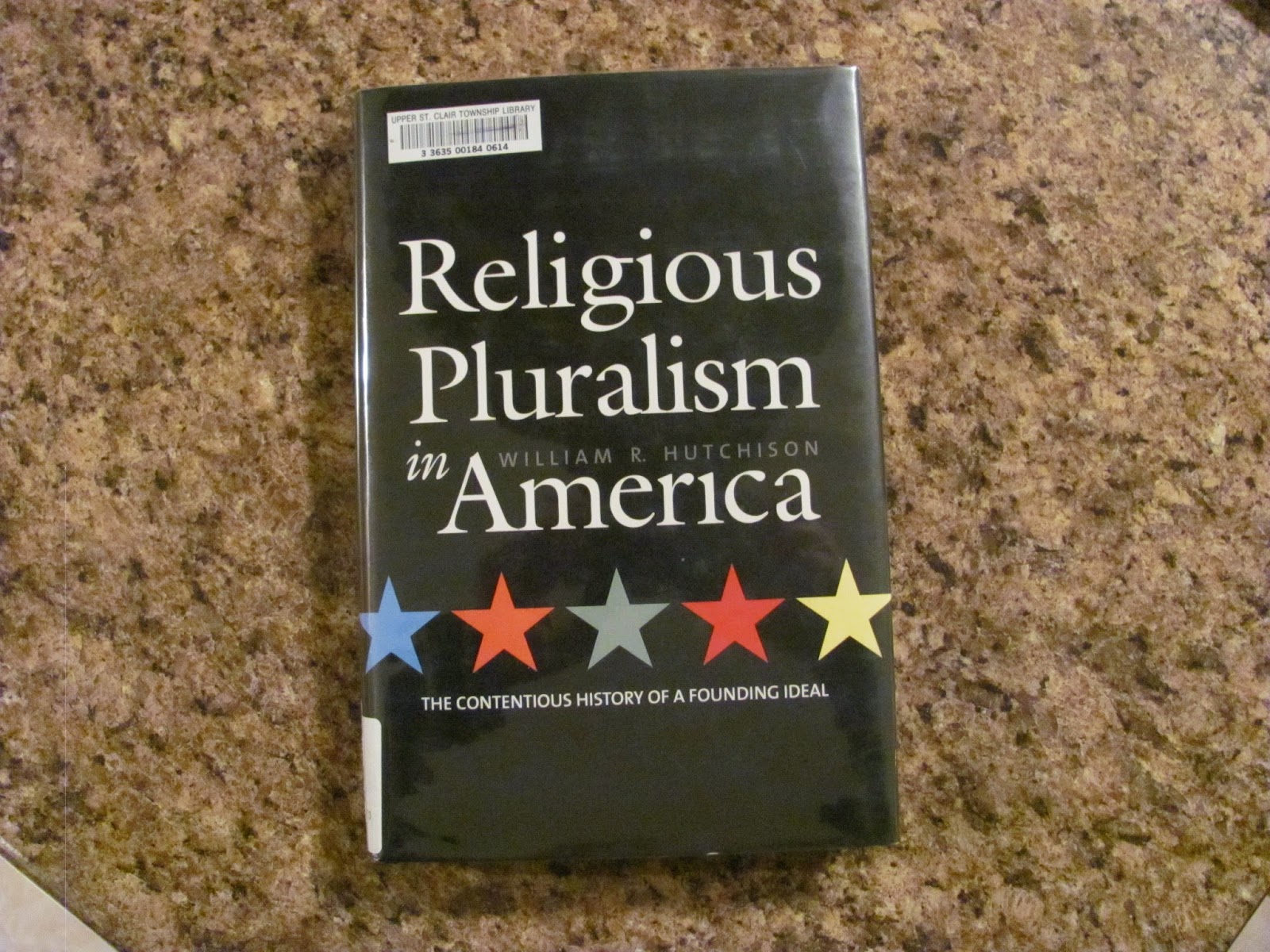
During the last several years of his long teaching career at Harvard, William R. Hutchison developed a series of lectures on the legal, political, and cultural history of religion in America. In 2003, he published the series as a book entitled Religious Pluralism in America: The Contentious History of a Founding Ideal

Throughout, Hutchison focuses on the presence of religious subcultures in the United States, and emphasizes that acknowledging diversity is something different from embracing pluralism.

Hutchison identifies three stages of what he calls religious pluralism in America: toleration, inclusion, and participation. He defines "toleration" as the mere legal and social tolerance of religiously deviant persons and groups. Even before the American revolution, the British colonies were known for their religious diversity and tolerance. Throughout much of the nineteenth century, Americans who identified with the dominant culture of Anglo-Calvinist Protestantism typically assumed that newly arrived immigrants, like Irish Catholics and German Lutherans, had the right to exist. Yet these groups were denied any sort of cultural authority. Often, toleration amounted to little more than the "absence of persecution" (6). This was in exchange for the absence of any socially threatening behavior on the part of the new immigrants.

By the end of the nineteenth century, says Hutchison, a growing number of Americans were coming to see mere toleration as inadequate, both morally and practically. Their dissatisfaction led to what Hutchison calls "inclusion," an impulse that represented a step towards a stronger form of pluralism. The middle chapters of the book reveal that inclusion resulted from a three-way collaboration: it was initiated by the leadership of the reigning Protestant liberals, and was claimed by Catholics and Jews. Still, inclusion rarely granted to the newly included "an equal or proportional right to share in the exercise of cultural authority" (6).

Hutchison depicts the years following the First World War as a time of steady march towards his third stage, "participation." By that term he means a social mandate according to which all sorts of individuals and groups (including groups defined by ethnicity, race, or gender as well as religion) "share responsibility for the forming and implementing of society's agenda" (7). The author is quick to acknowledge that during the early twentieth century there were still signs of intolerance, like anti-immigrant legislation and the Ku Klux Klan. At the same time, there also emerged significant signs of greater participation. For example, religious leaders established the National Council of Christians and Jews in 1928. National Brotherhood Week was first observed in 1934.

At least three public-policy landmarks of the 1950s and 60s hastened the advance of inclusion. First, although it was in some ways xenophobic, the McCurran-Walter Act of 1952 lifted the ban on immigration from Asia and the Pacific. Second, and even more important, was the Brown v. Board of Education decision handed down in 1954. Finally, the Immigration and Nationality Act of 1965 "abolished the quota system that had kept immigration from Asia to a minimum" (224).

Hutchison ends on a note of hope. The words of the Founders, he intimates, rather than their inconsistent examples, will finally win the day in America. That is still to be seen, and it is still unclear what that sort of victory, if achieved, will look like.

Friday, July 04, 2014

The American Revolution: A Brief History by a First-Rate Scholar

Wood, Gordon S. The American Revolution: A History. New York: Modern Library, 2002.

In the "Preface," to this brief survey, historian Gordon S. Wood suggests that the American Revolution should simply be "explained and understood." And that's what this book sets out to do: to explain  "[h]ow the Revolution came about, what its character was, and what its consequences were" (xxv).

Wood's approach differs from the standard telling of the story. Whenever I hear the phrase "the American Revolution," I naturally think of what I was taught were the high points of "the War of Independence": events like Paul Revere's ride, battles at Lexington and Concord, Bunker Hill, and Cornwallis's surrender to George Washington at Yorktown. It's the stuff of old-style history. Great men and events. Kings and wars. And, when describing wars, guns and trumpets.

However, historians like Wood want to tell us that, although never incidental, the war was not the essence of the Revolution. It was, instead, something more like a result, or a series of events that accompanied the Revolution. Consequently, only one of the seven chapter titles in this book contains the word "war." Indeed, Wood pays surprisingly little attention to events whose names we easily recognize.

Instead, he tells about the social, economic, political, and cultural forces that created a burden for great change in the British American colonies, a burden that was so compelling that it lead to open rebellion against an imperial king. Even more, Wood describes the new world, with new sensibilities, that came in the wake of the war; an emphasis on the rights and responsibilities of individuals, and what America could and ought to become. Above all, the qualified sense that all men were created equal began to change attitudes toward women, marriage, children, and slaves. Economic questions, international trade, political theory and practice. Nothing, it seems, went untouched by the Revolution. To cap it all off, a spirited debate between Federalists and Anti-federalists resulted in a federal constitution for the United States of America, a document that from the very beginning, recognized the political sovereignty of "We the people."

Wednesday, April 23, 2014

Ap Bac: The Event and Interpretation of a "Miserable Damn Performance," January 2, 1963

In his recently-published Historical Dictionary of the War in Vietnam, Ronald Frankum includes the following in his entry for “Ap Bac”:
On January 2, 1963, the 7th Division of the Army of the Republic of Vietnam (ARVN) engaged the 261st Main Force Battalion near the village of Ap Bac and the 415th Regional Battalion in Ap Tan Thoi. The American advisor to the 7th ARVN Division, Lieutenant Colonel John Paul Vann, had encouraged the move in order to achieve a quick and decisive victory against an enemy that had hurt the morale of the ARVN forces earlier in an October 1962 defeat of an ARVN ranger platoon.  . . . In previous encounters with helicopters, the troops of the National Liberation Front (NLF) had fled or exposed themselves to ground and air fire . . . In this instance, the NLF practiced strict fire discipline and stood its ground along a tree and canal line, maintaining a strong defensive position.  . . . It was not until early evening that the ARVN forces reinforced the troops fighting on the ground to such an extent that they forced the NLF to leave the battlefield.  . . . Ap Bac was a lesson for the South Vietnamese military and American advisers who were filled with frustration at opportunities lost. It also marked the beginning of more pronounced media criticism of the ARVN and the American military role in the war after Military Assistance Command, Vietnam, commander General Paul Harkins declared that the operation was a success, because the ARVN had secured Ap Bac. (54-55)
During the half century since that battle, American military advisors in Vietnam, journalists on the scene, and historians of the war have weighed in on a number of related questions. What exactly happened at Ap Bac? Why did the engagement unfold as it did? What were the keys to the Viet Cong victory? Why was the ARVN so soundly defeated in spite of its having what seemed to be every advantage? How did Gen. Harkins’ ridiculous, upbeat reports on the battle expose and perhaps reinforce inconsistencies within both the ARVN and American military? And how did those inconsistencies damage the relationship between American military leaders and the international press?

In what follows, my goal is to discern some answers to at least a few of those questions by exploring an array of important contributions to the historiography of the battle of Ap Bac, and to see how each source compares to and contrasts with the others. Is it possible to see a defined picture, one that fits with a coherent interpretation of the rest of the war?

A good place to begin is with the Pulitzer-prize winning book A Bright Shining Lie, by journalist Neil Sheehan. First published in 1988, Sheehan’s work is essentially two books which the author names in the subtitle: John Paul Vann and America in Vietnam. Basic to his widely-read account is Sheehan’s idea that the life of John Vann, an incredibly talented yet deeply flawed American military officer, is a powerful lens through which to view the much larger landscape of the war.

For my purposes here, the most significant aspect of Sheehan’s work is that he devotes all of Book III to “The Battle of Ap Bac.” Beyond that, the first several pages of Book IV, “Taking On the System,” recount the aftermath of the battle. In all, Sheehan provides 80 pages directly focused on Ap Bac (i.e., 203-83). Something else makes his narrative especially important: Sheehan was himself part of the press corps in Vietnam at the time, and actually traveled to the scene the morning after the battle. Years later, along with his interviews with several military leaders who were involved in the battle, the author consulted the finest of primary sources: “John Vann’s exhaustive after-action report” and “the equally thorough Viet Cong report that was later captured,” which, Sheehan notes, “tended to corroborate each other” (805-06).

Sheehan’s account establishes, or at least identifies and reinforces, several important particulars associated with the Battle of Ap Bac. First, regarding its relative significance, Sheehan not only devotes an entire section to Ap Bac, he calls it “the first great battle of the American war in Vietnam” (199), one “that would affect the course of the war” (205).

Second, the Viet Cong at Ap Bac had the advantage of excellent intelligence. They “knew that an attack was coming on the morning of January 2, 1963” (206). Consequently, according to Sheehan’s account, they had established the best possible positions. They were dug in so deeply and camouflaged so well that not even their muzzle fire revealed their positions. To top it all off, they also had a solid escape plan. By contrast, the American planner who served under Vann estimated that there would be no more than 120 Viet Cong regulars, if that many, protecting the target, a VC radio transmitter located at nearby Tan Thoi. In fact, there were approximately three times that many guerillas waiting (205).

Third, by the time of Ap Bac the Viet Cong were trained in tactics designed to neutralize the ARVN advantage of using American helicopters and M-113 armored personnel carriers. They had been training to lead and shoot moving aircraft (218-19), a technique at which they apparently had become well-practiced. From Sheenan’s description it also seems clear that the VC had some idea of how they might slay the “green dragons,” their name for the feared M-113s. Their tactic was to shoot at the exposed, unprotected machine gunners and drivers of the M-113s once they came within range. Then, after the machines had stopped, the guerillas would explode grenades thrown onto or just above the carriers, wounding and demoralizing the troops inside (255-57).

Fourth, a hesitancy that often appeared to stem from sheer cowardice undermined the ARVN “attack” throughout the day. Sheehan tells, for example, how ARVN lieutenants refused to allow American advisor Sgt. 1st Class Arnold Bowers to use their radios, sometimes feigning that they could not understand English. It became clear to Bowers that if he were allowed to use the radio, the lieutenants might be ordered to do something they didn’t want to do (224-25).

Fifth, in the aftermath of the Ap Bac catastrophe, the relationships between the American military, the press, and the American people began to change. Hours after the Viet Cong had been permitted to make a clean getaway, John Vann did not attempt to hide his rage, even in the presence of the international press. What made matters even worse was that Gen. Harkins seemed to believe the duplicitous reports of the ARVN’s General Huynh Van Cao. Too, Harkins did not appreciate Vann’s withering post-battle write up, and he resented the colonel’s angry conviction that what the ARVN turned in at Ap Bac was “a miserable damn performance” (277). It soon became clear to some observers that, although Harkins was not the only one, he was the most prominent example of an American military leader involved in Vietnam who saw only what he wanted to see. Sheehan, speaking for himself and other representatives of the American press in Vietnam, says that until that time, they “believed in what our government said it was trying to accomplish in Vietnam, and we wanted our country to win this war just as passionately as Vann and his captains did” (271). But by then, things had changed: “Ap Bac was putting Vietnam on the front pages and on the television evening news shows with a drama that no other event had yet achieved” (278).

On the question of relationships between the American people, the press, and the U.S. military in Vietnam, perhaps no other scholar has conducted more research than William M. Hammond. In two early books, Hammond provided exhaustive treatments of the military and media in Vietnam during the years 1962-68 and 1968-73. Later, he condensed all the material from those two previous volumes and produced a smaller, more manageable work designed for a broader audience: Reporting Vietnam: Media and Military at War, published in 1998. Hammond relates that in the aftermath of the battle of Ap Bac, editorials and commentaries that appeared in American newspapers “were biting.”

"The Washington Daily News, for example, termed Ap Bac a ‘humiliation.’ The Baltimore Sun described the enemy ‘slipping away . . . ahead of a half-hearted Vietnamese pursuit.’ The Detroit Free Press wondered how Diem’s harsh dictatorship could give peasant soldiers any motive to fight at all" (9).

Consequently, in spite of Gen. Harkins’ defense of the ARVN and his upbeat assessment of the progress of the mission in Vietnam, Ap Bac “marked a divide in the history of the war.  . . . After it, [American reporters] decided their government was lying and withdrew” (9).

In an environment that became more and more poisonous over time, the U.S. government held at least a temporary advantage: the administration largely controlled the information on which the news media depended. Hammond observes that what eventually broke the ensuing stalemate between the government and the news media was the American public, which chose to go “its own way.” Americans, he says, followed “their own third course, exercising their own independence of mind, and displaying a substantial measure of contempt for all those in the press and government who had sought to manipulate them over the years.” The American people, weary of reading about the “many deaths and contradictions . . . moved to repudiate the earlier decision.” When they did, it was relatively easy for the American press to follow. By contrast, the U.S. military “lacked the ability to do the same.” Wanting to retain whatever honor they could, emotionally tied to the prospect of some sort of victory, leaders of the U.S. Armed Forces “fixed their anger on the press, the most visible element of the society that appeared to have rejected them” (296). A disappointing story, Hammond’s account basically confirms Sheehan’s view that the battle of Ap Bac marked a true turning point in America’s involvement in Vietnam.

When it comes to the question of how and why the Viet Cong could have been so well prepared at Ap Bac, very few other books would be able to match the penetrating insight provided by Larry Berman’s, Perfect Spy: The Incredible Double Life of Pham Xuan An, Time Magazine Reporter & Vietnamese Communist Agent, published in 2007. Berman, a good researcher and a fine writer, tells the riveting story of Pham Xuan An, a bright young Vietnamese who officially became a Communist in 1953, and was sponsored and guided by the party to become a spy, likely the best to ever work for the North Vietnamese government. After he attended Orange Coast College in California during the late 1950s, An returned to Saigon and developed relationships with a large number of Americans as well as high-ranking officials in the Diem regime and the South Vietnamese army. Having gained the trust of so many important, well-connected people, An was able to learn the information that only they would know, and acquire copies of documents that he would, in turn, pass along to fellow spies who eventually delivered it to Hanoi. It was in this context that An was able to provide the Viet Cong with the information they needed in order to learn how they could fight against the helicopters and armored personnel carriers which the Americans were providing to the ARVN. “For weeks beforehand,” says Berman, “in order to calculate the most effective shooting range, [the People’s Liberated Armed Forces] had been practicing in the nearby Plain of Reeds by attaching to bamboo poles cardboard models of Shawnee and Huey helicopters that emulated their flight characteristics” (141). Three months after Ap Bac, the CIA observed that “the Viet Cong evidently have been able to maintain intelligence coverage of virtually every level in the South Vietnamese military and civil establishment” (143). An’s clandestine work in behalf of Hanoi was the essential substance behind that report.

Interestingly enough, however, An himself attributed the VC victory at Ap Bac to more than the preparations of the underdogs. He suggested that the Diem regime’s paranoid emphasis on loyalty to the virtual exclusion of professional competence was the undoing of the ARVN. “Diem had generals who should have never received their assignments,” said An, “but they were promoted because they kissed the hand of Nhu and Diem” (142). Here we see a corroboration of especially two parts of Sheehan’s extended narrative. First, the Viet Cong at Ap Bac were prepared far better than anyone among the ARVN or American military ever would have guessed. Berman’s account provides a large part of the explanation for how they could have achieved such a high level of preparedness. Second, Berman’s book also corroborates and helps to explain the obstinate, sluggish responses of ARVN commanders and troops, as well as the frustrations of American military advisors like Vann and Bowers.

Among the more-recent accounts of the Vietnam War, perhaps no project has been more controversial than the one initiated by Mark Moyar in Triumph Forsaken: The Vietnam War, 1954-1968. The author explains that this book, published in 2006, is the first in a proposed two-volume work covering the entire war. The division between the two comes at July 28, 1965, when President Johnson announced a massive American build up in Vietnam (xi). Moyar candidly explains that his work represents a particular, minority view of the war known as the revisionist school. Orthodox, conventional scholars, who make up the majority, see the war as “wrongheaded and unjust.” Moyar and his revisionist cohort, on the other hand, see it as “a noble but improperly executed enterprise” (xi).

Within this context, Moyar goes to great lengths to overturn the typical reading of Ap Bac. Still in the “Preface,” he asserts that John Paul Vann, the central figure in Sheehan’s Bright Shining Lie, “was more dishonest in dealing with the press than Sheehan ever acknowledged” (xvi). As part of his project to dismantle the reigning orthodox view of the war, Moyar insists that Ho Chi Minh was not a frustrated Vietnamese nationalist who hated the Chinese and adopted Communism only after he was rebuffed by the Americans. In fact, Ho became enamored with the dream of international Communism when he studied and worked in France and Russia while still a young man (1-31). Ngo Dinh Diem, by contrast, was a bright cultural conservative who welcomed advances in technology. Diem was a great man who bravely endured culturally-insensitive, dim-witted Americans (37-38), who turned out to be disloyal to him (115-16). Had it not been for their treacherous meddling, Diem likely could have led South Vietnam to victory. “Supporting the coup of November 1963” which resulted in the deaths of Diem and his brother, Ngo Dinh Nhu, “was by far the worst American mistake of the Vietnam War” (xvi). And, the much-maligned domino theory expressed by President Eisenhower and adopted by his successors was essentially sound (138-39).

Given his very different take on the main outline of the Vietnam War, it comes as no surprise that Moyar also reads the Battle of Ap Bac in a contrasting light. In his chapter devoted to the battle, Moyar offers an alternative view of at least four features in the story. First, John Paul Vann’s strategy for the battle was deeply flawed from the beginning. In the hours and days after the battle, Vann, a deceitful self-promoter, placed virtually all of the blame for the loss on the ARVN leadership and troops in order to cover his own responsibility. The Saigon troops were not guilty of complete cowardice and ineptitude. Second, when Vann bitterly complained about the ARVN, and also about his superior officers, young newsmen like David Halberstam and Neil Sheehan, none the wiser, took in his half-truths and reported the misrepresentation to the world. Moyar points out that journalist Richard Tregaskis, who had become famous for his World War II diaries, offered a different, much more positive and accurate view on what was happening in Vietnam. But tragically, the reports that came from the likes of Halberstam and Sheehan were read and believed by a large majority of Americans. This marked a significant difference between the foreign press that American military leaders dealt with during the Second World War and in Korea. While still a U.S. Army General, Dwight Eisenhower preferred to keep the news upbeat and optimistic, and the press, for the most part, cooperated. By contrast, the representatives of the press in Vietnam assumed that U.S. military leaders were either deluded or were cynically attempting to pull the wool over their eyes. Third, says Moyar, in spite of their victories at places like Ap Bac, the Viet Cong would never be strong in the Mekong Delta. Going up against superior fire power in rice paddies added up to an insurmountable problem for the VC. Moyar insists that the real theater of potential victory for the Communists was in the central highlands, much closer to North Vietnam (186-205).

Moyar concludes that, as it was with the entire Vietnam War, so it was with Ap Bac: the problems did not relate to the legitimacy or the fundamental goals of the United States. Rather, the decisive problems related to the execution of the war and its portrayal in the popular media.

With his title, Vietnam: The History of an Unwinnable War 1945-1975, published in 2009, John Prados unmistakably identifies himself as an orthodox historian of the war. What’s more, Prados insists that the critical points in his three-decade span of time were the early years:

"As will become evident, the core argument advanced here is that, whatever the intentions and aims of American leaders, the United States acted within a context defined along political, military, foreign policy, social, and economic dimensions--in effect, an “envelope”--and that envelope narrowed over time due to developments in all those fields" (xi).

Prados also believes that the wide variety and large number of histories related to the Vietnam War are essentially "atomized." They do not report a "unified field theory." Instead, one discusses U.S. presidential politics, another deals with a certain important battle, another examines the Diem regime, and so on. (In his bibliographical essay at the end of his book, Prados seems to indicate that if one of his predecessors had done a good job of writing something that approximated a unified field theory, it was the late Stanley Karnow).

Because Prados is convinced that whichever way the war turned, it was largely doomed by the end of the Eisenhower years, he does not give nearly as much attention to Ap Bac as does Moyar. Prados situates Ap Bac in the context of Diem’s incompetent behavior and decline, which led to his being murdered as U.S. officials stepped away from him:

"In January 1963 a fight took place at a village called Ap Bac in the delta. This time, despite ARVN’s considerable numerical superiority, as well as mechanized troops and helicopters courtesy of the United States, the PLAF unit not only stood its ground but actually defeated the attackers, who suffered many casualties. . . . Diem replaced neither of the responsible commanders. Kennedy had to notice. If strategic hamlets were to work, they had to be shielded by the ARVN. As for the adversary, the Liberation Front wasted no time exploiting Ap Bac as a psychological success, with propaganda to emulate, or replicate, the victory.  . . . Had Diem spent as much effort prosecuting the war and making his government a dynamic alternative to the NLF as he did countering antipathy toward the Ngo family, the military would have been no problem. Instead, the palace openly played with officer assignments and posts made desirable by opportunities for corruption" (75).

In this way, then, Prados’s discussion both assumes and advances his unequivocal judgment about the war in general. Clearly speaking directly to Moyar, he writes: “Triumph was not forsaken in Vietnam, nor victory lost; there was no day that the war was won, except for Hanoi on April 29, 1975, when its troops marched into Saigon” (546).

Historians will continue to debate the event and significance of the Battle of Ap Bac. It is also certain that they will continue to see the battle as either a turning point in the war or, giving it less significance, at least a reflection of larger, even more important movements as a tragic story in twentieth century military history unfolded.

Works Cited

Berman, Larry. Perfect Spy: The Incredible Double Life of Pham Xuan An, Time Magazine Reporter and Vietnamese Communist Agent. New York: HarperCollins/Smithsonian, 2007.

Frankum, Ronald B., Jr. Historical Dictionary of the War in Vietnam. Lanham, MD: Scarecrow Press, 2011.

Hammond, William M. Reporting Vietnam: Media and Military at War. Lawrence, KS: University Press of Kansas, 1998.

Moyar, Mark. Triumph Forsaken: The Vietnam War, 1954-1965. Cambridge: Cambridge University Press, 2006.

Prados, John. Vietnam: The History of an Unwinnable War, 1945-1975. Lawrence, KS: University of Kansas Press, 2009.

Sheehan, Neil. A Bright Shining Lie: John Paul Vann and America in Vietnam. New York: Vintage, 1989.

Friday, February 15, 2013

England and the Early U.S. in Asian Trade

Fichter, James R. So Great a Proffit: How the East Indies Trade Transformed Anglo-American Capitalism. Cambridge, MA: Harvard University Press, 2010.

This book is about Anglo-American capitalism in Asia. The story, says author James R. Ficther, illustrates "the deep links between the United States and the rest of the world from that country's inception (2-3).

For what it's worth, the part about "from that country's inception" is significant. The field of historical study that focuses on the U.S. and the rest of the world is growing rapidly. More to the point, it emphasizes not so much U.S. impact on the rest of the world, but rather the world's contributions and connections to U.S. history.

In this book, Fichter notes that American international traders did quite well for themselves in the years that immediately followed the American Revolution. Their economic success helped to pave the way for the tremendous growth that the U.S. experienced during the nineteenth century. But how did it happen? A careful historian, Fichter argues that there were a number of global factors at work in the rise and success of early-U.S. international trade. According to the author, some of these factors were as follows:

1. A strong American resistance to state-sponsored monopolies. The English East India Company was the only corporation that could legally import Asian goods, like tea, to Great Britain and her colonies. This, says Ficther, was at the root of the Boston Tea Party in December 1773. It wasn't merely that British subjects in America resented taxes on tea. It was that they also rejected the monopoly that locked American merchants out of the import business. From the beginning, the United States held onto the economic theory that insists that open and fair trade is a good thing for everyone.

2. The French Wars, which lasted from about 1793-1815, were an incredible distraction and impediment to European trade. European navies required ships for military purposes. Hostile countries interfered in each other's international trade. All along, the U.S. was basically neutral. So its trading vessels could safely sail under the American flag and do business with anyone.

3. Asian sellers wanted to be paid by Western buyers in silver. But there wasn't much of that in the early United States. American business leaders remedied that problem by selling shares in a given trading voyage to sometimes twenty or more individual investors. Most of these investors could never have owned a ship or financed a voyage. But they could still get in on the huge profits that came from international trade. In essence, by pooling their silver, Americans were not only able to make a lot of money, they were also able to quickly become major players in the game of Western trade with the East.

4. In spite of all its pomp and pride, the English East India Company, a state monopoly, was incredibly inefficient. Ironically, by attempting to retain its authority and unique legal status, it defeated itself.

5. British colonization in Asia created a whole set of problems associated with ruling a place so far from home. The United States didn't have those problems because it didn't have colonies in Asia.

By 1815, the English East India Company was kaput. Also by that time, enough American international traders had accumulated enough capital that they were able to help other industries in the U.S. to grow. In short, the British came to adopt a superior approach to Asian trade. While that was happening, the United States became a major player in Asian trade. The foregoing is nothing like a complete review of this book. But it does present some of the highlights.

Now, what was best about this book? I'm no expert on this topic, but I can tell you about what struck me. I think that the scope and depth of this book are impressive, to say the least. Ficther has spent a good bit of time in libraries and archives literally all over the world. Because of the extent of his painstaking research, he is able to tell a broad, complex story that takes into account a tremendous amount of wide-ranging information. This book represents quite an achievement, one that the reader will learn from and appreciate.

What wasn't so good about this book? While focusing on economics, Ficther tends to ignore the political dimension of his story. This shows up when one takes note of the featured actors. The author pays a lot of attention to people like American merchants, ship captains, and representatives of the East India Company. By contrast, we hear very little about significant politicians of the day. Perhaps the most glaring omission is Fichter's near silence about the labor of slaves in the Caribbean, an absolutely vital aspect of this episode in history. I am reluctant to fault a book along this line because it seems like faulting the author for not writing a different book. But I do think that more attention to the issues I have mentioned here would make this really fine book that much better.